
Gym Accessories Buying Guide for Beginners
A beginner does not need a complete accessory bundle before the first workout. The useful starting kit contains only what the program, equipment instructions, facility rules, comfort, or hygiene actually requires.
Walk through one planned session and mark every unresolved step: carrying water, timing rest, protecting floor contact, securing plates, using shared surfaces, or storing small equipment. Try the facility-provided or simplest available option before buying. Measure the user and equipment interface, read the instructions, and rehearse setup and removal without meaningful resistance. Favor accessories that are obvious to adjust, easy to clean, and compact to store. Add another item only when a repeated problem has a clear name.
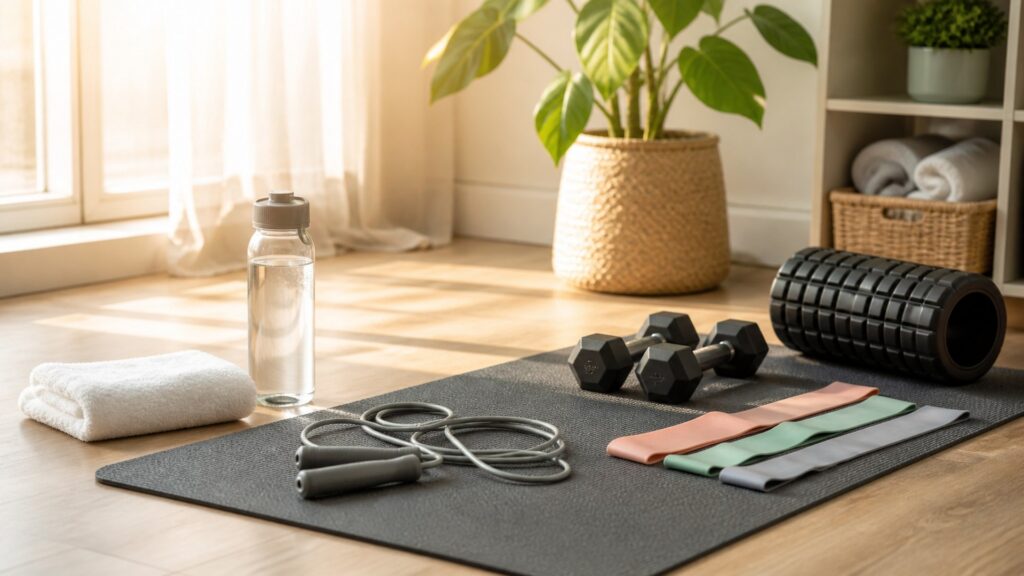
Buying framework
Let the first workouts reveal the accessory list
Begin with the program and location, identify one repeated obstacle, and choose the simplest accessory that resolves it without adding confusing setup or upkeep.
Start with the written session: List the exercises, equipment, duration, clothing, hydration, floor work, and facility requirements. Do not buy for advanced movements or imagined goals that are absent from the next several weeks.
Separate required from optional: Mark manufacturer-required items, facility rules, personal hygiene pieces, comfort aids, organizational tools, and performance extras. Required compatibility and safe equipment use come before convenience or matching sets.
Name one first failure: Identify the exact moment that is awkward, such as an unreadable timer, shifting plate, uncomfortable shared mat, misplaced key, or no place to put a bottle. Avoid vague promises of better workouts.
Choose the fewest setup steps: Count adjustments, attachments, knots, apps, chargers, and cleanup tasks. A beginner accessory should be easy to orient correctly and remove without remembering a complicated sequence during a new exercise.
Set an upgrade trigger: Add equipment only after a repeated fit, compatibility, load, storage, or access limit appears. Record the problem and required measurement so the next purchase solves evidence rather than impatience.
Who this is for
Match a small starter kit to the first setting
Home workouts, commercial gyms, first strength programs, classes, and accessibility needs produce different beginner accessory priorities.
Home bodyweight beginner: Start with the floor area, footwear, timer, hydration, and any mat or support required by the exercises. Check slip, edge curl, cleaning, storage, and household pathways before adding portable resistance.
Commercial-gym beginner: Learn what the facility supplies and permits before purchasing handles, collars, chalk, bands, or supports. A personal towel, bottle, lock, or contact item may solve more immediate routine friction.
Beginning strength trainee: Follow the program and equipment instructions for collars, rack use, spotting, and attachments. Add a belt, straps, wraps, or specialized handle only for a defined reason with appropriate coaching and fit.
Class and studio beginner: Confirm mat, footwear, towel, grip aid, storage, and cleaning expectations with the instructor or venue. Choose items that are easy to identify and do not crowd shared transition space.
Accessibility-focused beginner: Prioritize reachable storage, readable markings, manageable closures, secure contact, easy release, and compatibility with mobility aids or support. Test the complete setup with the actual user instead of relying on universal design claims.
What to pay attention to
Translate beginner-friendly into clear actions
A starter accessory should have an obvious purpose, unambiguous orientation, compatible dimensions, manageable contact, simple care, and instructions the user can follow independently.
Purpose and included instructions: The listing should state what the accessory is intended to do, how it connects, relevant warnings, and what is included. Avoid products whose main benefit remains a broad claim after reading the manual.
Body fit and adjustment: Measure the actual contact area and test straps, belts, grips, pads, or supports in the exercise position. Check edge pressure, closure reach, range, breathing, circulation, and an easy way to loosen or remove it.
Equipment compatibility: Verify bar sleeves, cable eyes, rack holes, pins, handles, anchors, mats, and floor surfaces as applicable. Do not assume a universal label covers every machine, doorway, bar, body, or room.
Contact stability and release: Test whether the accessory stays positioned during the intended movement yet releases deliberately afterward. Keep tails, cords, bands, bottles, phones, and bags outside feet, cables, plates, benches, and walkways.
Visible settings and progressions: Favor marked lengths, levels, resistance, timer controls, or storage labels that can be reproduced. A beginner should be able to return to the easiest setup after a break without guessing.
Cleaning and storage steps: Count the surfaces, covers, crevices, closures, and drying needs. Choose a visible storage home that keeps the item clean, lets damp material dry, and does not block the next workout.
Returns, parts, and support: Confirm the trial window, warranty, replacement bands, pins, caps, chargers, covers, or consumables, plus accessible instructions and contact support. Test fit and compatibility before return deadlines expire.
Avoid these traps
Avoid turning the starter kit into another project
Beginner accessory purchases go wrong when bundles replace a program, advanced supports replace learning, universal claims replace measurements, or upkeep exceeds the value of the item.
Buying every recommended extra: Generic lists cannot know the facility, program, body, floor, or equipment. Buy required items first, borrow or test when allowed, and wait for recurring problems before adding specialized accessories.
Choosing support without learning its role: A belt, strap, wrap, brace, pad, or grip can change contact but does not automatically teach movement or make loading appropriate. Ask the coach or follow the program before adopting it.
Trusting one-size or universal labels: Bodies, bars, racks, cable machines, doors, floors, and storage spaces differ. Compare actual dimensions and permitted uses, then complete an unloaded fit check before assuming the accessory belongs.
Starting with strong elastic resistance: Bands store energy and can recoil if grip, material, or anchoring fails. Begin with the program's easiest permitted option, inspect the full band, verify the anchor, and clear its travel path.
Ignoring where the item will live: Loose accessories disappear into bags, collect residue, or enter walkways. Assign a reachable storage location and cleaning step before purchase, especially in a shared home or commercial facility.
Decision guidance
Trial the accessory inside one beginner workout
The useful test starts with the session plan, rehearses orientation and removal, adds only permitted low consequence, and ends with cleaning and storage.
Circle the unresolved step: Use the written workout to identify one setup, fit, timing, hydration, floor, hygiene, or storage problem. State what successful improvement would look like without using an undefined performance promise.
Check the existing option: Try the facility item, phone timer, ordinary towel, existing bottle, or manual log when appropriate. New hardware earns a place only when it makes the recurring task clearer, cleaner, safer, or easier.
Measure and read before setup: Record body and equipment dimensions, floor and storage constraints, and the complete included hardware. Read intended use, adjustment, warning, cleaning, and inspection instructions before the first exercise.
Rehearse the easiest version: Orient, attach, adjust, use, release, and remove the accessory without meaningful resistance or time pressure. Confirm visible settings, stable contact, movement clearance, and the ability to ask for help.
Reset and decide: Clean, dry, inspect, and store the item after the workout. Keep it only when the original problem improved and the beginner can repeat every step without adding disproportionate confusion or maintenance.
Ownership & compatibility
Keep the starter kit small and understandable
A beginner benefits from consistent storage, visible settings, clean contact surfaces, and early replacement of damaged pieces more than from a growing collection of seldom-used extras.
Give each item one home: Keep timers, collars, straps, bands, bottles, towels, mats, locks, and chargers in predictable locations. Separate personal and facility hardware so incompatible parts do not enter the wrong equipment.
Clean after the actual contact: Follow material instructions for sweat, skin, floors, chalk, shared handling, or outdoor use. Open closures and dry damp textiles, foam, or rubber fully before putting them in a closed bag.
Inspect with a simple checklist: Look for cracks, fraying, stretched elastic, weak stitching, loose hardware, sharp edges, poor grip, damaged chargers, or unreadable markings. Stop using the item when intended function cannot be confirmed.
Keep the easiest setting visible: Record band, strap, block, timer, handle, or support settings so the beginner can resume after travel, illness, or a break. Progress only when the program provides a reason.
Remove accessories that lost their job: As the plan changes, retire, donate, or store usable pieces that no longer solve a recurring need. Do not leave obsolete attachments on machines or cluttering floors merely because they were purchased.
FAQ
Beginner gym accessory questions
These answers cover essential starter items, bundles, mats, bottles, bands, personal supports, compatibility, cleaning, and when a beginner has a real reason to upgrade.
What gym accessories does a beginner actually need?
Should a beginner buy an accessory bundle?
Does a beginner need an exercise mat?
How should a beginner choose a gym bottle?
Are resistance bands suitable for beginners?
Does a beginner need a lifting belt or straps?
How can a beginner check accessory compatibility?
How should beginner gym accessories be cleaned?
When should a beginner upgrade gym accessories?
Bottom line
Buy only after the first problem has a name
The right beginner accessory solves one recurring workout problem, fits the actual user and equipment, has simple instructions, and returns cleanly to a visible storage home.
Start with the program: List the exercises, location, facility rules, required equipment, and real contact surfaces.
Use the simplest answer: Test available timers, storage, mats, bottles, or facility accessories before adding hardware.
Rehearse every step: Measure, orient, adjust, use, release, clean, inspect, and store at low consequence.
Earn the upgrade: Add another accessory only when a repeated limitation defines its exact job.
Reading Shortcuts
Jump to the program-first framework, beginner settings, simple accessory checks, or common starter-kit questions.
Decision Reminders
Keep the program, required items, first repeated problem, simple setup, body and equipment fit, contact stability, cleaning, storage, and upgrade trigger visible.
- Program: Buy for exercises and rules in the next several weeks, not an imagined future routine.
- Problem: Name the exact setup, timing, contact, hydration, hygiene, or storage failure.
- Rehearsal: Read instructions and practice orientation, adjustment, removal, and release before resistance.
- Reset: Clean, dry, inspect, and return each beginner accessory to one visible home.
Glossary Snippets
Terms for understanding beginner accessory purpose, fit, compatibility, setup, and progression.
When a Top 10 Helps
Use beginner accessory rankings after defining the program, required items, repeated problem, body and equipment measurements, setup, cleaning, storage, and upgrade boundary.
- Need filter: Reject products that solve no current exercise, equipment, hygiene, access, or storage problem.
- Simplicity filter: Rank only accessories the beginner can fit, release, clean, inspect, and store correctly.
A starter ranking cannot know your program, facility rules, body fit, equipment dimensions, coaching needs, or available accessories.
When a Comparison Helps
Compare finalists through the same beginner workout, unloaded setup, permitted easy use, deliberate release, cleaning, inspection, and storage reset.
- First session: Compare instructions, orientation, fit, adjustment, contact, movement clearance, and help access.
- Next session: Inspect cleaning, drying, visible settings, storage, material condition, parts, and readiness.
Keep the simplest beginner gym accessory that resolves the named workout problem and can be fitted, released, cleaned, and stored correctly without extra complexity.