
Hair Masks Buying Guide for Hair Type and Texture
Hair type is more useful when you break it into decisions. Strand thickness affects weight tolerance, density changes how much product is needed, curl pattern influences coverage, and porosity or damage clues shape the balance between softness and strength. This guide turns those traits into a practical hair-mask choice and application plan.
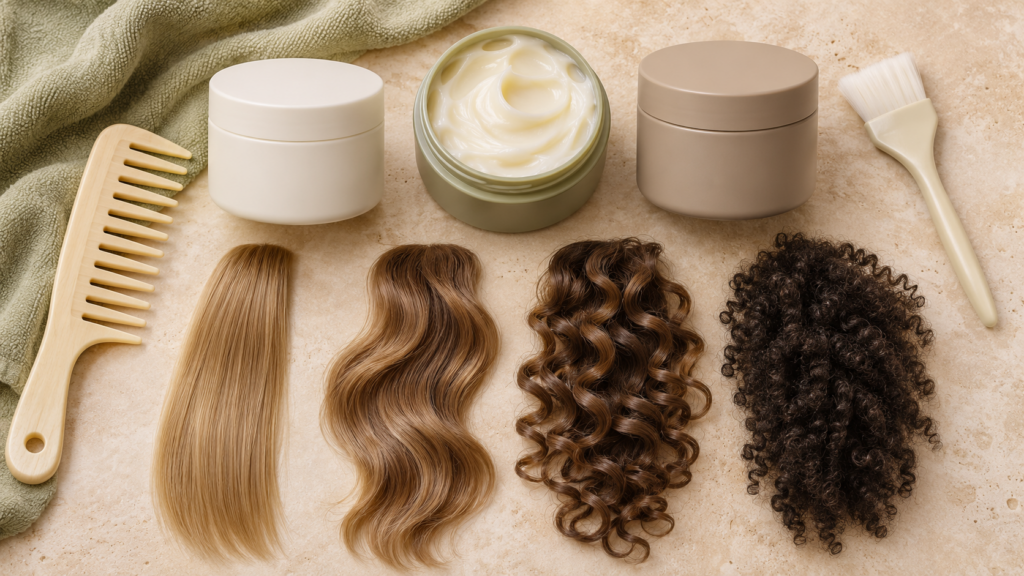
Buying framework
Read Your Hair in the Right Order
Start with the traits that change product weight, coverage, and handling. Curl pattern alone rarely decides the best mask.
Strand thickness: Fine strands usually reach their weight limit sooner than medium or coarse strands. Richness and dose should follow the fiber, not the amount of hair on the head.
Density: Low, medium, or high density changes how much product is needed for even coverage. Dense hair can require more sections without automatically needing a heavier formula.
Curl or wave pattern: Bends and coils make uniform distribution more demanding. Slip, sectioning, and application time may matter more than a texture label on the jar.
Porosity and damage clues: Fast wetting, rough ends, chemical processing, heat wear, and rapid moisture loss can signal that targeted conditioning deserves priority. Treat porosity as an observation, not a permanent identity.
Scalp and length needs: A comfortable scalp does not guarantee that the lengths need the same product. Most masks are easier to control when placement follows the dry or damaged zones and the label directions.
Who this is for
Match Mask Behavior to Hair Type
These profiles combine traits that actually change the purchase instead of treating straight, wavy, curly, and coily hair as single formulas.
Fine strands or easily flattened roots: Favor a lighter rinse-out mask, measurable dose, and mid-length-to-end placement. Judge success by softness without lost movement or a coated root area.
Coarse strands or persistently rough lengths: A richer emollient mask may improve manageability, but compare slip, rinse feel, and styling behavior instead of assuming the thickest product is always best.
Wavy hair with uneven definition: Look for enough conditioning to reduce friction without a finish that collapses the wave. Target dry ends first and test a smaller dose before increasing frequency.
Curly or coily hair with high density: Prioritize section-by-section spread, usable slip, and an amount that can cover the full head. Density drives application workload while strand thickness still sets weight tolerance.
Color-treated, heat-stressed, or mixed-texture hair: Choose for the most fragile zones and control placement. Processed ends may need richer conditioning or strength support even when newer growth needs less.
What to pay attention to
Translate the Label Into Texture Decisions
Useful specifications tell you how the mask will behave in your routine, where it belongs, and what tradeoff to watch.
Weight-tolerance lens
Will the formula soften your strand thickness without flattening the root area, dulling movement, or leaving a film?
Coverage lens
Can the texture spread through your density and curl pattern with a realistic amount, section count, and contact time?
Richness and finish: Words such as lightweight, smoothing, buttery, or intensive suggest a likely finish but are not standardized. Compare them with your strand thickness and weight tolerance.
Slip and detangling role: For curls, coils, dense hair, or fragile lengths, a mask that supports low-friction sectioning may be more useful than one that only promises shine.
Moisture versus strength emphasis: Softening and strengthening language describes different priorities. If hair is stiff or tangles after use, reduce overlapping strength-focused products and reassess the conditioning balance.
Directed contact time: A three-minute mask and a twenty-minute treatment demand different wash-day time. Buy the duration you can follow consistently rather than planning to extend it without directions.
Dose, spread, and rinse behavior: Jar size alone does not reveal value. Dense or long hair can use more per application, while fine hair may need a small amount that rinses cleanly.
Placement and frequency: Check whether the label allows scalp use and how often it recommends treatment. Begin with the directed minimum, then adjust one variable at a time.
Avoid these traps
Avoid Hair-Type Masking Mistakes
A texture label can be a useful shortcut, but it becomes misleading when it replaces strand, density, and routine decisions.
Buying only by curl pattern: Two people with similar curls can have different strand thickness, density, processing history, and weight tolerance. Use curl pattern to plan distribution, not to choose richness by itself.
Confusing density with coarse strands: A full head of fine hair can be dense, and coarse hair can have low density. Coverage needs and formula weight are separate decisions.
Treating porosity as a fixed product category: Porosity clues can vary by zone and change with damage or buildup. Use current behavior and processing history instead of relying on one float test or permanent label.
Applying a rich mask from scalp to ends by default: Roots, mids, and ends often have different needs. Follow the label and target the driest or most processed zones when whole-head application creates weight.
Changing dose, frequency, and styling at once: Multiple changes make softness, residue, limpness, or better definition hard to attribute. Test one mask with a stable routine over several uses.
Using a mask to explain scalp symptoms or sudden hair change: Cosmetic masks cannot diagnose persistent irritation, shedding, or abrupt texture changes. Stop a product if it causes a reaction and seek appropriate professional guidance when needed.
Decision guidance
Choose the Mask, Dose, and Placement Together
The strongest choice is a formula and application plan that solve the main problem without creating a new one.
If fine hair needs softness without collapse: Start with a lighter mask, small dose, and end-focused placement. Increase only after checking the dry result, not while the hair is still slick in the shower.
If dense curls or coils are hard to coat evenly: Prioritize slip and spread, divide the hair into enough sections, and compare cost per full application rather than cost per jar.
If coarse or rough-feeling hair stays hard to manage: Test a richer conditioning finish and adequate contact time, then judge detangling, rinse feel, and next-day flexibility.
If processed ends differ from healthier roots: Use targeted placement and consider separate dose levels by zone. The most damaged area can guide the mask without determining the treatment for every strand.
If the first mask feels heavy, stiff, or coated: Change one lever: use less, reduce frequency, narrow placement, or select a lighter or less strength-focused formula. Repeated buildup is evidence, not a reason to add more treatment.
Ownership & compatibility
Run a Texture-Specific Mask Trial
A controlled trial reveals more than a texture label because it measures the result on your actual strand thickness, density, and routine.
Record the starting point: Note strand thickness, density, processing history, dry zones, wash interval, current conditioner, and the problem the mask should solve.
Follow the label first: Use the directed placement, amount range, contact time, and frequency before making the treatment longer or more frequent.
Keep the comparison stable: Hold shampoo, detangling method, styling products, heat use, and drying method as steady as practical for several wash cycles.
Score the dry result: Compare detangling resistance, softness, movement, definition, residue, root lift, and how the ends behave after the hair is fully dry.
Set the adjustment rule: Change only dose, placement, or frequency first. Switch formula families when weight, stiffness, poor spread, or inadequate conditioning repeats.
FAQ
Hair Mask Questions by Type and Texture
These answers separate strand traits, application decisions, and realistic expectations.
Do fine hair types need to avoid hair masks?
Are thick hair and dense hair the same thing?
Does curly or coily hair always need the richest mask?
How should I choose a mask for wavy hair?
Should low-porosity hair use heat with a mask?
What kind of mask suits high-porosity or damaged ends?
Can I use a hair mask instead of conditioner?
How often should different hair types use a mask?
When should I stop using a hair mask?
Readiness check
Put Hair Type Into Decision Order
A dependable mask choice follows the traits that change weight, coverage, and placement.
Size the strand: Use fine, medium, or coarse thickness to estimate weight tolerance.
Map the density: Plan the amount and number of sections needed for full coverage.
Read the pattern: Let waves, curls, or coils guide distribution and detangling needs.
Target current condition: Give dry, processed, or fragile zones the treatment they need without automatically coating healthier areas.
Judge the dry result: Keep the mask only when softness, movement, definition, and manageability improve without persistent residue or stiffness.
Texture-Match Shortcuts
Jump to the trait that changes the mask decision.
Six Texture Checks
Use these before choosing a richer or lighter mask.
- Strand: Estimate weight tolerance.
- Density: Plan coverage and dose.
- Pattern: Account for bends, coils, and distribution.
- Condition: Target dry or processed zones.
- Routine: Buy a realistic contact time.
- Finish: Judge softness after the hair dries.
Useful Hair-Type Terms
Plain language for mask decisions.
When a Top 10 List Helps
Use rankings after the hair traits and finish goal are clear.
- The strand is sized: Filter out formulas likely to be too heavy or too light.
- Coverage is estimated: Compare realistic dose for the hair density.
- The main problem is named: Separate slip, roughness, damage, weight, and definition needs.
- The trial rule is ready: Know what result will justify keeping the mask.
Already have a shortlist? A Comparison can help resolve the remaining tradeoffs.
When a Comparison Helps
Compare finalists on the same texture and routine constraints.
- Richness differs: Compare expected finish against strand weight tolerance.
- Slip differs: Consider sectioning and low-friction detangling.
- Dose differs: Estimate cost per complete application.
- Strength emphasis differs: Watch the balance between support, softness, and stiffness.
Still discovering options? Start with a Top 10 to build a relevant shortlist.