
Hair Masks Buying Guide for Wash Day Planning
A hair mask can improve wash day only if its directions fit the sequence you can complete. Place it on a timeline: before shampoo, after cleansing, instead of conditioner, before conditioner, or as a leave-in. Protect its contact time and account for rinsing, detangling, drying, and styling. The right choice solves a specific handling problem without making every wash unmanageable.
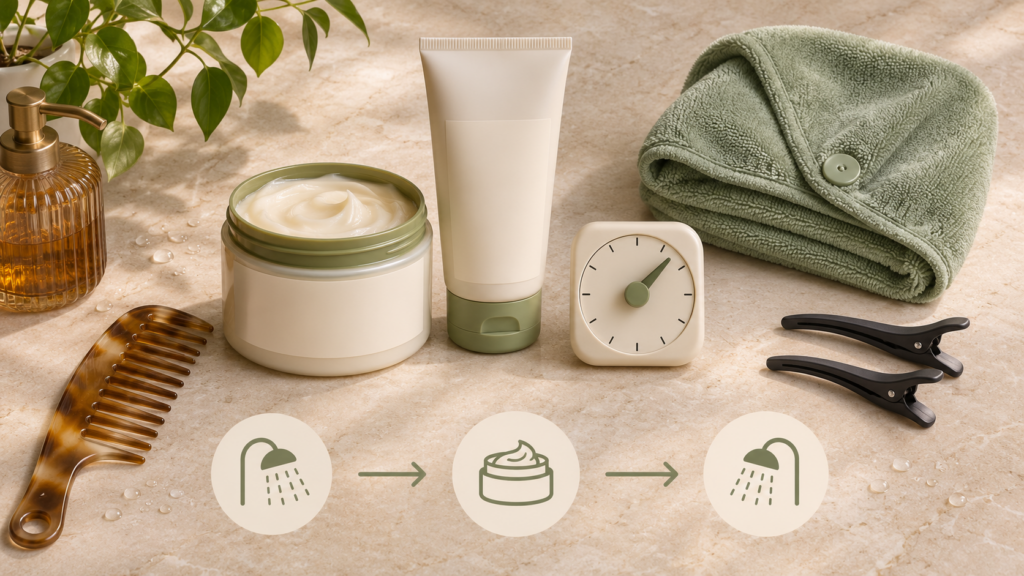
Buying framework
Build the Wash Day Before Choosing the Jar
Map the whole routine first. A mask that looks appealing in isolation can fail when its placement, waiting period, or rinse demands collide with cleansing, detangling, or styling.
Name the job: Choose one primary outcome you can observe during the finished routine, such as easier detangling, less roughness after drying, or enough conditioning without flatness.
Place the mask on the timeline: Use the label to mark the exact treatment stage and the step that immediately follows it. Packaging language alone does not establish the route.
Protect the waiting period: Treat contact time as scheduled time. Decide whether you can section hair, finish another shower step, or use a timer without leaving the product on by guesswork.
Plan the exit step: A rinse-out mask needs enough water and time for a thorough rinse. A leave-in needs a dose that still allows the styling products and drying method to work.
Set the next checkpoint: Judge the completed wash day and the days that follow. The next-wash date, residue, tangling, and style longevity matter as much as softness at the sink.
Who this is for
Match the Format to the Wash Day You Run
The useful buyer groups are defined by schedule, drying method, and tolerance for extra steps—not by a universal idea of an intensive treatment.
Fast weekday washer: Favor a short-contact rinse-out or a true one-step replacement whose directions remove another step instead of simply adding time.
Long weekly wash planner: A longer contact time may fit when sectioning, detangling, and deep conditioning are already scheduled. Check that the rinse and drying window remain realistic.
Exercise or frequent-wash routine: Prioritize controllable dose and frequency. A heavy mask at every wash may add weight or force extra cleansing that defeats the plan.
Air-dry routine: Evaluate whether the mask changes drying time, curl formation, volume, or the amount of leave-in needed after rinsing.
Heat-styling day: Plan for rinse quality, heat protectant, and total product layering. A mask does not replace a protectant unless the label explicitly says so.
What to pay attention to
Read Directions as Scheduling Specifications
The most useful label details tell you where the product goes, how long it stays, what follows it, and how often the entire sequence must be repeated.
Clock lens
Count application, contact, rinsing, detangling, and drying—not contact time alone.
Sequence lens
Check what comes immediately before and after the mask, including conditioner, leave-in, and styling products.
Application stage: Dry, pre-shampoo, post-shampoo, damp-hair, and leave-in directions create different wash-day routes.
Contact time: Compare the stated minutes with the time you can reliably protect. A longer wait is not automatically a better treatment.
Rinse status: Confirm whether the formula requires a full rinse, a light rinse, or no rinse. Texture and packaging do not answer this safely.
Conditioner relationship: Look for explicit language about replacing, preceding, or following conditioner. Do not delete or duplicate the conditioning step by assumption.
Dose and sectioning: A small amount spread through ends differs from section-by-section saturation. Dense or long hair can increase application time and total use.
Frequency: Translate weekly, every few washes, or as-needed guidance into your real calendar and expected uses per container.
Avoid these traps
Avoid Schedule and Sequence Errors
Most routine problems come from treating the mask as an isolated purchase instead of one timed step in a complete wash day.
Adding the mask without removing anything: If directions position it as a conditioner replacement, stacking both may add unnecessary time and weight. If they do not, skipping conditioner may reduce slip.
Starting the timer too early: Contact time usually begins after application is complete. Read the label and account for the minutes needed to section and distribute product.
Using more product to shorten the wait: Dose and time are separate instructions. A thicker layer does not reliably compensate for an incomplete contact period.
Rushing the rinse: Residual product can change dry feel, volume, and the next-wash interval. Budget enough water and time for the directed rinse.
Changing the entire routine together: A new cleanser, mask, leave-in, and drying method make the result impossible to attribute. Introduce one meaningful change first.
Scheduling an intensive step every wash: Start with the labeled frequency and observed need. More frequent use can create weight or obscure the role of other products.
Decision guidance
Fix the First Wash Day Bottleneck
When the routine fails, adjust the earliest repeatable problem instead of immediately buying a stronger or more expensive mask.
If application takes too long: Choose a smaller dose, easier-spreading format, targeted placement, or a product that does not require careful full-head sectioning.
If the waiting period gets skipped: Move to a shorter-contact formula or schedule the mask only on a longer wash day.
If detangling gets harder: Verify whether conditioner is still required and reduce friction before increasing mask frequency.
If drying runs late: Check rinse quality and total leave-in load, then consider a lighter format or less frequent use.
If the next wash arrives sooner: Reduce dose or frequency and simplify overlapping conditioners and stylers before abandoning the category.
Ownership & compatibility
Run a Three-Wash Planning Trial
A short, controlled record shows whether the mask improves the routine or merely adds time.
Record the baseline: Note total wash-to-finish time, detangling difficulty, drying time, finished feel, and days until the next wash.
Follow the label route: Use the stated stage, dose, contact time, rinse step, and conditioner relationship before customizing.
Use a visible timer: Time only the directed contact period. Do not rely on an uncertain estimate while completing other tasks.
Keep the finish consistent: Use the same drying method and a similar styling stack so weight, movement, and residue are comparable.
Change one planning variable: If needed, adjust dose, frequency, placement, or format one at a time and record what changed.
FAQ
Wash Day Hair Mask Questions
These answers clarify placement, timing, conditioning, frequency, and the practical boundaries of a repeatable routine.
Should I use a hair mask before or after shampoo?
Do I shampoo after a hair mask?
Does a hair mask replace conditioner?
How long should a hair mask stay on?
Can I use a hair mask every wash day?
When should I start the timer?
Can I detangle while the mask is on?
Why does my hair take longer to dry after a mask?
How many washes should I use before deciding?
Readiness check
Choose the Mask That Fits the Clock
A repeatable mask routine has a clear job, a protected place in the sequence, and an exit step that still leaves enough time for detangling, drying, and styling.
Map the route: Place cleansing, mask, conditioner, leave-in, and styling in order.
Count every minute: Include application, contact, rinse, detangling, and drying.
Preserve essential steps: Do not remove conditioning or heat protection by assumption.
Test the finished routine: Judge dry feel, style longevity, residue, and next-wash timing.
Simplify when needed: A shorter, lighter, or less frequent mask may be the better purchase.
Wash Day Shortcuts
Jump to the scheduling decision that is slowing down the routine.
Six Wash Day Checks
Use these before adding a mask to the cart.
- Job: Name one observable problem.
- Stage: Place the mask in the sequence.
- Time: Count application and contact separately.
- Rinse: Protect enough time and water.
- Finish: Include drying and styling.
- Calendar: Plan the next wash.
Useful Planning Terms
Plain language for comparing routine fit.
When a Top 10 List Helps
Use rankings after the wash-day route is defined.
- The available time is clear: Filter out contact times you will routinely skip.
- The stage is clear: Compare pre-shampoo, rinse-out, and leave-in options separately.
- The conditioning plan is clear: Know whether the routine still needs conditioner.
- The frequency is clear: Estimate use per month and container life.
Already have a shortlist? A Comparison can help resolve the remaining tradeoffs.
When a Comparison Helps
Compare finalists on the same routine constraints.
- Timing differs: Total application, contact, and rinse time.
- Sequence differs: What comes before and after the mask.
- Dose differs: Expected use for length and density.
- Finish differs: Drying time, movement, residue, and next-wash interval.
Still discovering options? Start with a Top 10 to build a relevant shortlist.