
Hair Oils Buying Guide for Hair Type and Texture
Hair type helps narrow the field, but it does not select an oil by itself. Strand diameter, density, curl pattern, porosity, damage, climate, and the rest of your routine all change how much oil hair can carry. Choose the lightest controllable format that solves a specific problem, then test a small dose on dry or damp lengths before increasing it.
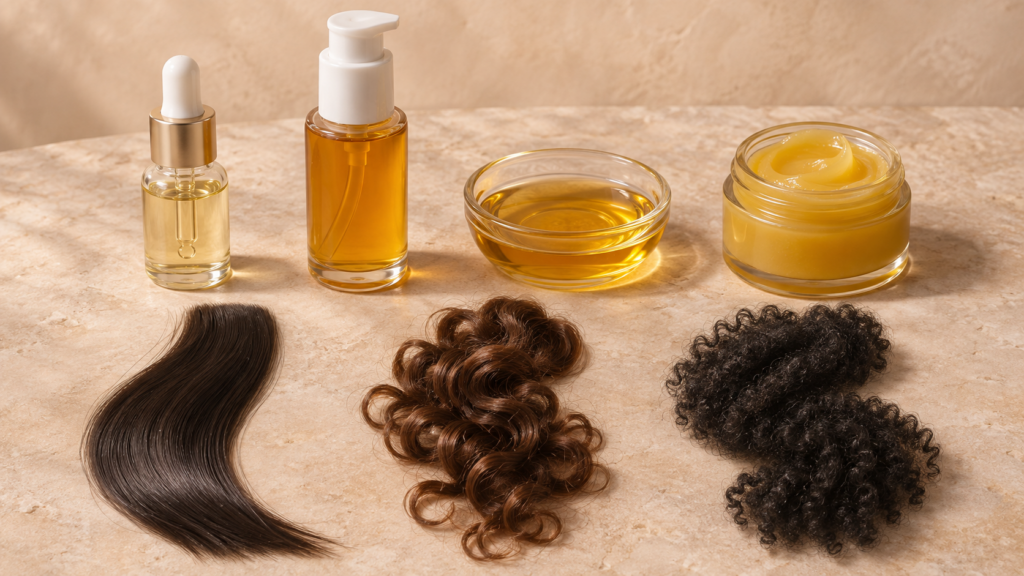
Buying framework
Start With Carrying Capacity, Not Curl Labels
The best match is the amount and formula weight your hair can carry without losing movement, definition, or a clean finish. Use type and texture as clues, then adjust by observation.
Strand diameter sets the first limit: Fine strands usually show excess weight quickly, while coarse strands may tolerate a richer film. Diameter matters more than how much hair is on the head.
Density changes distribution: High-density hair can need more total product because there is more surface area, but each section may still need a light dose. Low-density hair often needs careful placement to preserve volume.
Curl pattern changes access: Waves, curls, and coils create more turns and sectioning needs. Apply in sections for even coverage instead of using a heavier oil to compensate for missed areas.
Porosity affects the trial: More porous or weathered lengths may absorb and lose moisture differently, but a porosity label cannot predict the ideal oil. Compare slip, shine, frizz, softness, and residue after drying.
The routine decides the final weight: Leave-in conditioner, cream, gel, heat protectant, and scalp products all add film. Judge the oil as the last layer in the actual routine, not in isolation.
Who this is for
Match Formula Weight to Hair Behavior
Choose by the result you need and the failure you want to avoid. These starting points are adjustable, not rules for every person with the same pattern.
Fine, straight, or easily flattened hair: Start with a fluid dropper or serum format and one controlled drop on the ends. Favor easy spread and a dry finish over a long list of oils.
Wavy hair that loses definition: Use a light oil sparingly after styling or once fully dry. Keep it away from the root area when volume and wave separation matter.
Curly hair needing slip and shine: A medium-weight blend can help with sectioning, finishing, or breaking a cast. Apply with flat palms or fingertips so coverage is even without disturbing curl groups.
Coily or coarse hair needing lasting softness: A richer oil or oil-balm may suit dense, coarse, or exposed ends, especially over a water-based leave-in. Increase section by section rather than pouring a large palmful.
Mixed texture, damaged, or color-treated hair: Treat zones separately. Use less on healthy roots and finer sections, then add a second small pass only to porous ends or high-friction areas.
What to pay attention to
Compare the Specs That Control the Finish
Packaging and use directions often predict everyday success better than a featured botanical. Compare dose control, formula weight, spread, placement, and finish.
Start lighter when
Strands are fine, density is low, roots flatten easily, or several leave-on layers are already used.
Consider richer when
Strands are coarse, ends are porous or weathered, density is high, or a light oil disappears without improving feel.
Viscosity and spread: A thin oil can cover a large area from a small dose; a thick oil stays more localized. Neither is automatically lighter after drying, so check the stated finish and trial it.
Dispenser control: A dropper or metered pump helps fine or low-density hair avoid overshooting. Wide-mouth jars suit balms but make repeatable dosing harder.
Silicone versus plant-oil blends: Silicones can reduce friction and add shine with a light feel; plant oils vary widely in weight and stability. Choose by finished behavior and preference rather than treating either family as universally superior.
Damp-hair versus dry-hair use: Damp application can aid distribution and seal a conditioning routine. Dry application gives more immediate feedback on shine, flyaways, and weight. Follow the label first.
Scalp versus length directions: Many finishing oils are intended for mid-lengths and ends. Do not assume a hair oil is a scalp treatment; use it on the scalp only when the product specifically directs that use and your scalp tolerates it.
Fragrance and oxidation protection: Scent persistence can matter in a leave-on product. Opaque or tinted packaging, a secure closure, and sensible storage help protect formulas that are sensitive to light, air, or heat.
Avoid these traps
Avoid the Most Common Texture-Matching Errors
Poor results often come from dose and placement rather than the oil category itself.
Choosing only by curl number: Two people with the same curl pattern can have different diameter, density, damage, and styling goals. Use pattern to plan distribution, not to dictate formula weight.
Starting with a palmful: Oil is easier to add than remove. Begin with one drop or the smallest pump, spread it fully, and reassess after the hair settles.
Applying at the roots by default: Root application can collapse volume or create a greasy look. Start at the ends and move upward only as needed unless the label specifies scalp use.
Confusing shine with hydration: Oil can reduce friction and change surface feel, but it does not replace water or a water-based conditioner. Address dryness with the whole wash and conditioning routine.
Layering without counting films: Creams, gels, serums, oils, and sprays can compound. If hair feels coated, test fewer layers before blaming a single ingredient.
Ignoring the next wash: A beautiful day-one finish may not be worth difficult cleansing or fast buildup. Track how the oil affects refresh days and wash frequency.
Decision guidance
Run a Three-Use Dose Test
A short controlled trial reveals more than a texture label or ingredient ranking.
Set one job: Choose finishing shine, end softness, frizz control, cast breaking, detangling support, or protective-style maintenance.
Pick the lowest practical weight: Start with a fluid or serum format unless prior results show it disappears without benefit.
Apply to one zone first: Test the ends or one section, keeping roots and the rest of the routine unchanged.
Repeat the same dose: Use the same drop or pump count for three comparable uses and note the dry result.
Adjust one variable: Change dose, placement, or timing—not all three—until softness and control improve without flatness or residue.
Ownership & compatibility
Keep the Finish Consistent After Purchase
Storage, dispensing, and routine discipline help the same bottle perform predictably.
Record the working dose: Note the number of drops or pumps and whether hair was damp or dry.
Warm only in the hands: Rub a small dose between palms for distribution. Do not heat the bottle or improvise hot-oil use unless the product directs it.
Protect the package: Close it promptly and store away from strong heat and direct light.
Watch for formula change: Stop using a product that develops an unexpected rancid odor, major color shift, separation that does not remix as directed, or damaged packaging.
Cleanse to observed need: Adjust cleansing when hair loses movement or feels coated. Do not follow a fixed buildup schedule that ignores your products, water, and scalp comfort.
FAQ
Hair Oil Questions by Type and Texture
Use these answers to refine dose, placement, and formula weight.
What hair oil is best for fine hair?
Do curly and coily hair always need heavy oil?
Should I apply hair oil to wet or dry hair?
Can hair oil moisturize dry hair?
How much hair oil should I use?
Is plant oil better than silicone serum?
Can I put finishing oil on my scalp?
How do I keep hair oil from looking greasy?
Does high-porosity hair need more oil?
Readiness check
Choose by Result, Then Tune the Dose
A useful hair oil fits the strand, section, routine, and finish—not merely a curl label.
Define the job: Know whether you need slip, shine, softness, frizz control, or cast breaking.
Start with carrying capacity: Use diameter, density, and existing layers to set formula weight.
Control the amount: Choose packaging that makes a tiny repeatable dose easy.
Place it deliberately: Begin at the ends and move upward only when needed.
Test across three uses: Keep the routine steady and adjust one variable at a time.
Hair-Oil Match Shortcuts
Jump to the factor most likely to change your dose or formula weight.
Six Texture-Match Checks
Use these before committing to a bottle.
- Diameter: Fine strands show excess weight sooner.
- Density: More hair changes total dose and sectioning.
- Pattern: Turns and coils change distribution.
- Layers: Count creams, gels, and serums already used.
- Placement: Begin at the ends, not the roots.
- Finish: Check movement after the hair settles.
Useful Hair-Oil Terms
Plain language for comparing weight and finish.
When a Top 10 List Helps
Use rankings after you define texture and dose needs.
- The target finish is clear: Separate shine, slip, softness, and scalp-use products.
- Formula weight is bounded: Filter out oils likely to flatten or disappear.
- Dose control is comparable: Favor measurable droppers and pumps.
- Routine fit is known: Count every leave-on layer before ranking.
Already have a shortlist? A Comparison can help resolve the remaining tradeoffs.
When a Comparison Helps
Compare finalists on the variables that change the dry result.
- Textures differ: Compare fluid oil, serum, rich blend, and balm.
- Dispensers differ: Compare repeatable drops, pumps, and open jars.
- Directions differ: Check damp, dry, scalp, and length placement.
- Finishes differ: Compare shine, slip, residue, and wash behavior.
Still discovering options? Start with a Top 10 to build a relevant shortlist.