
Hair Spray Buying Guide for Damage Repair Goals
Hair spray can support a damage-conscious routine, but it cannot restore a split end or reverse structural damage. The useful buying question is whether the spray gives needed hold while limiting unnecessary stiffness, repeated brushing, forceful application, heat exposure, and difficult removal. Treat repair language as a claim to inspect, then choose the film and delivery pattern that reduce avoidable handling in your real style.
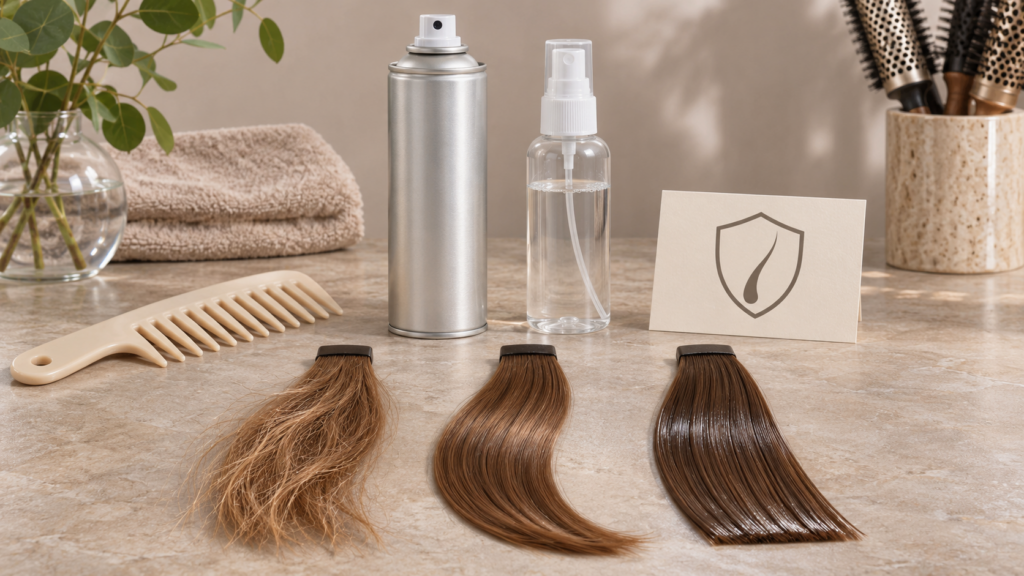
Buying framework
Set a Realistic Damage-Conscious Job
Hair spray is a styling film, not a structural repair. Buy it for the way it can reduce repeat handling while keeping the desired shape.
Separate support from repair: A spray may smooth the surface, add shine, or reduce the need to restyle, but those cosmetic effects do not fuse split ends or return weakened fiber to its original condition.
Name the hold task: Decide whether you need flyaway control, root support, humidity resistance, or a final set. A precise job usually needs less product and fewer corrective brush passes.
Choose the lowest useful hold: More rigidity is not automatically more protective. Use enough support to avoid repeated restyling, while preserving the movement and brush-out your next step requires.
Inspect the application step: A fine, even mist and controlled burst can cover fragile sections without wet spots or repeated passes. Delivery quality matters as much as the hold label.
Plan removal before buying: The full routine includes brushing, cleansing, and detangling. A strong first-day result is a poor fit if removal consistently demands extra friction or repeated washing.
Who this is for
Match the Spray to Where Damage Changes Styling
Fragility is not one condition. Start with the step where the hair is most likely to snag, stiffen, overheat, or need repeated manipulation.
Bleached or porous lengths: Favor even deposition and a flexible dry film that does not concentrate stiffness at the ends. Apply less to the last few inches and compare feel after complete drying.
Heat-styled hair: Choose hold that can reduce repeat tool passes, but keep thermal protection as a separate requirement unless the current label gives explicit heat-protection directions.
Breakage-prone edges: Use targeted placement instead of saturating the hairline. Avoid relying on maximum hold when the style itself creates persistent tension.
Fine fragile hair: A lighter dose and finer mist may give enough support without collapse, tack, or a difficult cleanse. Test dose before assuming a stronger formula is needed.
Tangle-prone curls and coils: Prioritize a film that supports the finished pattern without forcing dry brushing. Consider how the spray behaves during rewetting, detangling, and the next style.
What to pay attention to
Read the Spray Through a Handling-Stress Lens
Ignore repair language until the delivery, film, restyling behavior, and removal fit the actual routine.
Handling lens
How much spraying, brushing, tension, and restyling are needed from application through removal?
Claim lens
Which benefits are directly stated and directed on the current label, and which are only suggested by repair-themed language?
Mist and droplet size: A fine broad mist can distribute a small dose evenly; sputtering or wet jets create rigid hot spots. A narrower pattern can be useful for precise placement.
Film flexibility: Flexible films retain movement and may tolerate gentle reshaping. Firmer films can preserve structure longer but may crack, flake, or resist brushing when disturbed.
Hold efficiency: Compare how little product achieves the required wear time. A high hold rating is not standardized proof that the formula will reduce handling in your routine.
Drying texture: Notice whether the film feels smooth, brittle, sticky, or rough at the ends. Surface feel is a practical clue, not proof that the hair was repaired or damaged.
Heat-protection claim: Do not infer thermal protection from words such as repair, shield, or strengthening. Look for explicit current directions covering the intended tool and use.
Brush-out and washout: A damage-conscious choice should release during the planned restyle or cleanse without picking, aggressive rubbing, or unnecessary repeated shampooing.
Avoid these traps
Avoid Repair Shortcuts That Add Stress
The common failure is buying a repair story while overlooking the force, stiffness, heat, or cleansing the product adds to the routine.
Treating smoothness as structural repair: A temporary coating can improve feel and appearance without rebuilding the strand. Judge the observable styling benefit and its routine cost.
Choosing maximum hold automatically: A rigid film may prevent touch-ups, but it can also make a style change or wash more difficult. Increase hold only when lighter support fails the real wear test.
Spraying damaged ends repeatedly: Ends often need the least deposit. Direct the burst toward the section that needs control and let overspray settle lightly rather than saturating fragile tips.
Using repair language as heat protection: Hold and thermal protection are different jobs. Do not add heat exposure unless the label explicitly supports the intended thermal use.
Brushing through a hard film: Dry force can create snagging or visible particles. Follow directions, soften or cleanse the film as appropriate, and avoid forcing a comb through resistance.
Changing the whole routine at once: A new treatment, leave-in, spray, brush, and tool setting make the result impossible to trace. Test one styling change through a complete wear-and-wash cycle.
Decision guidance
Let the First Stress Point Choose the Fix
Change the earliest step that creates tugging, stiffness, overload, or extra heat before replacing the whole routine.
If the mist lands in wet patches: Clean the actuator as directed, shorten the burst, increase distance if the label permits, or compare a finer delivery system.
If the style needs constant correction: Confirm even placement and full drying, then increase hold modestly. Judge success by fewer corrections across the wear period, not by how rigid the film becomes.
If the ends feel rigid: Reduce or omit the end dose and compare a more flexible spray. Keep the base products unchanged so the trial identifies the real cause.
If brushing creates flakes or snags: Stop forcing the dry film. Use the product-directed reset or washout method and compare a brushable formula for styles that must change.
If breakage remains unexplained: Do not treat spray choice as the sole solution. Review tension, heat, chemical services, detangling, and seek qualified help for sudden, severe, painful, or persistent changes.
Ownership & compatibility
Manage the Full Styling Cycle
A damage-aware spray earns its place when application, wear, refresh, and removal remain predictable without escalating force.
Measure the working dose: Count bursts and placement zones rather than spraying by feel. Small dose changes can alter stiffness and washout more than a new hold label.
Keep refreshes local: Reinforce only the section that lost control. Recoating the whole style adds film where no new support is needed.
Clean the actuator and tools: A sputtering nozzle changes droplet size, while coated brushes can add drag. Follow material and product directions for cleaning.
Audit the entire stack: Leave-ins, oils, heat protectants, and spray all affect feel and residue. Keep each layer only when its job is clear.
Reassess after chemical services: Bleaching, coloring, or relaxing can change porosity and handling. Retest dose, placement, and removal rather than assuming the former routine still fits.
FAQ
Hair Spray and Damage-Repair Questions
These answers separate realistic styling support from repair claims a hair spray cannot establish.
Can hair spray repair split ends?
Is flexible hold always better for damaged hair?
Should I avoid alcohol in every hair spray?
Can repair hair spray replace heat protectant?
Why do damaged ends feel crunchy after spraying?
Does brushable spray prevent breakage?
Can I layer spray over a bond-building treatment?
How should I test a spray on fragile hair?
When should breakage get professional attention?
Readiness check
Buy for Gentler Control, Not a Repair Promise
The best match supports the style while reducing reasons to handle fragile hair again.
Define the job: Choose the control and wear time before comparing claims.
Inspect delivery: Favor a mist that covers evenly without wet hot spots.
Use only enough hold: Trade extra rigidity only for a meaningful reduction in restyling.
Keep roles separate: Do not confuse hold, conditioning, and thermal protection.
Judge removal: Count the brushing, cleansing, and detangling needed to release the film.
Damage-Aware Shortcuts
Jump to the decision that reduces unnecessary handling.
Six Damage-Aware Checks
Use these before choosing another spray.
- Job: Name the exact control the style needs.
- Mist: Check for even coverage without wet spots.
- Flex: Match film movement to the next step.
- Heat: Require explicit thermal directions.
- Dose: Count bursts and placement zones.
- Removal: Avoid forceful brush-out or cleansing.
Damage-Conscious Styling Terms
Plain language for evaluating claims and handling.
When a Top 10 List Helps
Use rankings after the damage-aware requirements are clear.
- The weak point is clear: Filter for delivery, flexibility, or durable control.
- The hold floor is clear: Avoid stiffness that does not reduce touch-ups.
- The heat role is clear: Do not infer thermal protection from repair language.
- The removal limit is clear: Reject formulas that require unwanted force.
Already have a shortlist? A Comparison can help resolve the remaining tradeoffs.
When a Comparison Helps
Compare finalists across the same application-to-removal cycle.
- Delivery differs: Compare wet spots and coverage at equal dose.
- Film differs: Compare movement after complete drying.
- Restyling differs: Track brush-out without forcing the hair.
- Washout differs: Note residue, extra cleansing, and end tangling.
Still discovering options? Start with a Top 10 to build a relevant shortlist.