
Hair Spray Buying Guide for Hair Type and Texture
Hair type changes what a layer of hair spray does after it lands. Fine strands can lose movement under a wet or heavy film, while dense curls may need flexible coverage that reaches the finished shape without flattening it. Match mist, dose, hold, and finish to the hair in front of you, then adjust for the style.
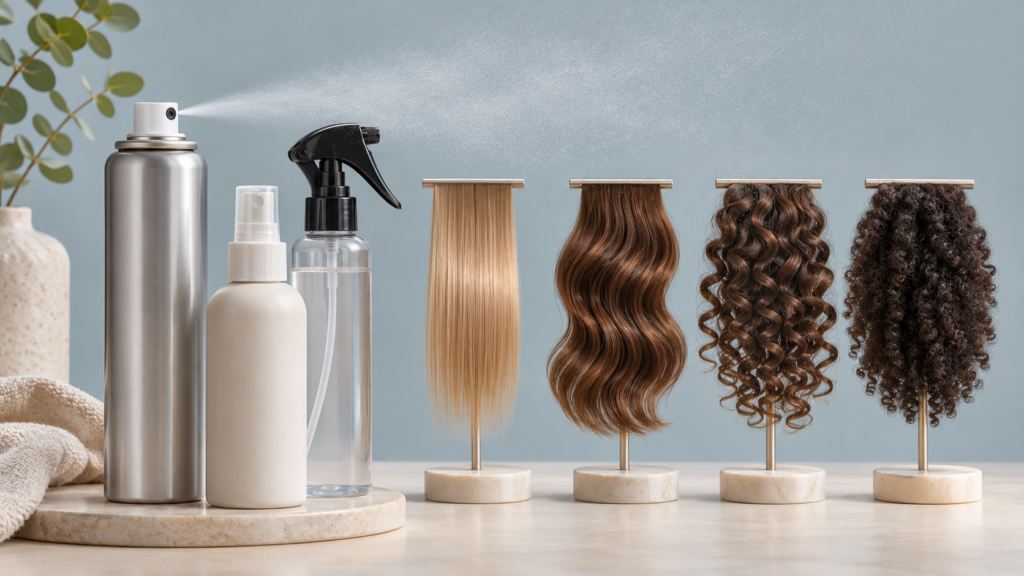
Buying framework
Start With the Hair That Carries the Film
The same spray can feel light on one head and obvious on another. Separate the variables before choosing hold.
Strand diameter: Fine strands have less mass to resist a wet mist or rigid coating. Coarser strands can tolerate more film, yet they may need wider coverage because a few coated pieces will not control the whole shape.
Density: Low-density hair shows separation and shine quickly when spray groups strands together. High-density hair presents more surface area, so one outside pass may leave inner sections unsupported.
Pattern: Straight hair makes droplets, stiffness, and residue easy to see. Waves, curls, and coils need the film to follow bends without turning each group into a hard shell or pulling an expanded shape flat.
Porosity and condition: Rough or porous lengths can catch product unevenly and feel dry sooner, while smoother hair may lose light grip. Treat porosity as a dosing clue, not a universal formula prescription.
Finished style: Natural movement, stretched texture, a curl set, root lift, and a structured updo ask different things from the same hair. Type narrows the starting point; the intended shape decides the useful support.
Who this is for
Match Common Hair Patterns to a Starting Point
These are starting conditions, not fixed rules. The same person may choose a different spray when the style changes.
Fine or low-density hair: Begin with a fine, broad mist and flexible hold. Short passes reduce wet spots and preserve separation; a natural or low-shine finish is less likely to make roots look coated.
Thick or high-density hair: Look for even output and enough working time to apply in sections. A flexible medium film can support the interior without relying on a hard outer shell.
Straight or easily weighed-down hair: Prioritize fast drying, low tack, and brushability. Apply from the labeled distance, then reinforce only the areas that lose lift or shape.
Wavy or curly hair: Choose a film that bends with curl groups and resists the condition causing expansion or collapse. A light veil over the finished pattern often preserves movement better than saturation.
Coily, braided, or highly shaped styles: Controlled placement matters more than maximum hold. Reach the intended surface or section, and favor a film that supports edges and shape without brittle buildup.
What to pay attention to
Translate Spray Features Through Texture
Delivery, dried-film behavior, and finish determine whether a formula complements the strand pattern.
Strand-load lens
Will the droplet size and dried film support the style without making individual strands collapse, clump, or feel rigid?
Shape-coverage lens
Can the spray reach the surfaces and inner sections that carry the style while preserving the intended pattern?
Mist fineness: A fine cloud distributes small droplets across fine or visibly separated hair with less spotting. A wetter stream offers precision on dense sections but needs careful distance and motion.
Spray width: Broad coverage suits an expanded curl set or long straight lengths. A narrow pattern is easier around roots, braids, or edges where overspray would change nearby movement.
Drying speed: Quick drying helps delicate volume stay lifted. More working time can help dense or textured sections receive an even layer, but excess wetness can soften a finished shape.
Film flexibility: Flexible films bend as waves, curls, and coils rebound. Firmer films suit shapes that should move less, though brushing and restyling can expose cracking or stiffness.
Tack and finish: Grip can help slippery straight hair or a set hold together, but too much joins fine strands. Shine may polish a sleek style yet magnify separation at sparse roots.
Layering and washout: Dense hair may need sectioned light layers instead of one heavy coat. Compare how the film accepts another pass, flakes when disturbed, and leaves during normal cleansing.
Avoid these traps
Avoid Turning Hair Labels Into Dosage Rules
A type label helps only when it changes a specific choice. Technique and finished shape still control the dose.
Assuming fine hair always needs strong hold: A rigid film can preserve shape while removing the movement that makes fine hair look full. Start with lighter delivery and increase support only where the style falls.
Coating only the outside of dense hair: An outer shell may look set while inner sections shift. Work in manageable sections and use light passes instead of saturating the top layer.
Spraying curls before the pattern is settled: Wet droplets and hand movement can distort curl groups. Finish arranging the shape, then mist from the recommended distance unless the label directs otherwise.
Using shine to correct rough texture: A reflective film changes appearance but does not repair the strand. Too much can highlight uneven deposits; keep conditioning and damage care separate.
Treating porosity as a precise diagnosis: Porosity varies across the head and with buildup. Use observed wetting, roughness, and residue as feedback instead of buying from one label alone.
Adding more when the nozzle is the problem: Sputtering creates large droplets that flatten fine hair and spot curls. Test the pattern away from hair and follow package cleaning directions first.
Decision guidance
Adjust From the First Texture-Specific Failure
A light, even trial shows whether the mismatch is delivery, film, placement, or strength.
Fine hair loses lift: Reduce wet load first: increase distance within label directions, shorten the pass, or choose a finer, faster-drying mist. Stronger hold helps only after delivery stops collapsing the root.
Straight hair looks separated: Choose lower tack or less shine, and sweep the nozzle rather than pausing. If shape still fails cleanly, add targeted support instead of another full coat.
Dense hair holds only at the surface: Apply lighter layers to the sections that build the style. A broad exterior pass cannot replace support inside a thick curl set, braid base, or updo.
Curls or coils feel shell-like: Move toward a more flexible film or reduce layering. The spray should help groups return to shape without turning normal bending into cracks or flakes.
Mixed textures respond differently: Divide the head by behavior. Use less at fine or smooth areas and targeted reinforcement where coarse, porous, or high-movement sections lose shape first.
Ownership & compatibility
Keep Texture Trials Comparable
Consistent application and nozzle care separate a formula mismatch from a changing spray pattern or overloaded routine.
Begin with a clean delivery test: Check the mist away from the face and hair. Note whether it forms a cloud, narrow stream, or uneven droplets; those differences change the load on every texture.
Hold technique steady: Use the labeled distance, similar pass speed, and the same section size when comparing products. Changing all three makes a suitable film look unreliable.
Watch cumulative residue: Texture products, dry shampoo, oils, and repeated spray layers change grip and washout. Judge the spray in the routine it will join, then reset when comparisons become muddy.
Store and handle as directed: Some hair sprays are pressurized or flammable. Follow container instructions for ventilation, heat, flames, storage, nozzle care, and disposal; never puncture or incinerate a can.
Stop for concerning reactions: Discontinue use for burning, swelling, pronounced itching, or another concerning reaction. Seek appropriate help for severe breathing symptoms or persistent irritation.
FAQ
Hair Spray and Texture Questions
Refine a starting point without treating texture categories as fixed prescriptions.
What hair spray is best for fine hair?
Does thick hair need strong-hold hair spray?
What hold works for curly hair?
Can hair spray weigh down straight hair?
How should I use hair spray on coily hair?
Does porous hair need a different hair spray?
Should low-density hair avoid shine spray?
Can I use different amounts on mixed textures?
Why does hair spray flake more on curls?
Readiness check
Choose the Film the Hair Can Carry
Hair type matters when it predicts where spray lands, how much film strands can carry, and how the finished shape moves.
Read the strand load: Use finer, lighter delivery where wetness or clumping shows quickly.
Map the density: Support inner sections when the style depends on more than its outer surface.
Respect the pattern: Let the film bend with waves, curls, and coils unless the style is meant to stay rigid.
Choose the finish: Balance grip and reflectivity against separation, texture visibility, and the intended look.
Correct the first failure: Change mist, placement, flexibility, or dose before escalating hold everywhere.
Texture Match Shortcuts
Jump to the variable that changes how the film lands or moves.
Six Texture Match Checks
Use these after one light, even application.
- Load: Did the mist collapse or join strands?
- Reach: Did support reach inner sections?
- Bend: Can the pattern move without cracking?
- Grip: Is tack useful or separating hair?
- Finish: Does shine suit density and style?
- Reset: Can the film layer and wash out cleanly?
Texture Terms That Change the Choice
Plain language for how hair carries a styling film.
When a Texture-Focused List Helps
Use rankings after you know how the hair carries product.
- Strand load is clear: Filter wet or heavy delivery for delicate volume.
- Coverage job is clear: Choose broad or sectional application for density.
- Pattern is clear: Match film flexibility to movement.
- Finish is clear: Compare natural, matte-looking, or glossy results intentionally.
Already have a shortlist? A Comparison can help resolve the remaining tradeoffs.
When a Side-by-Side Test Helps
Hold section size and spray distance steady.
- Fine versus wet mist: Compare collapse, spotting, and evenness.
- Flexible versus firm film: Compare rebound, stiffness, and fracture.
- Broad versus narrow spray: Compare exterior coverage with precise reach.
- Natural versus shiny finish: Compare separation and texture visibility.
Still discovering options? Start with a Top 10 to build a relevant shortlist.