
Hair Styling Tools Buying Guide for Blowouts
Choose blowout tools by dryer airflow, nozzle fit, brush diameter and bristles, section size, tension, heat protection, ergonomics, cooling, and finish durability.
Blowout Tool System roadmap: Define the blowout shape; Map section and moisture; Coordinate air and tension; Test the whole head; The smooth straight blowout user; The volume seeker; The curly stretch user; The fine-hair user; The dense long-hair user; Dryer airflow; Nozzle geometry; Brush diameter; Bristle and vent design; Section moisture; Cool setting and release; Buying the largest brush; Pointing airflow randomly; Pulling harder for smoothness; Keeping sections too wet; Skipping rear ergonomics; For sleek results; For root lift; For curved ends; For curly stretching; For faster dense-hair sessions; Write a blowout map; Remove shed hair; Inspect snag points; Judge day two. Blowout Tool System audit order: Judge day two; Inspect snag points; Remove shed hair; Write a blowout map; For faster dense-hair sessions; For curly stretching; For curved ends; For root lift; For sleek results; Cool setting and release; Section moisture; Bristle and vent design; Brush diameter; Nozzle geometry; Dryer airflow; The dense long-hair user; The fine-hair user; The curly stretch user; The volume seeker; The smooth straight blowout user; Test the whole head; Coordinate air and tension; Map section and moisture; Define the blowout shape. A blowout is a coordinated drying method, not simply a powerful dryer plus a round brush. Evaluate the pre-dry stage, root direction, subsection depth, nozzle path, brush release, cooling, and the result at the back of the head. A convincing setup preserves the intended shape after the arms tire and on the following day without corrective passes everywhere. Rehearse each blowout contender with a fixed dampness target and identical sections. Begin by recording how much pre-drying is needed before the brush can create tension without dragging. At the roots, assess whether the dryer and nozzle can direct air where the brush lifts; at the mid-lengths, watch for secure grip without snagging; at the ends, check whether the barrel releases cleanly and forms the intended curve. Brush diameter should be judged against the shortest layer it must capture, not only the longest length. Nozzle security matters because a rotating or loose concentrator changes the air path midway through a pass. Compare the cool control for accessibility while both hands are occupied. Then consider the complete physical load: dryer weight, brush weight, handle size, cord position, noise, and the time spent reaching behind the head. Photograph crown, sides, back, and ends once cool, then review root collapse and end shape the next morning. A better blowout system shortens corrections through coordinated airflow and section control; it does not merely make the first visible panel look polished. Treat the back of the head as the deciding blowout test. Mark a consistent pre-dry endpoint, clip the same subsection widths, and time roots, middle, and ends independently. Observe whether the nozzle stays aligned as the wrist rotates, whether the brush releases tips without rewinding, and whether cool air is reachable without losing tension. Compare the final shape under side lighting, where rough patches and collapsed roots are easier to see. Then store and clean the complete kit once, including shed hair and intake debris, because awkward maintenance changes how often the method remains practical. A credible winner should deliver similar curvature and polish across front and back while reducing the temptation to revisit dry sections with more heat. Repeat the method with the opposite side first to expose fatigue and handedness. Count brush stalls, dropped sections, nozzle adjustments, and moments when the cord interrupts the path. Test the smallest face-framing layer and the longest rear section because one barrel diameter may not control both. Let every section cool before scoring shine or bend, then avoid touching it until the whole head is complete. The purchase should also leave room for clips, a heat-safe resting place, intake cleaning, and brush sanitation. Consistency across these ordinary tasks is more useful than a fast demonstration performed only on an easy front panel. Identify the stage that limits the finish before upgrading: moisture removal, root direction, brush grip, end release, cooling, or physical endurance. Spend toward that bottleneck. More wattage will not correct a slipping brush, and a larger barrel will not capture short layers. The final rehearsal should include the crown, nape, and face frame, followed by an honest next-day check for collapse, roughness, tangles, and corrective heat. Check the work area as carefully as the tool. The outlet, mirror height, counter space, resting mat, and cord path determine whether the dryer and brush can move in coordinated arcs. Read cleaning directions for both pieces and inspect seams where product or shed hair collects. A setup that is easy to reset after use is more likely to deliver the same blowout next week. Repeat the finalist without a fresh haircut or salon prep so the purchase proves useful under ordinary at-home conditions and familiar products.
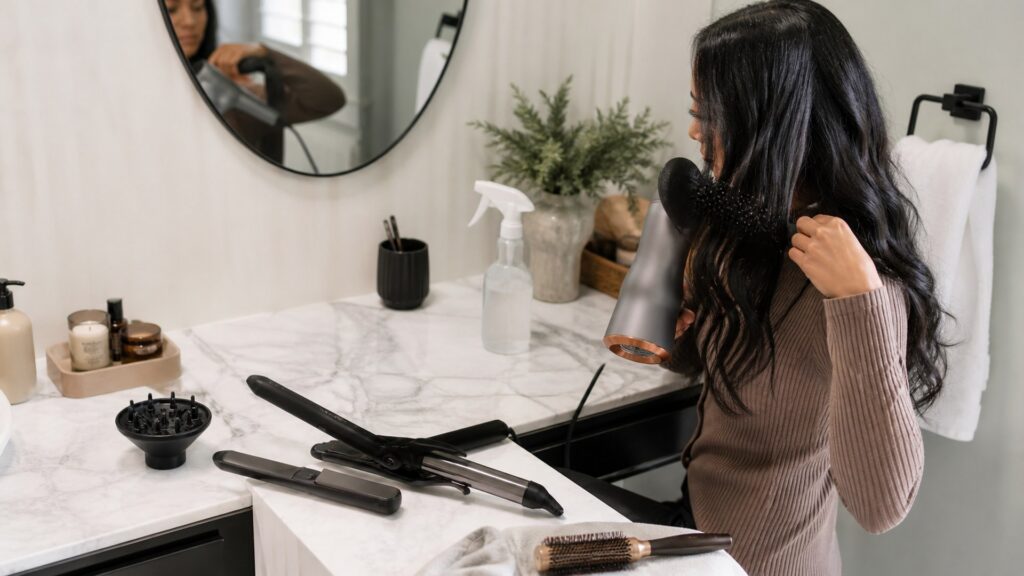
Buying framework
Define the blowout shape
Build blowout tool system from the actual sequence.
Define the blowout shape: Straight polish, curved ends, root lift, large bounce, or stretched curls require different brush paths and diameters.
Map section and moisture: Start from consistent dampness, product coverage, subsection depth, root direction, and pre-dry endpoint.
Coordinate air and tension: Nozzle direction, brush grip, dryer distance, movement, heat, and cool setting work as one system.
Test the whole head: Time crown, back, hairline, ends, arm fatigue, tangles, cleanup, and next-day durability.
Who should buy what
Match blowout tool system to the user
Each blowout tool system profile changes the configuration.
The smooth straight blowout user: Needs concentrated aligned airflow, suitable paddle or round brush tension, and controlled ends.
The volume seeker: Should match brush diameter and section elevation to length while cooling roots in position.
The curly stretch user: Needs sections, detangling, directed airflow, moderate tension, heat protection, and pattern-recovery monitoring.
The fine-hair user: Benefits from lighter brushes, lower heat, moderate velocity, small sections, and minimal finishing passes.
The dense long-hair user: Needs sustainable dryer weight, sufficient airflow, clips, barrel length, and an intake-cleaning plan.
What to pay attention to
Read the specifications that control blowout tool system
These blowout tool system characteristics change selection and ownership.
Dryer airflow: Compare velocity control, heat independence, nozzle seal, cool shot, intake access, weight, and noise.
Nozzle geometry: A narrow concentrator supports directional smoothing but must remain secure and at the directed distance.
Brush diameter: Hair length, target bend, section width, and root access determine useful size more than maximum barrel.
Bristle and vent design: Grip, flex, heat transfer, seam quality, venting, and cleanability shape tension and drying.
Section moisture: Too-wet sections extend heat time; too-dry sections may invite rewetting and repeated passes.
Cool setting and release: Support the shape as it cools and unwind without tangling, snagging, or crushing the bend.
Avoid these traps
Prevent common blowout tool system failures
Replace each blowout tool system shortcut with a defined test.
Buying the largest brush: Oversized barrels can reduce root access, lose short layers, and create sections too thick to dry evenly.
Pointing airflow randomly: Air against the intended path can roughen the finish and increase corrective passes.
Pulling harder for smoothness: Excess tension raises breakage risk; improve section size, slip, airflow, and brush control first.
Keeping sections too wet: Long exposure may follow even at moderate heat; pre-dry according to method.
Skipping rear ergonomics: A tool that works at the front may become heavy, tangled, or imprecise behind the head.
Decision guidance
Choose a specific blowout tool system route
Follow the blowout tool system path matching the dominant constraint.
For sleek results: Use a secure concentrator, controlled brush tension, consistent sections, and airflow from roots toward ends.
For root lift: Elevate sections with a diameter suited to length and cool before releasing.
For curved ends: Choose a barrel that captures the section without overlapping or trapping tips.
For curly stretching: Prioritize detangling, moderate tension, fewer passes, and recovery tracking.
For faster dense-hair sessions: Improve pre-dry, section map, airflow, clips, and ergonomics rather than defaulting to maximum heat.
Ownership & compatibility
Keep blowout tool system repeatable
Maintenance and tracking protect the blowout tool system result.
Write a blowout map: Record products, dampness, sections, brush, settings, direction, and cool phase.
Remove shed hair: Clean bristles, vents, nozzle, and intake after cooling according to directions.
Inspect snag points: Retire cracked seams, bent bristles, loose nozzles, damaged cords, or rough barrel edges.
Judge day two: Score root collapse, end shape, frizz, tangles, and the amount of heat needed to refresh.
FAQ
Hair Styling Tools Buying Guide for Blowouts FAQ
Answers for the exact blowout tool system purchase and use case.
How should buyers assess dryer airflow in blowout tool system?
How should buyers assess nozzle geometry in blowout tool system?
How should buyers assess brush diameter in blowout tool system?
How should buyers assess bristle and vent design in blowout tool system?
How should buyers assess section moisture in blowout tool system?
How should buyers assess cool setting and release in blowout tool system?
What mistake belongs at blowout tool system checkpoint 1?
What mistake belongs at blowout tool system checkpoint 2?
What mistake belongs at blowout tool system checkpoint 3?
Bottom line
For sleek results
Close the blowout tool system decision with a measured routine.
Set the baseline: Define the blowout tool system outcome and constraint before shopping.
Stress the winner: Test the finalist at the hardest realistic blowout tool system point.
Own the method: Track and maintain the complete blowout tool system cycle.
Reading Shortcuts
Navigate blowout tool system.
Decision Reminders
Control the blowout tool system trial.
- Baseline: Write the initial blowout tool system condition.
- One variable: Change one blowout tool system factor at a time.
- Stop rule: Pause blowout tool system when the failure boundary appears.
Glossary Snippets
Terms for blowout tool system.
Using a Hair Styling Tools Top 10
Filter rankings through blowout tool system.
- Apply blowout tool system: Reject options that miss the central constraint.
- Normalize blowout tool system: Use the same method for every finalist.
- Price blowout tool system: Include dose, time, cleaning, and replacement.
- Document blowout tool system: Keep the reason each finalist advanced.
Popularity cannot supply the blowout tool system baseline.
Comparing Blowout Tool System Finalists
Hold blowout tool system technique and context steady.
- Start blowout tool system: Use matched preparation.
- Observe blowout tool system: Check the mid-routine result.
- Stress blowout tool system: Test the likely weak point.
- Review blowout tool system: Score ownership after cleanup.
Restart if the blowout tool system baseline changes.