
Hair Styling Tools Buying Guide for Curly Hair
Choose styling tools for curly hair by curl goal, diffuser geometry, airflow, heat, sectioning, tension, detangling, drying time, shrinkage, and pattern recovery.
Curly-Hair Styling Tools roadmap: Choose the curl outcome; Protect the wash-day pattern; Control disturbance; Measure recovery; The definition preserver; The dense-root dryer; The stretch-style user; The occasional straightener; The travel curl user; Diffuser bowl and prongs; Air speed versus heat; Section and load; Brush tension; Plate and barrel edges; Dry-time ergonomics; Buying a universal diffuser blindly; Using maximum airflow; Brushing without a goal; Straightening unrecovered hair repeatedly; Ignoring product buildup on tools; For clump preservation; For root lift; For stretching; For occasional smoothing; For travel; Map dry time; Clean films from attachments; Inspect pattern return; Protect storage geometry. Curly-Hair Styling Tools audit order: Protect storage geometry; Inspect pattern return; Clean films from attachments; Map dry time; For travel; For occasional smoothing; For stretching; For root lift; For clump preservation; Dry-time ergonomics; Plate and barrel edges; Brush tension; Section and load; Air speed versus heat; Diffuser bowl and prongs; The travel curl user; The occasional straightener; The stretch-style user; The dense-root dryer; The definition preserver; Measure recovery; Control disturbance; Protect the wash-day pattern; Choose the curl outcome.
Buying framework
Choose the curl outcome
Build curly-hair styling tools from the actual sequence.
Choose the curl outcome: Preserving clumps, adding root lift, stretching, smoothing, or creating uniform curls require different tools.
Protect the wash-day pattern: Test tool use after a consistent product application, wetness level, section map, and drying start.
Control disturbance: Coordinate diffuser depth, venting, airflow, heat, hand movement, and touching before full dryness.
Measure recovery: After stretching or heat, track whether the natural pattern returns under the normal wash routine.
Who should buy what
Match curly-hair styling tools to the user
Each curly-hair styling tools profile changes the configuration.
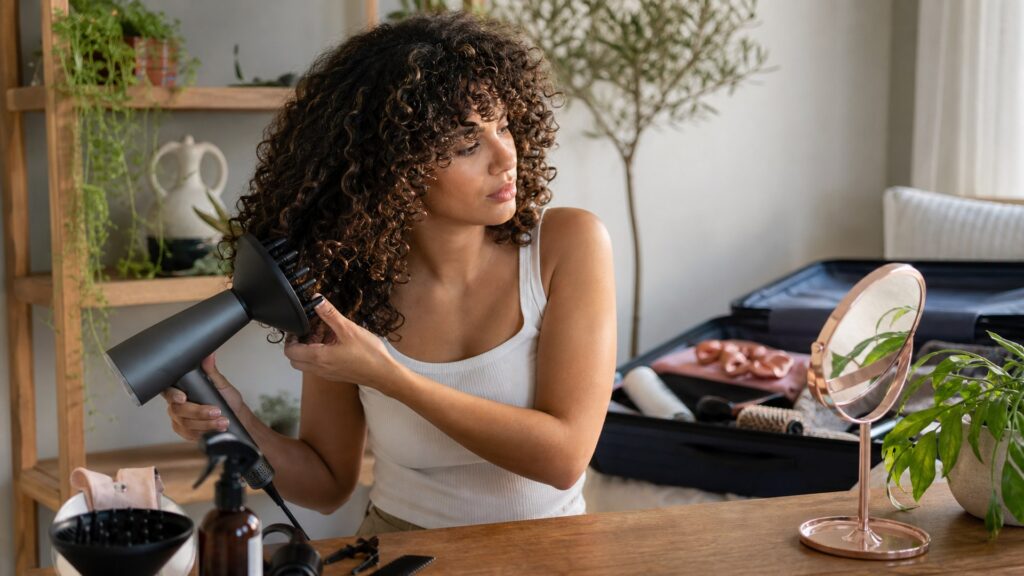
The definition preserver: Needs a diffuser that supports curl groups without crushing them or blasting them apart.
The dense-root dryer: Benefits from section access, bowl depth, prong reach, manageable dryer weight, and sufficient low-speed drying.
The stretch-style user: Should control brush or comb tension, nozzle direction, heat, sections, and repeated passes.
The occasional straightener: Needs low stable plate settings, edge control, protectant compatibility, and a recovery plan.
The travel curl user: Should prioritize diffuser fit, voltage reality, pack volume, secure attachments, and hotel-bathroom ergonomics.
What to pay attention to
Read the specifications that control curly-hair styling tools
These curly-hair styling tools characteristics change selection and ownership.
Diffuser bowl and prongs: Depth, diameter, prong length, vent distribution, and attachment stability determine support and root access.
Air speed versus heat: High air movement can disrupt clumps even when temperature is moderate; controls should be independent enough for the method.
Section and load: Dense curls may need staged roots and lengths; overcrowding the diffuser slows drying and distorts shape.
Brush tension: Bristle spacing, flex, edge seams, handle grip, and section width affect detangling, definition, or stretching.
Plate and barrel edges: Rounded snag-free transitions matter when curling or smoothing textured sections.
Dry-time ergonomics: Weight, balance, noise, cord reach, arm position, and cooldown matter during long dense-hair sessions.
Avoid these traps
Prevent common curly-hair styling tools failures
Replace each curly-hair styling tools shortcut with a defined test.
Buying a universal diffuser blindly: Nominal fit may wobble, block controls, detach when hot, or sit too shallow for the curl group.
Using maximum airflow: Faster air can produce more movement and frizz without drying dense roots evenly.
Brushing without a goal: A brush that defines wet sections differs from one used to stretch during directed airflow.
Straightening unrecovered hair repeatedly: If the pattern or fiber feels compromised, adding more passes is not correction.
Ignoring product buildup on tools: Styling films on bowls, vents, bristles, plates, and barrels change handling and cleanliness.
Decision guidance
Choose a specific curly-hair styling tools route
Follow the curly-hair styling tools path matching the dominant constraint.
For clump preservation: Choose a stable deep-enough diffuser and test low disturbance before increasing heat.
For root lift: Compare prong reach and section access without scraping scalp or collapsing lengths.
For stretching: Use controlled airflow direction and moderate tension, then track breakage and pattern return.
For occasional smoothing: Require stable lower plate heat, few passes, and full dryness where directions require it.
For travel: Verify electrical compatibility and diffuser security before assuming a compact dryer supports curls.
Ownership & compatibility
Keep curly-hair styling tools repeatable
Maintenance and tracking protect the curly-hair styling tools result.
Map dry time: Record root, mids, ends, section load, settings, movement, and full-dry endpoint.
Clean films from attachments: Follow cool-tool directions and keep vents and diffuser holes unobstructed.
Inspect pattern return: Use matched wash days and note weak zones, not just first-day smoothness.
Protect storage geometry: Avoid crushed prongs, bent bristles, pinched cords, and closed cases around residual heat.
FAQ
Hair Styling Tools Buying Guide for Curly Hair FAQ
Answers for the exact curly-hair styling tools purchase and use case.
How should buyers assess diffuser bowl and prongs in curly-hair styling tools?
How should buyers assess air speed versus heat in curly-hair styling tools?
How should buyers assess section and load in curly-hair styling tools?
How should buyers assess brush tension in curly-hair styling tools?
How should buyers assess plate and barrel edges in curly-hair styling tools?
How should buyers assess dry-time ergonomics in curly-hair styling tools?
What mistake belongs at curly-hair styling tools checkpoint 1?
What mistake belongs at curly-hair styling tools checkpoint 2?
What mistake belongs at curly-hair styling tools checkpoint 3?
Bottom line
For clump preservation
Close the curly-hair styling tools decision with a measured routine.
Set the baseline: Define the curly-hair styling tools outcome and constraint before shopping.
Stress the winner: Test the finalist at the hardest realistic curly-hair styling tools point.
Own the method: Track and maintain the complete curly-hair styling tools cycle.
Reading Shortcuts
Navigate curly-hair styling tools.
Decision Reminders
Control the curly-hair styling tools trial.
- Baseline: Write the initial curly-hair styling tools condition.
- One variable: Change one curly-hair styling tools factor at a time.
- Stop rule: Pause curly-hair styling tools when the failure boundary appears.
Glossary Snippets
Terms for curly-hair styling tools.
Using a Hair Styling Tools Top 10
Filter rankings through curly-hair styling tools.
- Apply curly-hair styling tools: Reject options that miss the central constraint.
- Normalize curly-hair styling tools: Use the same method for every finalist.
- Price curly-hair styling tools: Include dose, time, cleaning, and replacement.
- Document curly-hair styling tools: Keep the reason each finalist advanced.
Popularity cannot supply the curly-hair styling tools baseline.
Comparing Curly-Hair Styling Tools Finalists
Hold curly-hair styling tools technique and context steady.
- Start curly-hair styling tools: Use matched preparation.
- Observe curly-hair styling tools: Check the mid-routine result.
- Stress curly-hair styling tools: Test the likely weak point.
- Review curly-hair styling tools: Score ownership after cleanup.
Restart if the curly-hair styling tools baseline changes.