
Hair Styling Tools Buying Guide for Professional Results
Choose styling tools for professional-looking results by finish definition, sectioning, heat stability, airflow, geometry, tension, ergonomics, repeatability, and tool upkeep.
Professional-Result Styling roadmap: Define the visible finish; Reverse-engineer sections; Demand repeatability; Audit the workstation; The precision blowout user; The polished straight-style user; The uniform curl user; The multi-texture stylist; The home user chasing salon speed; Thermal consistency; Airflow precision; Geometry and alignment; Section repeatability; Ergonomic control; Maintenance state; Buying salon branding; Skipping section discipline; Polishing with extra passes; Ignoring the cool phase; Practicing only at full speed; For smooth blowouts; For glassy straight styles; For uniform curls; For versatile results; For home efficiency; Create a style card; Photograph all angles; Reset the station; Calibrate expectations. Professional-Result Styling audit order: Calibrate expectations; Reset the station; Photograph all angles; Create a style card; For home efficiency; For versatile results; For uniform curls; For glassy straight styles; For smooth blowouts; Maintenance state; Ergonomic control; Section repeatability; Geometry and alignment; Airflow precision; Thermal consistency; The home user chasing salon speed; The multi-texture stylist; The uniform curl user; The polished straight-style user; The precision blowout user; Audit the workstation; Demand repeatability; Reverse-engineer sections; Define the visible finish.
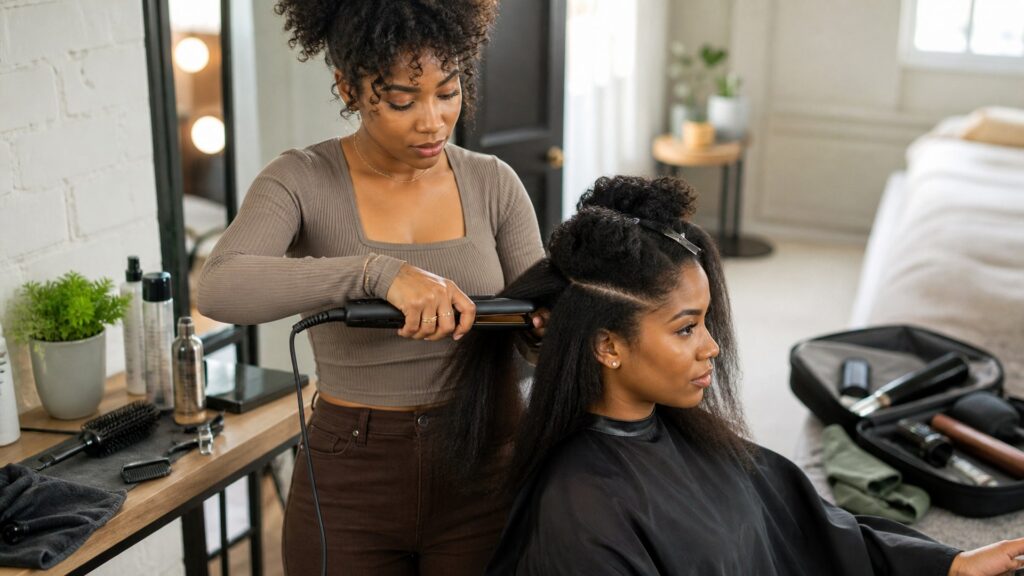
Buying framework
Define the visible finish
Build professional-result styling from the actual sequence.
Define the visible finish: Specify root direction, smoothness, bend placement, curl uniformity, edge polish, movement, and expected durability.
Reverse-engineer sections: Map the head, elevation, subsections, clips, brush or plate path, and cooling before buying hardware.
Demand repeatability: A result achieved once at maximum heat is less useful than one reproduced with controlled settings and timing.
Audit the workstation: Mirror angles, outlets, cord routing, tool rests, lighting, product placement, and cleanup affect execution.
Who should buy what
Match professional-result styling to the user
Each professional-result styling profile changes the configuration.
The precision blowout user: Needs coordinated dryer, nozzle, round brush, section clips, tension, and cool setting.
The polished straight-style user: Should prioritize heat stability, plate alignment, edge control, narrow corrective access, and few passes.
The uniform curl user: Needs barrel consistency, usable length, clamp control, section timing, and a reliable cooling pattern.
The multi-texture stylist: Benefits from independent controls and attachments that change mechanics, not merely marketing names.
The home user chasing salon speed: Should account for rear visibility, arm endurance, section skill, and safe workstation limits.
What to pay attention to
Read the specifications that control professional-result styling
These professional-result styling characteristics change selection and ownership.
Thermal consistency: Compare setting accuracy, recovery, hot spots, and output drift across the full style.
Airflow precision: Nozzle seal, orientation, velocity steps, heat independence, and cool-shot access determine cuticle-direction work.
Geometry and alignment: Plate closure, edge radius, barrel diameter, clamp gap, brush roundness, and bristle rows shape finish.
Section repeatability: Clips, comb tails, guide marks, timers, and mirrors can improve consistency more than extra heat.
Ergonomic control: Balance, grip, swivel, button location, stand, cool tip, and cord reach affect deliberate movement.
Maintenance state: Residue, lint, loose attachments, worn bristles, chipped coatings, and drifting controls undermine professional-looking results.
Avoid these traps
Prevent common professional-result styling failures
Replace each professional-result styling shortcut with a defined test.
Buying salon branding: Professional positioning does not guarantee fit with the user's hair, hands, outlet, or method.
Skipping section discipline: Random section depth produces uneven heat, bend, root direction, and durability.
Polishing with extra passes: Repeated contact may flatten movement and increase damage without correcting the underlying path.
Ignoring the cool phase: Shape often needs supported cooling; immediately disturbing it can erase careful heating.
Practicing only at full speed: Safe consistent technique develops through controlled repetitions, not rushed event-day experiments.
Decision guidance
Choose a specific professional-result styling route
Follow the professional-result styling path matching the dominant constraint.
For smooth blowouts: Invest in airflow direction, nozzle fit, brush control, section clips, and cooling before higher heat.
For glassy straight styles: Choose aligned snag-free plates and a repeatable one-pass section rather than multiple finishing passes.
For uniform curls: Standardize section width, barrel orientation, contact time, release, and cooling.
For versatile results: Prefer tools with genuinely independent mechanics and settings over many redundant attachments.
For home efficiency: Choose the system that can be executed safely with available mirrors, arm range, outlets, and time.
Ownership & compatibility
Keep professional-result styling repeatable
Maintenance and tracking protect the professional-result styling result.
Create a style card: Record sections, products, temperature, airflow, tension, timing, and cooling.
Photograph all angles: Front-only shine can hide inconsistent crown, back, ends, and root direction.
Reset the station: Clean surfaces and attachments, cool tools, inspect cords, and restock clips after every session.
Calibrate expectations: A skilled finish depends on technique and hair condition; hardware cannot remove every constraint.
FAQ
Hair Styling Tools Buying Guide for Professional Results FAQ
Answers for the exact professional-result styling purchase and use case.
How should buyers assess thermal consistency in professional-result styling?
How should buyers assess airflow precision in professional-result styling?
How should buyers assess geometry and alignment in professional-result styling?
How should buyers assess section repeatability in professional-result styling?
How should buyers assess ergonomic control in professional-result styling?
How should buyers assess maintenance state in professional-result styling?
What mistake belongs at professional-result styling checkpoint 1?
What mistake belongs at professional-result styling checkpoint 2?
What mistake belongs at professional-result styling checkpoint 3?
Bottom line
For smooth blowouts
Close the professional-result styling decision with a measured routine.
Set the baseline: Define the professional-result styling outcome and constraint before shopping.
Stress the winner: Test the finalist at the hardest realistic professional-result styling point.
Own the method: Track and maintain the complete professional-result styling cycle.
Reading Shortcuts
Navigate professional-result styling.
Decision Reminders
Control the professional-result styling trial.
- Baseline: Write the initial professional-result styling condition.
- One variable: Change one professional-result styling factor at a time.
- Stop rule: Pause professional-result styling when the failure boundary appears.
Glossary Snippets
Terms for professional-result styling.
Using a Hair Styling Tools Top 10
Filter rankings through professional-result styling.
- Apply professional-result styling: Reject options that miss the central constraint.
- Normalize professional-result styling: Use the same method for every finalist.
- Price professional-result styling: Include dose, time, cleaning, and replacement.
- Document professional-result styling: Keep the reason each finalist advanced.
Popularity cannot supply the professional-result styling baseline.
Comparing Professional-Result Styling Finalists
Hold professional-result styling technique and context steady.
- Start professional-result styling: Use matched preparation.
- Observe professional-result styling: Check the mid-routine result.
- Stress professional-result styling: Test the likely weak point.
- Review professional-result styling: Score ownership after cleanup.
Restart if the professional-result styling baseline changes.