
Home EV Chargers Buying Guide for Charging Cable Management
The charging cable is the part of a home station the driver touches every day, yet it is often planned after the wall unit has been mounted. That reversal can leave a nominally long cord stretched across a doorway, coiled on the floor, or pulling sideways on the vehicle inlet.
Cable management begins with two routes: where the lead travels while connected and where it rests afterward. Park the car normally, open the doors, operate the garage door, and walk the usual path before fixing a mounting point. A good layout makes the safe action the easy action—connect without tugging, disconnect without dragging, and return the coupler without a complicated winding ritual.
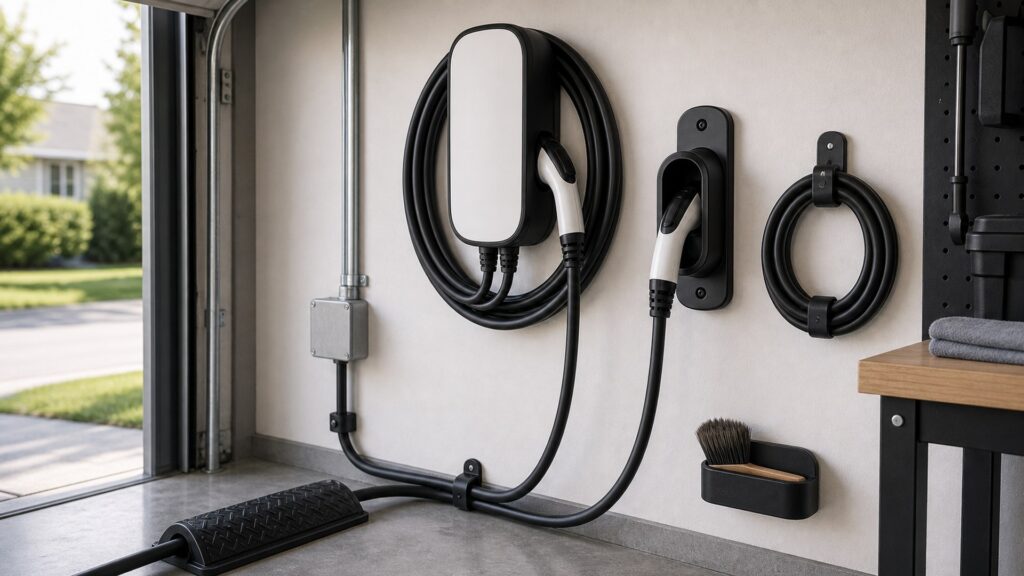
Layout test
Use the cable before installing the charger
A full-size mockup exposes conflicts that tape-measure distance misses.
Mark both endpoints: Identify the proposed mount and the vehicle inlet in every normal parking orientation. Include variation between drivers.
Lay out the connected route: Allow handling slack and keep the cord away from tires, door edges, walking lines, sharp corners, and moving mechanisms.
Design the return motion: The driver should be able to support the coupler, form broad loops, and place it in the holster without dragging the connector.
Repeat in difficult conditions: Try the motion beside the second car, with groceries, in darkness, and with the stiffness expected on cold days.
Garage patterns
Cable trouble follows movement, not floor area
A small bay can work well with deliberate placement, while a large garage can still encourage unsafe crossover.
Single assigned parking spot: A short direct route and fixed holster reduce floor exposure and make inspection easy.
Shared two-car bay: Mounting must prevent one lead from crossing the other vehicle's doors, tires, or central walking line.
Tandem driveway: Connector access changes with parking order, so cable reach cannot be separated from departure sequence.
Changing vehicle household: Different inlet locations favor placement with controlled reach rather than an extension-based workaround.
Driver with limited reach: Holster height, connector weight, grip, loop size, and required force should support comfortable independent use.
Handling characteristics
Nominal length is not usable length
Mounting height, loops, turns, and connector approach consume reach.
Connected route
Trace the cord from station to inlet with cars, doors, people, and garage equipment moving normally.
Stored route
Check support, bend shape, connector protection, floor clearance, and one-handed return after every session.
Cable length: Measure along the intended path with slack at the inlet; do not use a straight wall-to-car line.
Low-temperature flexibility: Published operating range and jacket behavior matter where an unheated garage or driveway makes the lead stiff.
Holster geometry: The dock should hold the connector securely, protect its contact end as intended, and permit a natural release motion.
Strain relief: Inspect how the lead exits the station and coupler during connection, storage, and maximum reach.
Organizer compatibility: Any retractor, arm, or bracket must suit the cable and installation without excessive tension, sharp bends, heat trapping, or blocked status.
Handling mistakes
Extra length is not a substitute for placement
Many cable problems come from adding slack instead of removing conflicts.
Buying the longest cord automatically: Surplus cable adds weight, floor contact, loops, and storage effort. Choose enough approved reach for real positions.
Pulling from the wall with no slack: A taut lead can load the vehicle inlet and strain cable ends when the car settles or someone brushes past.
Coiling too tightly: Small repetitive bends and forced wrapping can stress the jacket and conductors. Follow the manufacturer's handling guidance.
Hiding damage in storage: A closed bin or tight winding can conceal cuts, crushed areas, contamination, heat marks, and strained ends.
Organizer choices
Select for the motion the driver will repeat
The simplest wall hook often beats a complicated device when the route is short and predictable.
Use a wall holster: Choose it for a direct assigned bay where broad loops stay off the floor and the connector remains easy to inspect.
Consider overhead support: It can clear a walkway when approved for the equipment, but must not pull upward or sideways on the connected inlet.
Consider a retractor: Evaluate force across full travel, cable compatibility, return speed, connector support, and behavior in cold conditions.
Change the charger location: When every organizer creates crossover or tension, moving the source may solve the underlying geometry better than adding hardware.
Cable care
Look where the cord bends and touches
Quick inspection during ordinary handling catches changes before they become a charging interruption.
Scan before connection: Check the connector, latch, pins as instructed, jacket, strain reliefs, and areas that contact the wall or ground.
Keep storage clean: Remove debris according to instructions and prevent the coupler from resting in liquids, dirt, or metal objects.
Watch the route evolve: New shelving, another vehicle, a garage-door repair, or changed parking can introduce pinch and abrasion points.
Stop for warning signs: Do not continue with exposed conductors, severe cuts, melting, abnormal heat, damaged pins, loose parts, or manufacturer-identified hazardous conditions.
FAQ
Questions about home charging-cable handling
These answers focus on reach, support, and damage prevention.
How long should a home charging cable be?
Can the cable lie on the garage floor?
Is it safe to drive over a charging cable?
Can I add an extension cable?
Should the cable be tightly coiled after charging?
Are overhead retractors safe for EV cables?
What if two vehicles have inlets on different sides?
How often should a charging cable be inspected?
When should a damaged cable be replaced?
Bottom line
A cable should disappear into the routine
Good management provides enough reach, no recurring conflict, easy storage, and visible condition without requiring carelessness or strength.
Mock up both routes: Connected and stored positions reveal different hazards.
Remove tension and traffic: The inlet, tires, doors, and feet should not compete with the lead.
Keep wear visible: Simple storage makes inspection part of every connection.
Reading Shortcuts
Jump to reach, storage, organizer choice, or inspection.
Before You Commit
Walk these routes with the car parked normally.
- Usable reach: Measure along the actual cord path.
- Clear route: Open every nearby door.
- Connector support: Test the return motion one-handed.
- Seasonal handling: Inspect bends and contact points.
Terms in This Guide
Terms defining cable reach, support, and strain.
When a Top 10 List Helps
Use rankings after the mounting location is mocked up.
- Usable reach: Usable reach includes handling slack.
- Clear route: The route avoids tires and doors.
- Connector support: Storage uses broad supported loops.
- Seasonal handling: Damage remains easy to see.
Already comparing finalists? Use a Comparison for a narrower decision.
When to Compare Two Finalists
Compare finalists with the same inlet and parking position.
- Clear route: Both remain flexible in local weather.
- Connector support: Both support the coupler securely.
- Seasonal handling: Both avoid inlet tension.
- Inspection visibility: The difference affects daily handling.
Need a broader shortlist first? Visit the Top 10 collection.