
Home EV Chargers Buying Guide for Home Charging Setup
A dependable home charging setup begins with the trip home, not the charger catalog. Where the car stops, how much energy it used, when it leaves again, and where its inlet sits determine what the equipment must accomplish each night.
Once that routine is clear, the electrical design can establish an appropriate charging current and connection method. Cable reach, weather exposure, local controls, and commissioning then turn approved hardware into a system that is easy to use. Treat the vehicle, house, and parking space as one installation; solving only one of them produces the familiar frustrations of slow recovery, awkward cords, or unexplained charging interruptions.
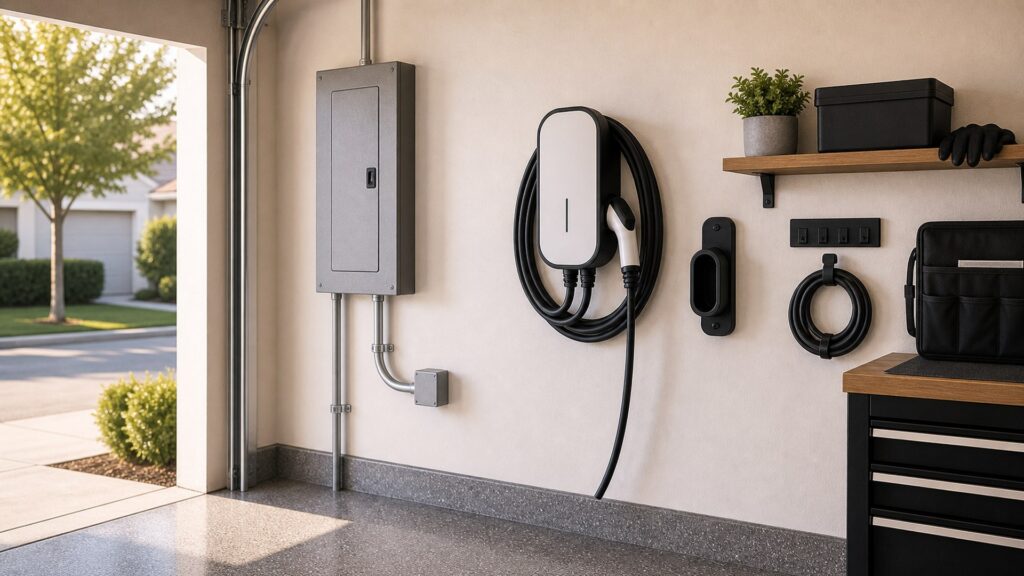
Setup sequence
Build outward from the parked vehicle
Resolve the physical routine first, then give an electrician the information needed to design the electrical path.
Park as usual: Mark the normal tire position, inlet location, walking route, and garage-door travel. Measure cable reach with handling slack.
Calculate recovery: Estimate typical and demanding daily kilowatt-hours along with the available parked hours. Full battery capacity is rarely the nightly requirement.
Confirm vehicle acceptance: Use documentation for the exact model and configuration. Extra EVSE output cannot make the onboard AC charger accept more.
Complete the electrical design: Have service capacity, circuit rating, protection, wiring, connection method, permits, and load management evaluated together.
Commission the result: Record the configured current, verify charging and fault behavior, label the circuit, and show every driver the local controls.
Household patterns
Different routines produce different setups
The useful distinction is not simply house versus apartment; it is how parking, departures, and authority shape charging.
Regular overnight commuter: Long dwell time often makes moderate output sufficient. Simple connection and reliable cable storage deserve priority.
Irregular shift worker: Quick overrides and clear completion status matter more than a rigid weekly schedule.
Outdoor driveway user: Weather suitability, drainage, impact exposure, nighttime visibility, and cold-cable handling belong in the initial layout.
Resident needing approval: Renters and multifamily owners must settle property permission, assigned parking, metering, access, and responsibility before choosing hardware.
Equipment details
Specifications become useful only in context
Ratings should answer a question about the designed circuit, parked car, or routine.
Energy path
Trace electricity from service capacity through the branch circuit and EVSE to the vehicle's onboard charger.
Daily routine
Rehearse arrival, connection, cable storage, departure, and an urgent unscheduled charge.
Configured amperage: Distinguish the station's maximum from the installation setting and the vehicle's draw.
Cable reach: Measure the routed distance from mount to inlet, including storage loops and relaxed connector handling.
Environmental marking: Match the complete product and installation instructions to indoor or outdoor exposure, temperature, sun, and water.
Safety certification: Verify a recognized certification mark on the exact model rather than relying on a marketplace description.
Offline behavior: Determine which schedules, limits, status indicators, and immediate-charge controls continue locally when connectivity fails.
Setup mistakes
Small assumptions become permanent annoyances
These errors are easier to prevent with a parked-car mockup and completed load design.
Choosing hardware before measuring: A suitable electrical rating does not rescue a cable that crosses a doorway or barely reaches the inlet.
Sizing for an empty-to-full refill: That scenario can inflate cost and circuit demand. Begin with normal daily energy and the time available to replace it.
Calling an open breaker space capacity: Panel space alone says nothing about service load, bus limits, feeder capacity, or conductor suitability.
Leaving commissioning undocumented: An unlabeled current setting or unknown sensor arrangement complicates future service and can be changed accidentally.
Decision guidance
Let the hardest boundary eliminate candidates
After the setup is designed, product comparison becomes much shorter.
When dwell time is generous: Choose the modest approved output that comfortably restores required energy and leaves installation margin.
When recovery time is tight: Higher power helps only if the car accepts it and the electrical plan supports it.
When parking varies: Favor placement and approved cord reach that serve each real position without extensions or traffic conflicts.
When capacity is constrained: Evaluate compatible load management with qualified design and documented failure behavior rather than assuming a service upgrade.
After installation
Keep the setup legible and inspectable
Cars and household loads change, so the original basis should remain available.
Save the design record: Retain permits, circuit information, configured current, manuals, and commissioning results.
Watch the handled parts: Inspect connector, cable jacket, strain relief, holster, mount, and any approved receptacle for heat or damage.
Revisit material changes: A second EV, new appliance, electrical work, solar, storage, or moved parking position can invalidate an old assumption.
FAQ
Questions that complete a home charging setup
Each answer addresses a boundary that should be settled before routine use.
How much charging power does a home setup need?
Should the charger be hardwired or plug-in?
Can an existing outlet support EV charging?
Where should a home charger be mounted?
Does the charger's rating determine charging speed?
What should commissioning include?
Is internet access required for home charging?
Can one setup later serve two EVs?
When should the installation be checked again?
Bottom line
A setup succeeds on ordinary nights
The right installation restores needed energy without making drivers think about electrical limits or cable improvisation.
Design from the routine: Daily energy, dwell time, and parking define useful performance.
Document the electrical path: Approved capacity and commissioning are part of the product choice.
Make connection effortless: Reach, storage, status, and fallback determine whether the setup stays pleasant.
Reading Shortcuts
Jump to routine, electrical design, placement, or commissioning.
Before You Commit
Confirm these points at the parked vehicle and panel.
- Energy target: Measure nightly energy and dwell time.
- Electrical design: Verify the vehicle's AC limit.
- Parking fit: Mock up cable reach and storage.
- Vehicle limit: Save the configured-current record.
Terms in This Guide
Terms that connect the car, house, and charging routine.
When a Top 10 List Helps
Use rankings after installation boundaries are settled.
- Energy target: Required energy fits the parked window.
- Electrical design: The complete circuit is approved.
- Parking fit: The connector reaches without extensions.
- Vehicle limit: Local charging remains understandable.
Already comparing finalists? Use a Comparison for a narrower decision.
When to Compare Two Finalists
Compare finalists under the same circuit and parking layout.
- Electrical design: Both fit the vehicle's acceptance.
- Parking fit: Both suit the installation environment.
- Vehicle limit: Both preserve limits during outages.
- Local operation: The difference affects everyday setup.
Need a broader shortlist first? Visit the Top 10 collection.