
Home EV Chargers Buying Guide for Outdoor Charging Installations
Outdoor charging equipment does not experience weather as one simple condition. A south-facing wall can bake in summer, a shaded connector can hold condensation, and a driveway cable can meet rainwater, road salt, tires, and snow equipment in the same week.
Product markings matter, but placement determines what those markings must withstand. Study the water path, sun exposure, seasonal temperatures, vehicle movement, pedestrian route, and cable storage before choosing a wall or pedestal location. The goal is not to make an outdoor station indestructible; it is to create a routine that does not repeatedly expose the charger or lead to avoidable damage.
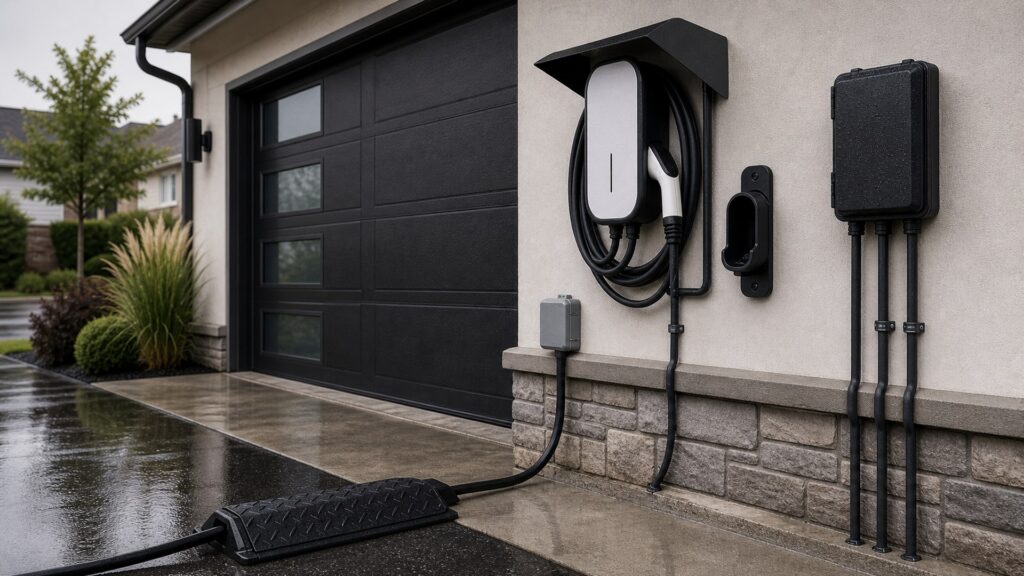
Site reading
Watch the driveway before choosing the wall
A short observation in poor weather can reveal more than a feature table.
Trace water: Look for roof runoff, irrigation, ponding, splash, snow piles, and melt paths while the connector is stored and connected.
Map moving hazards: Mark bumpers, doors, trailers, bins, mowers, shovels, and walking routes throughout a normal week.
Record seasonal extremes: Consider direct sun, reflected heat, freezing temperatures, windblown debris, salt, humidity, and handling with gloves.
Fix the parking orientation: The normal inlet position determines cable reach and whether the lead crosses pavement or a path.
Design the complete installation: Match approved equipment, wiring method, mounting, protection, drainage, permits, and commissioning to the chosen place.
Outdoor contexts
A driveway is not one uniform environment
Exposure and access differ sharply between sheltered walls and open shared parking.
Covered carport: Shelter may reduce direct rain but not wind-driven moisture, condensation, heat, or vehicle impact.
Open driveway: Sun, runoff, snow work, and a long cord route often control placement more than the panel location.
Curb-adjacent private space: Pedestrian separation, property rules, theft resistance, and vehicle strikes require special attention.
Shared outdoor parking: Authorization, assigned spaces, metering, cable return, accessibility, and inspection responsibility must be explicit.
Outdoor characteristics
The enclosure rating is only the first check
Cord behavior, mounting instructions, connections, and the surrounding site complete the decision.
Weather path
Follow rain, meltwater, sun, temperature, and debris across the enclosure, connector, and cable.
Movement path
Observe cars, people, landscaping equipment, and snow removal around stored and connected equipment.
Environmental rating: Verify the exact model's marked suitability and every required mounting orientation and closure.
Operating temperature: Compare the published range with local extremes, including solar-heated surfaces and cold starts.
Cable flexibility: A stiff cord can resist coiling and pull on the inlet; handling matters as much as length.
Connector storage: The holster should support the coupler, drain as intended, and remain reachable above snow or water.
Materials and hardware: Review corrosion exposure, fasteners, mounting surface, conduit entries, and service access.
Local controls: Indicators should be readable outdoors, and necessary charging should remain possible during connectivity loss.
Outdoor mistakes
Suitable equipment can still occupy the wrong place
Most preventable failures begin with site geometry rather than missing features.
Mounting beneath runoff: An outdoor marking is not permission to ignore roof discharge, irrigation, ponding, or installation instructions.
Leaving cable on the driveway: Tires, grit, ice, and snow tools can damage the lead and create a walking hazard.
Adding an improvised cover: A box may trap heat, interfere with bends, hide status, or violate clearances and instructions.
Ignoring connector exposure: The coupler and cable spend much of their life away from the enclosure and need equal protection.
Placement choices
Prefer the location that removes repeated hazards
A shorter conductor route is not automatically the better outdoor position.
When rain dominates: Manage runoff, splash, drainage, entries, and connector storage with an approved installation.
When winter is difficult: Favor reachable holsters, manageable cord stiffness, protected storage, and clearance from plowing.
When vehicles pass close: Plan appropriate physical protection without putting the connector beyond comfortable reach.
When pedestrians share the area: Keep the lead outside walking routes in both stored and connected states.
When connectivity is unreliable: Choose clear local status so weather does not compound an account or network problem.
Seasonal care
Inspect after weather has done its work
Event-based checks complement ordinary visual inspection.
After storms or flooding: Look for movement, water-entry indications, debris, standing water, damaged conduit, and compromised mounting.
After impact: Stop use and evaluate the enclosure, mount, wiring path, connector, and protective equipment.
At seasonal changes: Examine jacket flexibility, cracking, corrosion, seals, holster drainage, labels, and the cord route.
When the site changes: Paving, gutters, landscaping, fences, parking habits, and snow storage can create new exposure.
FAQ
Outdoor charger questions shaped by the site
Product suitability and placement conditions both matter.
Can any home EV charger be installed outdoors?
Does a weather rating make a charger waterproof?
Where should the connector be stored outside?
Can the charging cable cross a sidewalk?
How does cold weather affect the choice?
Is a roof required above outdoor EVSE?
What protects a charger from vehicle impact?
Can I use an extension cord to reach outside?
When should outdoor charging stop immediately?
Bottom line
Choose the driest routine, not merely an outdoor label
Success comes from suitable equipment placed where water, movement, and seasonal handling are controlled.
Read the site in bad weather: Runoff, cold, darkness, and snow reveal the practical design.
Protect every exposed part: The connector and cable deserve the same care as the enclosure.
Reinspect after change: Storms, paving, and new parking habits can alter the original conditions.
Reading Shortcuts
Jump to weather, placement, cable handling, or care.
Before You Commit
Observe these conditions during the worst local season.
- Exposure match: Trace runoff and standing water.
- Water path: Map vehicles and walking routes.
- Physical protection: Test cold-weather connector storage.
- Seasonal handling: Plan event-based inspections.
Terms in This Guide
Terms connecting outdoor ratings to actual exposure.
When a Top 10 List Helps
Use rankings after the outdoor location is defined.
- Exposure match: The exact model suits outdoor use.
- Water path: Water avoids vulnerable points.
- Physical protection: The lead stays out of traffic.
- Seasonal handling: Local controls remain accessible.
Already comparing finalists? Use a Comparison for a narrower decision.
When to Compare Two Finalists
Compare finalists in the same exposure and cable route.
- Water path: Both tolerate expected temperatures.
- Physical protection: Both provide stable storage.
- Seasonal handling: Both permit inspection.
- Local use: The difference affects seasonal handling.
Need a broader shortlist first? Visit the Top 10 collection.