
Home EV Chargers Buying Guide: How to Choose the Right One
A home EV charger should be sized for the miles that need to be restored, not for the largest amperage printed on the box. A modest circuit can meet many overnight routines, while a powerful station may add installation cost without shortening charging for a vehicle with a lower onboard limit.
The decision joins four pieces: the car, the house, the parking space, and the household schedule. Resolve electrical capacity and installation method with qualified guidance, then compare cable reach, environmental rating, controls, and service support. The best unit is the one that fits ordinary nights and still handles the occasional demanding return without improvisation.
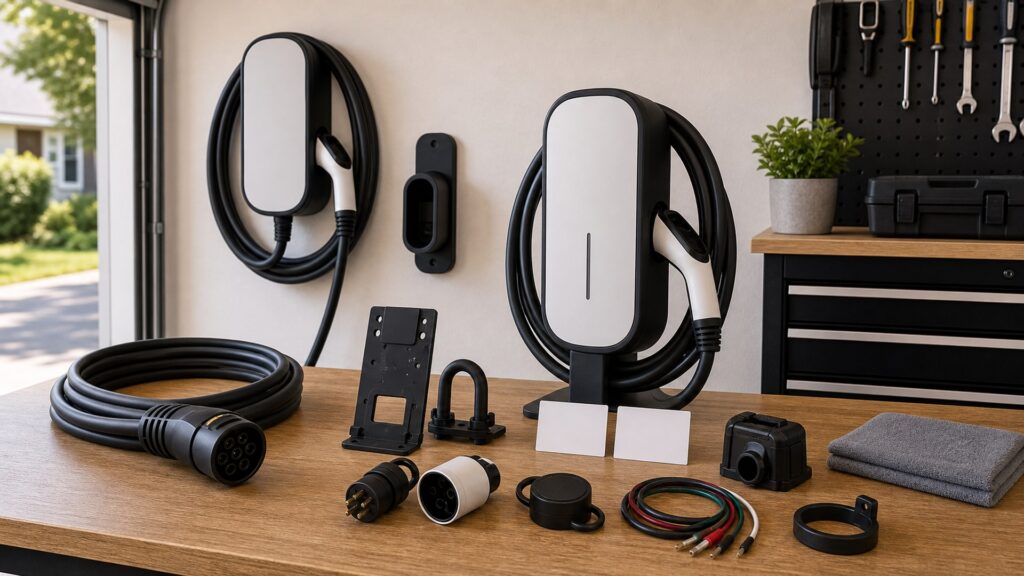
Buying framework
Size the charger from the trip backward
Begin with energy and dwell, then let the electrical and parking conditions narrow the product family.
Estimate nightly recovery: Translate typical and demanding driving into energy needed before the next departure. Avoid planning every session as an empty-to-full refill.
Check the vehicle's AC limit: The car may accept less power than the station offers. Use model-specific documentation before paying for output the vehicle cannot use.
Establish the installation: Have service capacity, circuit design, connection method, permits, and inspection requirements resolved for the chosen current.
Mock up the parking space: Confirm mounting height, inlet reach, connector storage, door movement, walkways, and impact exposure with the vehicle parked normally.
Choose only useful controls: Scheduling, energy records, load management, and remote status should solve a real household problem and retain understandable local operation.
Who this is for
Home routines call for different charger priorities
The same station can be excellent in one house and unnecessarily complex in another.
Predictable overnight commuter: Reliable moderate Level 2 charging and simple cable storage may matter more than maximum output or elaborate automation.
Long-distance driver: Higher daily recovery can justify more circuit capacity when the vehicle accepts it and the home installation supports it.
Outdoor driveway household: Weather rating, drainage, impact protection, cold cable handling, and visible nighttime access become central.
Renter or multifamily resident: Property approval, metering, assigned parking, shared access, and removable versus permanent equipment may control the decision.
Future two-EV household: Consider compatible power sharing, wall space, and cable geometry, but base expansion on a real electrical plan rather than speculative maximums.
What to pay attention to
Translate ratings into hours, reach, and limits
A useful specification changes what the driver experiences or what the installer can approve.
Energy and electrical fit
Match daily driving and parked time to vehicle acceptance and the approved circuit.
Physical and ownership fit
Evaluate mounting, cable reach, environment, controls, service, and long-term support.
Configured current: Distinguish maximum capability from the installed setting. The circuit, load design, and vehicle determine usable charging.
Cable length and flexibility: Measure usable reach with mounting height and storage included. Cold conditions can make a nominally long cord difficult to handle.
Safety certification: Confirm the applicable recognized certification mark on the exact model and configuration, not merely a seller's claim about the product family.
Indoor or outdoor marking: Match the environmental rating and installation instructions to rain, sun, temperature, condensation, and mounting orientation.
Local controls: A driver should see status and start a necessary charge without depending entirely on a phone, account, or remote server.
Load-management support: If capacity control or multi-EV sharing matters, require exact compatible models, documented failure behavior, and qualified commissioning.
Avoid these traps
Headline power can distract from the real limits
Most poor purchases overlook the vehicle, house, or parking space while focusing on charger features.
Buying the highest amperage automatically: More output may add no speed when the car or circuit is the lower limit. Size from energy need and acceptance.
Treating an empty breaker slot as capacity: Panel space does not prove that the service, bus, feeder, or load calculation supports charging.
Measuring cable reach in a straight line: Mounting height, walls, holsters, and handling slack consume length. Test the route with the actual car.
Choosing smart features without fallback: Remote controls are useful until accounts or networks fail. Understand local charging, schedules, limits, and status first.
Decision guidance
Let the tightest constraint choose the charger
The vehicle, electrical design, location, or schedule will usually eliminate more candidates than the feature list.
If overnight dwell is long: A moderate configured current may recover daily energy comfortably and reduce installation demands.
If charging windows are short: Higher output can help only when both the vehicle and approved circuit support it.
If the charger sits outdoors: Choose the complete weather-suitable installation and a cable that remains manageable in local seasons.
If service capacity is limited: Consider compatible dynamic load management within a qualified design rather than assuming a service upgrade or reducing safety margins.
If simplicity matters most: Favor clear local status, durable cable handling, and supportable hardware over features that require several accounts.
Ownership & compatibility
Keep the original installation understandable
A charger may outlast a vehicle, phone, router, or utility tariff.
Retain the records: Keep the circuit design, permit, configured current, model documentation, and commissioning results with the home electrical file.
Inspect high-use parts: Check the connector, latch, cable jacket, strain reliefs, holster, mount, and any permitted receptacle for damage or abnormal heat.
Review software dependence: Know what happens if the vendor changes accounts, subscriptions, firmware support, or cloud services. Basic local charging should remain clear.
Reassess major changes: A new EV, second station, panel work, solar, storage, or large appliance can alter the original load and compatibility assumptions.
FAQ
Home charger questions to settle before purchase
These answers address the boundaries that product listings often leave unclear.
How powerful should a home EV charger be?
Is a hardwired charger better than a plug-in model?
Can I use an existing garage outlet?
Does a higher-rated charger always charge faster?
Do home chargers work during an internet outage?
What safety marking should I look for?
How long should the charging cable be?
Can one home charger serve two EVs?
When should a home charger be inspected professionally?
Bottom line
Choose the charger that fits the whole home system
A good home EVSE restores needed energy, stays inside the electrical plan, reaches the parked car safely, and remains understandable after the app is forgotten.
Start with energy: Daily recovery and dwell determine useful power.
Respect the installation: Vehicle, circuit, connection, and environment set firm boundaries.
Favor durable simplicity: Reach, local status, service, and inspection matter every day.
Reading Shortcuts
Jump to energy, installation, placement, or connected controls.
Before You Commit
Complete these checks with the exact car and parking position.
- Daily energy recovery: Calculate nightly energy before amperage.
- Electrical fit: Confirm the vehicle's AC limit.
- Vehicle acceptance: Have the circuit design approved.
- Connection method: Mock up cable reach and storage.
Terms in This Guide
Terms defining home EVSE selection and installation.
When a Top 10 List Helps
Rank chargers after power, circuit, and location are settled.
- Daily energy recovery: Daily energy can be recovered.
- Electrical fit: The electrical path is approved.
- Vehicle acceptance: The cable reaches without extensions.
- Connection method: Local operation is understandable.
Already comparing finalists? Use a Comparison for a narrower decision.
When to Compare Two Finalists
Compare finalists at the same installed current and parking layout.
- Electrical fit: Both fit the vehicle acceptance rate.
- Vehicle acceptance: Both suit the environment.
- Connection method: Both preserve required limits offline.
- Parking reach: The difference affects daily ownership.
Need a broader shortlist first? Visit the Top 10 collection.