
Hot Brushes Buying Guide for Heat Protection
Heat protection begins with controlling exposure, not with trusting a label on the tool or a bottle beside it. A hot brush should make a useful change at a conservative setting and move smoothly enough to avoid corrective passes.
Compare minimum heat, stability, shielding, and release before maximum temperature. Preparation matters too: the product manual determines whether hair should be dry or damp, while the protectant label determines amount and application timing.
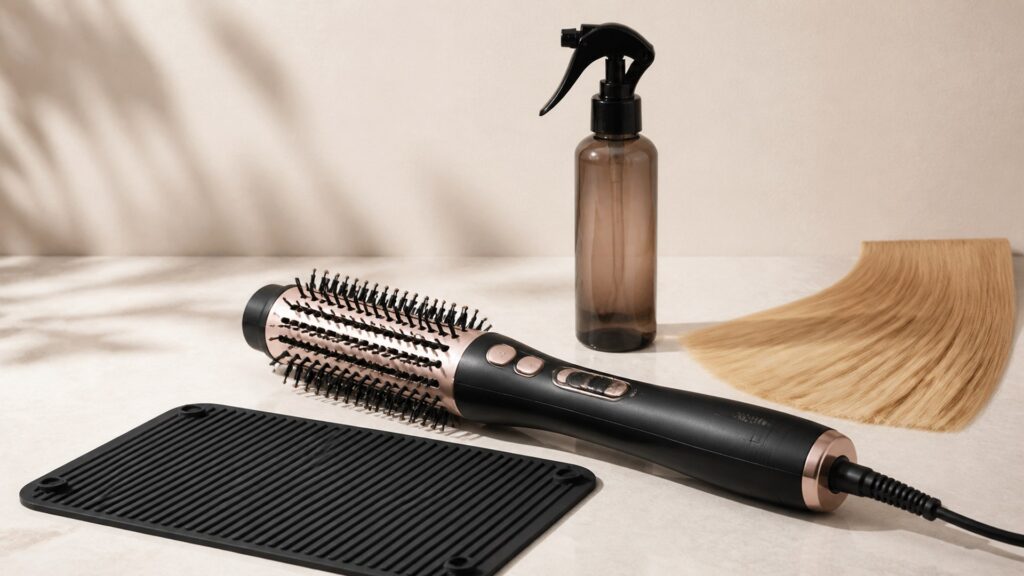
Frame the real job
Start with the result you want from a hot brush
Define the mildest acceptable result, such as neater surface texture or softly curved ends.
Write a finish brief: Count current passes on vulnerable areas.
Rehearse the sequence: The objective is to reduce unnecessary exposure, not to chase the sleekest possible transformation.
Choose a stopping rule: Write down warning signs that will end testing immediately.
Fit tool to user
Who benefits from this hot brush setup?
Color-treated, fragile, or frequently styled hair calls for particularly cautious settings.
Occasional finisher: Beginners benefit from clear controls and protected edges.
Routine stylist: Fast workers need buttons that resist accidental changes.
Technique-minded buyer: Anyone unable to sense rising housing temperature should favor strong shielding and an obvious shutoff system.
Translate the specification sheet
Features that affect heat-conscious styling
Inspect the low end of the temperature range and whether increments are understandable.
Evidence from the first session
Look for even bristle coverage, guarded hot edges, stable output, and automatic shutoff.
Evidence after repetition
A claimed protective coating cannot compensate for poor regulation, rough seams, or a high minimum setting.
Control under load: Look for even bristle coverage, guarded hot edges, stable output, and automatic shutoff.
Contact and release: A claimed protective coating cannot compensate for poor regulation, rough seams, or a high minimum setting.
Settings you can repeat: For hot brushes buying guide for heat protection, record this point during a complete session before reaching a verdict.
Avoid misleading trials
Common errors when testing for heat-conscious styling
Prepare hair exactly as both product and appliance instructions require.
Chasing the hottest result: Distribute protectant evenly without saturating heated surfaces.
Using showcase sections: Start low, keep the brush moving, and limit repetitions.
Ignoring tool boundaries: Stop after smoke, persistent steam, scorching odor, melted residue, or an unexpectedly hot handle.
Spend for demonstrated value
Choose a basic model, upgrade, or keep waiting
An upgrade is defensible when finer low-temperature control or steadier output demonstrably reduces passes.
Choose the straightforward option: Decorative displays and very high ceilings are irrelevant to protection.
Upgrade for a named constraint: A cheaper brush with predictable mild settings can be the more responsible choice for a restrained routine.
Wait when evidence is thin: For hot brushes buying guide for heat protection, record this point during a complete session before reaching a verdict.
Include life after checkout
Cleaning, storage, and safe use of a hot brush
Residue can disturb glide and heat transfer, so clean cooled surfaces as directed.
Build a cooling habit: Remove hair from bristles without damaging their mounts.
Clean without damaging parts: Examine vents, seams, cord, and plug before use.
Inspect before restarting: Retire any appliance that spikes, smells electrical, or shows damaged insulation.
Practical answers
Questions buyers ask about a hot brush for heat-conscious styling
Answers to the decisions that most often change a hot brushes buying guide for heat protection shortlist.
What matters first when choosing for Heat Protection?
How should I test the tool at home?
Does the headline feature guarantee better results?
What is a clear reason to reject or replace it?
Make the final call
Your final hot brush check
Select the brush that reaches the modest target with the least effective exposure and cleanest release.
Return to the brief: Technique and protectant remain necessary; no feature makes heat harmless.
Review the whole session: If safe settings cannot shape the hair without repetition, reconsider the tool category itself.
Record the reason: Retire any appliance that spikes, smells electrical, or shows damaged insulation.
Reading Shortcuts
Jump to the evidence you need for a heat-conscious styling decision.
Decision Reminders
Keep these hot brush checkpoints beside your shortlist.
- Desired result: Shape hair at the lowest effective exposure with fewer corrective strokes.
- Fair trial: Check temperature stability and count passes on vulnerable sections.
- Safety limit: Apply compatible heat protection, dry hair to the maker’s requirement, and keep the tool moving.
Glossary Snippets
Terms that clarify a hot brush comparison.
When a Top 10 List Helps
Use a ranked list to discover credible hot brush formats, then screen them against the heat-conscious styling routine.
- The format is undecided: A broad list reveals plausible forms and price levels.
- A shortlist is needed: Rankings narrow discovery but do not replace fit testing.
Have finalists already? Open the comparison section.
When a Direct Comparison Helps
Place finalists side by side only after confirming that each can perform the heat-conscious styling job safely.
- Two candidates remain: Side-by-side evidence exposes meaningful tradeoffs.
- An upgrade is uncertain: Compare whether added cost corrects the original weakness.
Still exploring? Start with the Top 10 section.