
Hot Brushes Buying Guide for Thick Hair
Thick hair tests a hot brush in places a quick front-section demonstration never reaches. Depth, heat recovery, and wrist comfort become obvious at the nape and through dense interior layers.
The right brush does not swallow the largest possible section. It handles a repeatable medium panel with firm but releasable engagement, allowing the user to finish the full head without fading output or mounting fatigue.
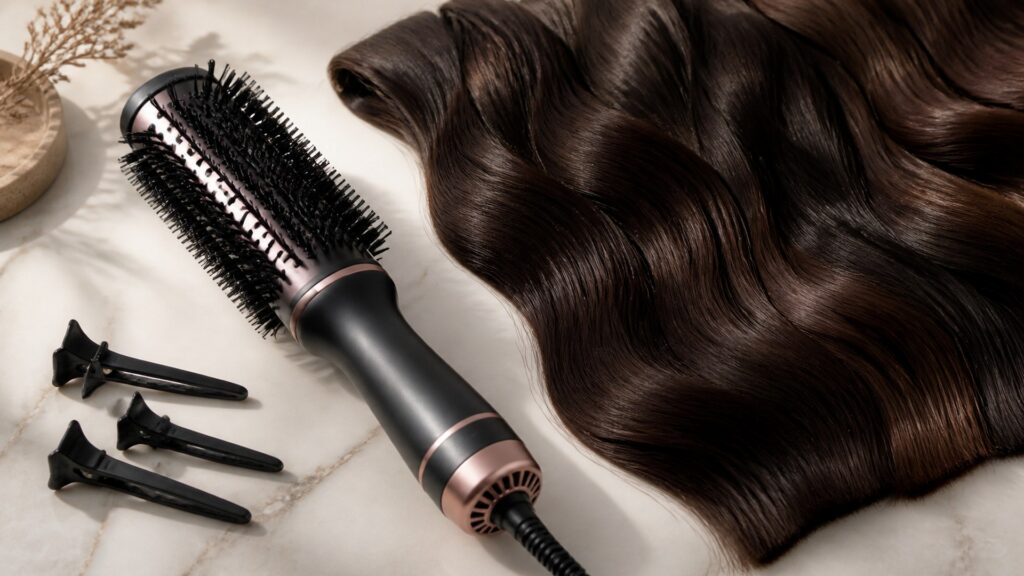
Frame the real job
Start with the result you want from a hot brush
Map density across the head and identify the slowest zones.
Write a finish brief: Decide whether you need stretching, smoothing, end shaping, or root lift.
Rehearse the sequence: Set a standard for the nape, not merely the visible top layer.
Choose a stopping rule: Count how many passes the present routine requires there.
Fit tool to user
Who benefits from this hot brush setup?
Very dense lengths favor substantial bristle depth and stable power.
Occasional finisher: Coarse short hair may need a smaller profile for root access.
Routine stylist: Long sessions magnify handle torque, so users with wrist sensitivity should practice the full motion before committing.
Technique-minded buyer: Skill does not cancel poor ergonomics.
Translate the specification sheet
Features that affect thick hair
Examine how deeply usable bristles extend, how the heated area is shielded, and how quickly output recovers after contact.
Evidence from the first session
Barrel dimensions should match the planned sections.
Evidence after repetition
Secure seams, readable settings, and a balanced grip matter more than a dramatic peak temperature.
Control under load: Barrel dimensions should match the planned sections.
Contact and release: Secure seams, readable settings, and a balanced grip matter more than a dramatic peak temperature.
Settings you can repeat: For hot brushes buying guide for thick hair, record this point during a complete session before reaching a verdict.
Avoid misleading trials
Common errors when testing for thick hair
Pre-section dense hair carefully and keep unused portions clipped away.
Chasing the hottest result: Never force a packed panel through the brush.
Using showcase sections: Begin at a conservative level, maintain movement, and let each section release before taking another.
Ignoring tool boundaries: Keep intake vents clear of loose strands and fabric.
Spend for demonstrated value
Choose a basic model, upgrade, or keep waiting
Higher cost makes sense for steady output, deeper controlled engagement, or materially better balance.
Choose the straightforward option: It does not make sense for a huge head that cannot reach the roots.
Upgrade for a named constraint: Reject bundles whose extra pieces add weight and storage while leaving dense zones unresolved.
Wait when evidence is thin: For hot brushes buying guide for thick hair, record this point during a complete session before reaching a verdict.
Include life after checkout
Cleaning, storage, and safe use of a hot brush
A thick-hair session can load bristles and vents quickly.
Build a cooling habit: Allow full cooling, remove trapped strands in small amounts, and clear airflow paths according to instructions.
Clean without damaging parts: Inspect attachment joints for movement.
Inspect before restarting: Coil the cord loosely and store the head without compressing its bristles.
Practical answers
Questions buyers ask about a hot brush for thick hair
Answers to the decisions that most often change a hot brushes buying guide for thick hair shortlist.
What matters first when choosing for Thick Hair?
How should I test the tool at home?
Does the headline feature guarantee better results?
What is a clear reason to reject or replace it?
Make the final call
Your final hot brush check
The winner should finish the challenging layers with consistent control and an acceptable number of passes.
Return to the brief: It should remain comfortable near the end of the session.
Review the whole session: If power weakens, sections jam, or the wrist compensates for poor balance, choose another design.
Record the reason: Coil the cord loosely and store the head without compressing its bristles.
Reading Shortcuts
Jump to the evidence you need for a thick hair decision.
Decision Reminders
Keep these hot brush checkpoints beside your shortlist.
- Desired result: Manage dense sections while preserving control from roots through ends.
- Fair trial: Compare section release and finish on the densest areas.
- Safety limit: Divide dense hair thoroughly and avoid forcing an oversized section through the teeth.
Glossary Snippets
Terms that clarify a hot brush comparison.
When a Top 10 List Helps
Use a ranked list to discover credible hot brush formats, then screen them against the thick hair routine.
- The format is undecided: A broad list reveals plausible forms and price levels.
- A shortlist is needed: Rankings narrow discovery but do not replace fit testing.
Have finalists already? Open the comparison section.
When a Direct Comparison Helps
Place finalists side by side only after confirming that each can perform the thick hair job safely.
- Two candidates remain: Side-by-side evidence exposes meaningful tradeoffs.
- An upgrade is uncertain: Compare whether added cost corrects the original weakness.
Still exploring? Start with the Top 10 section.