
How Air & Environmental Health Products Works

Air and environmental health products do not share one universal mechanism. A monitor estimates a condition, a filter captures selected particles, ventilation dilutes indoor sources, a dehumidifier condenses water, and a treatment device may alter a specific pathway in air or water.

The first step is to name the problem accurately. Particles, gases, excess moisture, allergens, and water contaminants behave differently. A product becomes useful only when its mechanism matches the target, its capacity matches the setting, and maintenance preserves the working pathway.

By: Review Streets Research Lab
Updated: August 13, 2026
Explainer · 8-12 min read
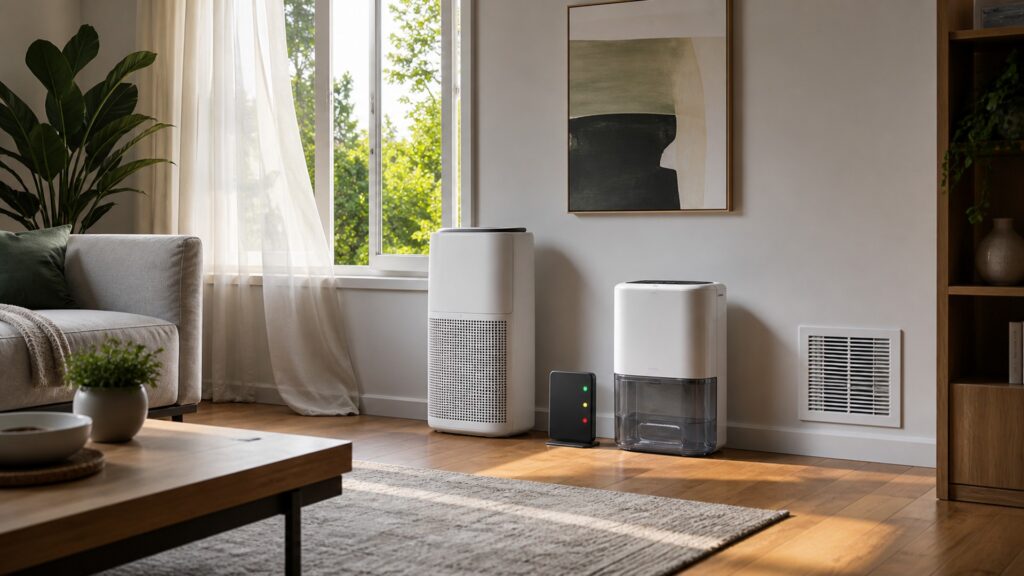
Air purifier, environmental monitor, dehumidifier, open window, and return vent in a modern living room
What You'll Learn

How Environmental Products Sense or Change Conditions

Map source control, ventilation, filtration, moisture control, monitoring, and maintenance as complementary tools.

  • The defining purpose and boundary of Air and Environmental Health Products
  • The physical or biological pathway involved
  • The variable that most changes the output
  • How conditions and maintenance affect results
  • Which Air and Environmental Health Products claims exceed the mechanism
  • How to apply the distinction in practice

Tip: Read the concept as part of a system, then connect it back to the use case.

Definitions

Key Concepts That Define Air and Environmental Health Products

These definitions connect the main idea to the variables, limits, and practical signals readers need to compare options.

Source Control

Removal, isolation, or reduction of a pollutant at its origin

  • Role of Source Control: Often prevents repeated release
  • Decision for Source Control: compare conditions only when this source control is relevant
  • Boundary for Source Control: other mechanisms and outcomes require separate evidence beyond this definition

Ventilation

Exchange of indoor and outdoor air

  • Role of Ventilation: Dilutes many indoor-generated pollutants
  • Decision for Ventilation: compare conditions only when this ventilation is relevant
  • Boundary for Ventilation: other mechanisms and outcomes require separate evidence beyond this definition

Filtration

Passage through media that captures selected material

  • Role of Filtration: Depends on efficiency and airflow
  • Decision for Filtration: compare conditions only when this filtration is relevant
  • Boundary for Filtration: other mechanisms and outcomes require separate evidence beyond this definition

Moisture Condition

The relationship among indoor water vapor, temperature, and material dampness

  • Role of Moisture Condition: Directs drying or humidity control
  • Decision for Moisture Condition: compare conditions only when this moisture condition is relevant
  • Boundary for Moisture Condition: other mechanisms and outcomes require separate evidence beyond this definition

Sensor

A component that estimates an environmental variable

  • Role of Sensor: Provides feedback rather than cleanup
  • Decision for Sensor: compare conditions only when this sensor is relevant
  • Boundary for Sensor: other mechanisms and outcomes require separate evidence beyond this definition

Treatment Capacity

The amount of air, water, or moisture a device can process over a stated interval

  • Role of Treatment Capacity: Links equipment size to environmental load
  • Decision for Treatment Capacity: compare conditions only when this treatment capacity is relevant
  • Boundary for Treatment Capacity: other mechanisms and outcomes require separate evidence beyond this definition

Tip: Keep the definitions connected; the strongest answer usually comes from the whole system, not one term.

Operating Path

How the System Produces Its Result

Start with a source or condition, then choose detection, removal, dilution, or moisture control as the pathway.

  • Identify pollutant type
  • Locate the source
  • Define the desired output

Different problems require different mechanisms.

Core Mechanism

What Performs the Main Work

Fans move air, filters capture particles, coils condense moisture, and sensors translate physical signals into estimates.

  • Check the active component
  • Separate sensing from treatment
  • Avoid unsupported multipurpose claims

The mechanism determines the relevant evidence.

Control Variable

What Changes Performance

Room volume, airflow, efficiency, runtime, outdoor conditions, and generation rate determine whether capacity is adequate.

  • Size equipment to space
  • Allow unobstructed flow
  • Run it when the source is active

A specification matters only in context.

Failure Modes

Where Results Become Misleading

Leaks, dirty filters, full tanks, poor placement, sensor drift, and new pollutant sources can defeat expected performance.

  • Maintain on schedule
  • Inspect airflow paths
  • Verify unusual readings

Environmental control is an operating process, not a one-time purchase.

Use Case

How to Match the Tool to the Need

Use source control first where feasible, then clean-air ventilation and filtration or moisture control as appropriate supplements.

  • Target the actual pollutant
  • Avoid intentional ozone generation
  • Combine compatible layers

A layered plan is stronger than expecting one box to solve every condition.

Quick Reality Check

A Layered Indoor Environment Strategy

A buyer-first boundary for Air and Environmental Health Products between direct performance and claims requiring more context or evidence.

Where It Works

Well-matched products can measure selected conditions, reduce particular particles, dilute indoor emissions, or manage moisture.

Monitoring can show whether an intervention changes the relevant variable over time.

Where It Stops

No portable device removes every pollutant or replaces source control and appropriate ventilation.

A consumer environmental reading does not diagnose a person's symptoms or prove a particular exposure caused them.

Common Myths

Misconceptions About Air and Environmental Health Products

Common shortcuts and misunderstandings can make the topic seem simpler than it is.

One environmental device can clean every indoor pollutant

Particles, gases, moisture, biological growth, and water contaminants require different mechanisms. A filter effective for airborne particles may do little for gases or humidity, so broad all-in-one claims need careful examination.

If a sensor detects a problem it also fixes it

Monitoring converts a physical or chemical signal into a reading or estimate. It can guide action, but it does not remove a source, exchange air, capture particles, or condense moisture by itself.

The highest setting is always the best setting

More airflow or treatment can improve one metric while increasing noise, energy use, drafts, dryness, or maintenance. The useful setting balances adequate performance with conditions that allow consistent operation. Evidence should match the stated purpose.

Environmental products require no upkeep after installation

Filters load, tanks fill, sensors drift, coils become dirty, seals leak, and water-contact surfaces can accumulate residue. Maintenance is part of the mechanism because neglected components change airflow, accuracy, and hygiene.

Tip: Treat strong claims as starting points for comparison, not final answers.

FAQ

Frequently Asked Questions About Air and Environmental Health Products

Concise answers to common questions readers may have after the main explanation.

Should source control or an air cleaner come first?

Source control is often the strongest first step because it prevents continued release. When removal is impossible, clean-air ventilation and appropriately selected filtration can supplement control according to pollutant type and outdoor conditions.

Can one monitor identify every air-quality problem?

No. Sensors target selected variables and may infer broad categories with cross-sensitivity and accuracy limits. A device that reports particles, carbon dioxide, or volatile compounds does not necessarily detect every hazardous pollutant.

How does room size affect environmental products?

A larger room contains more air and may require greater airflow, extraction, or treatment capacity. Open doors, ceilings, floor plans, pollutant generation, and outdoor exchange also alter the effective volume and result.

Why does placement matter so much?

Walls, furniture, windows, vents, kitchens, bathrooms, direct sunlight, and local sources can distort airflow or readings. Follow clearance instructions and place monitors where measurements represent the decision you need to make.

Bottom Line

Environmental products work by measuring or changing a defined condition—not by creating generic healthy air or water.

Identify the source and pollutant, use the matching mechanism at adequate capacity, maintain it, and combine source control, ventilation, filtration, or moisture management where appropriate.

Next Steps

Go Deeper or Compare Your Options

Use these Review Streets paths to connect the explainer to related categories, comparisons, and next decisions.

Why HEPA Filtration Matters

HEPA media captures a very high share of particles passing through it, but room performance also depends on how much air reaches the filter, whether air bypasses it, how long the unit runs, and whether its capacity fits the space.