
How Automatic Pill Dispensers Works

Automatic Pill Dispensers products release a preloaded medication compartment at scheduled times and provide local alarms, reducing access to other doses while depending on correct filling, programming, power, user response, and a current medication plan.

The sections below investigate the operating sequence. It uses dose compartment, lockout, and release window to explain what changes the outcome, where uncertainty enters, and which response is proportionate.

By: Review Streets Research Lab
Updated: August 18, 2026
Explainer · 8-12 min read
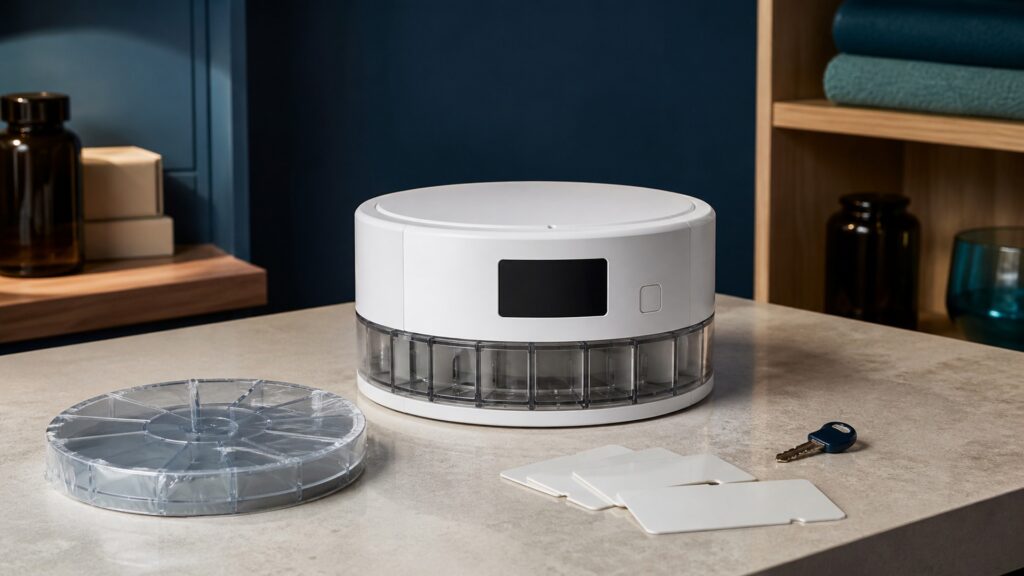
People-free editorial still life illustrating verified medication plan loaded compartments internal clock scheduled alignment lockout alarm dose release acknowledgement and refill
What You'll Learn

Follow Automatic Pill Dispensers from Preparation to Output

Consider dose compartment, release window, the working environment, failure scenarios, and a proportionate response without allowing a label to substitute for analysis.

  • How dose compartment defines the first decision
  • Why lockout changes the working pathway
  • Where release window may become a source of variation
  • Which conditions alter fill verification
  • What backup power signals for maintenance and the next review
  • When contingency plan signals a limit or next action

Tip: Read the concept as part of a system, then connect it back to the use case.

Definitions

Six Concepts That Shape This Decision

These definitions connect the main idea to the variables, limits, and practical signals readers need to compare options.

Dose Compartment

Section holding one scheduled medication set.

  • Role: In the present context, dose compartment starts the sequence.
  • Check: For dose compartment, locate this concept in the official directions.
  • Boundary: It cannot correct a category mismatch.

Lockout

Restriction preventing early access.

  • Role: Before operation begins, lockout controls delivery.
  • Check: For lockout, observe it during a routine trial before options are scored.
  • Boundary: A positive condition by itself cannot prove the final outcome.

Release Window

Time when a dose becomes available.

  • Role: While the product is working, release window marks the active step.
  • Check: For release window, record any technique or condition that changes its behavior.
  • Boundary: Interpretation still depends on the surrounding steps.

Fill Verification

Independent check of loaded medicines.

  • Role: During result review, fill verification describes the output.
  • Check: For fill verification, relate it to the immediate result rather than an unsupported generalization.
  • Boundary: Different needs may change its practical importance.

Backup Power

Energy source during an outage.

  • Role: During an unexpected situation, backup power reveals a performance limit.
  • Check: For backup power, inspect it when the result is unusual or operation fails.
  • Boundary: Visible normality does not eliminate failure risk.

Contingency Plan

Instructions for device failure or travel.

  • Role: When choosing the response, contingency plan closes the operating loop.
  • Check: For contingency plan, include it in the maintenance and follow-up plan.
  • Boundary: It never replaces an appropriate response to warning signs.

Tip: Keep the definitions connected; the strongest answer usually comes from the whole system, not one term.

Purpose

Define the Intended Output Before Following the Parts

For the operating sequence, the intended user and direct result need to be explicit before secondary features are considered. Dose Compartment defines the starting point, while lockout helps show whether the product is being judged for the job it was designed to perform.

  • Clarify missed-dose handling
  • Document battery backup
  • Check clock accuracy
  • Define travel constraints

Dose Compartment is useful only when it answers the stated purpose.

Mechanism

Trace Dose Compartment, Lockout, and Release Window

Dose Compartment means section holding one scheduled medication set. Lockout affects the next part of the process: restriction preventing early access. The pathway then reaches release window, meaning time when a dose becomes available.

  • Locate dose compartment in the instructions
  • Observe how lockout changes operation
  • Treat release window as a defined step
  • Relate fill verification to the first-order output

Looking at operation identifies where fill verification can change the result.

Conditions

Compare the Factors Behind Fill Verification

A useful evaluation holds these factors in view: caregiver refill responsibility; pharmacist review; medicine identity and schedule; compartment capacity; and dose times. Multiple changes at one time cloud whether whether fill verification or the setup produced the result.

  • Hold lockout design steady
  • Label fill accuracy
  • Recheck alarm audibility and duration
  • Preserve context for backup power

Comparable conditions make the operating sequence easier to interpret without pretending uncertainty disappears.

Limits

Plan for Problems Involving Backup Power

The safety plan should cover these actions: maintain a manual contingency plan; contact a pharmacist about discrepancies or device failure; follow the intended-use boundary; inspect before operation; and use the least intensive suitable setting. If the step associated with backup power breaks down or the user's condition changes, a seemingly normal output should not delay the response called for.

  • Stop when the response differs from expectations
  • Protect children and private information
  • Have a qualified person verify the current list and fill plan
  • Follow the contingency plan when problems involve contingency plan

The safety boundary for the operating sequence includes failure, misuse, and warning signs.

Routine

Make Contingency Plan Part of a Sustainable Process

The recurring workflow should cover these steps: perform the practical task in sequence; check clock power and next dose; confirm the tray is seated and locked; respond to the alarm; remove only the released dose; and record taken or missed status. Other routine actions are: inspect remaining supply without changing the plan; and recharge or replace batteries. The routine should preserve review steps set for the user.

  • Perform scheduled verified refills
  • Check condition before use
  • Prepare compatible supplies
  • Confirm settings and power

The best routine for the operating sequence is the simplest sustainable approach with acceptable reliability.

Quick Reality Check

A Practical Boundary for the operating sequence

Use dose compartment and fill verification to separate a conclusion justified by a broader claim the product cannot prove by itself.

Reasonable Findings

A suitable application can demonstrate how dose compartment affects lockout under this product's documented conditions.

A consistent review of release window and fill verification can reveal whether the near-term job remains practical over time.

What Still Requires Caution

The device does not turn backup power into proof of why a problem exists or make contraindications disappear.

A failure involving contingency plan needs the response established for the user instead of continuing an unreviewed trial.

Common Myths

Misconceptions That Distort the Decision

Common shortcuts and misunderstandings can make the topic seem simpler than it is.

Lockout works identically in every design

Lockout contributes one input to the operating sequence. That definition is too narrow to support the claim. A careful reading incorporates battery backup. A safe-use plan should also contact a pharmacist about discrepancies or device failure.

Release Window proves the cycle achieved its goal

Release Window describes a control within the operating sequence. The description does not justify that conclusion. Any conclusion must include clock accuracy. The user may also need to follow the intended-use boundary.

Fill Verification always improves at the highest setting

Fill Verification marks an intermediate step in the operating sequence. Its role in the pathway is more limited than the myth suggests. The answer also depends upon travel constraints. The applicable precaution is to inspect before operation.

Backup Power never changes with maintenance

Backup Power sets one boundary around the operating sequence. A correct setup still cannot control every variable. The conclusion cannot omit caregiver refill responsibility. Responsible follow-through should use the least intensive suitable setting.

Tip: Treat strong claims as starting points for comparison, not final answers.

FAQ

Questions to Ask Before Choosing

Concise answers to common questions readers may have after the main explanation.

What should be checked first for fill verification?

Fill Verification enters at the start of the operating sequence. Start by reviewing pharmacist review. The daily routine should also check clock power and next dose. The applicable precaution is to use the least intensive suitable setting.

How can the result be interpreted for backup power?

Backup Power changes a control point in the operating sequence. Interpret the observation alongside medicine identity and schedule. The daily routine should also confirm the tray is seated and locked. The escalation plan should also stop when the observed response is not anticipated.

Which condition commonly changes performance for contingency plan?

Contingency Plan affects the observable output from the operating sequence. Compare performance only after recording compartment capacity. The daily routine should also respond to the alarm. Before continuing, remember to protect children and private information.

When should use stop or receive review for dose compartment?

Dose Compartment helps define the stopping point for the operating sequence. Before continuing use, confirm dose times. The daily routine should also remove only the released dose. This boundary requires users to have a qualified person verify the current list and fill plan.

Bottom Line

Judge the operating sequence through dose compartment, release window, and the real conditions surrounding backup power.

A sound decision keeps lockout visible, builds fill verification into the repeated process, and responds promptly when contingency plan or another defined warning condition appears.

Next Steps

Go Deeper or Compare Your Options

Use these Review Streets paths to connect the explainer to related categories, comparisons, and next decisions.

Quick Summary

Practical Takeaways

  • Dose Compartment frames the first practical question.
  • Lockout helps explain the working mechanism.
  • Measurement context includes missed-dose handling.
  • Safety planning includes this rule: maintain a manual contingency plan.
  • Reliable follow-through includes this action: perform the hands-on job in sequence.