
Drum Shell
The rotating cylindrical surface attached to the wheel hub.
- Role: Provides the inner friction surface
- Check: Diameter, scoring, and heat marks
- Limit: Oversized drums reduce proper contact
Brake drums work by enclosing curved brake shoes inside a rotating metal drum. When hydraulic pressure moves the wheel cylinder, the shoes expand outward and press their friction linings against the inside of the drum.
That enclosed design changes how force, heat, dust, adjustment, and parking-brake hardware behave. Understanding the sequence helps readers see why drums can last a long time in some rear-brake uses, yet still need careful inspection of springs, adjusters, wheel cylinders, and shoe contact.
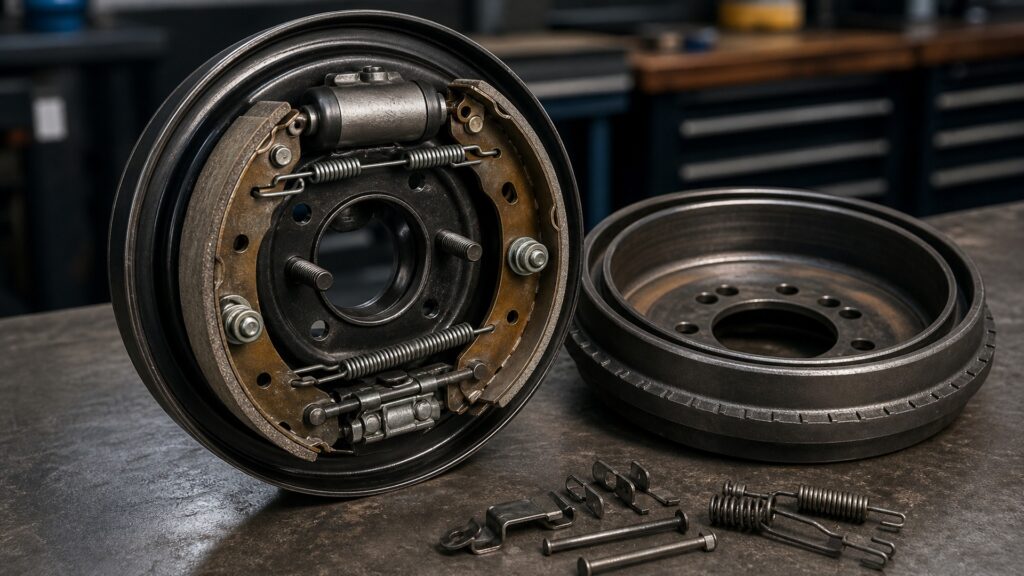
A clear explanation of brake drums, focused on role, mechanism, fit, service limits, and repair decisions.
Tip: Read the concept as part of a system, then connect it back to the use case.
These definitions connect the main idea to the variables, limits, and practical signals readers need to compare options.
The rotating cylindrical surface attached to the wheel hub.
Curved friction pieces that press outward into the drum.
The hydraulic actuator that pushes the shoes apart.
Springs that pull shoes back after braking.
The threaded mechanism that maintains shoe-to-drum clearance.
Fixed contact areas that locate shoes and react against braking force.
Tip: Keep the definitions connected; the strongest answer usually comes from the whole system, not one term.
The drum-brake sequence starts with hydraulic pressure and ends with shoe lining pressed against the drum's inner surface.
A drum brake works by outward expansion inside a rotating shell.
As the drum rotates, shoe geometry can help pull a leading shoe into stronger contact. That self-energizing effect is useful, but it also makes adjustment and hardware condition important.
Drum geometry influences feel as well as stopping force.
Drum shoes need a small clearance from the drum. Too much clearance increases travel; too little clearance creates drag and heat.
Clearance is a quiet but central drum-brake setting.
Because the friction surface is inside the drum, heat and dust are less exposed to airflow than on many disc brakes.
The enclosure is useful for packaging but changes heat behavior.
Drum-brake issues often hide until the drum is removed or symptoms become obvious. Inspection has to include the whole internal hardware set.
A drum inspection is an internal system inspection.
The operating sequence explains why drum brakes feel different from disc brakes and why inspection happens inside the shell.
It shows why shoes, springs, adjusters, and wheel cylinders must be inspected together.
It explains why clearance and return action change pedal travel and drag.
It does not identify the exact failed part without opening and measuring the assembly.
It does not mean every drum system behaves the same under load.
Common shortcuts and misunderstandings can make the topic seem simpler than it is.
The drum is the rotating friction surface that the shoes press against.
Return springs control release and can create drag when weak or installed incorrectly.
Automatic adjusters can seize, wear, or be assembled incorrectly.
Leaks, thin lining, or frozen adjusters can hide until inspection.
Tip: Treat strong claims as starting points for comparison, not final answers.
Concise answers to common questions readers may have after the main explanation.
The wheel cylinder pushes the shoes outward when hydraulic pressure rises.
Springs pull the shoes away from the drum after pressure drops.
It keeps shoe clearance close enough to limit pedal travel as the lining wears.
The working parts are enclosed, so the drum usually has to come off for a full view.
Yes. Weak springs, poor adjustment, shoe binding, or parking-brake issues can keep shoes rubbing.
Brake drums work through outward shoe expansion inside a rotating shell.
The practical takeaway is to inspect the full internal mechanism, because shoes, springs, adjusters, and the drum surface all shape the result.
Use these Review Streets paths to connect the explainer to related categories, comparisons, and next decisions.
Use the Automotive Replacement Parts path for related brake component explainers and comparisons.
Use the Brake Components path for related brake component explainers and comparisons.
Use the Brake Drums path for related brake component explainers and comparisons.
Choose a retailer
Prices checked regularly. We may earn a commission at no cost to you.