
Abutment Clip
A metal contact surface where disc pad ears slide.
- Role: Reduces pad binding
- Check: Rust under clips
- Limit: Must match bracket shape
Brake hardware kits work by renewing the small parts that position, guide, return, or quiet brake friction components. In a disc brake, that may mean abutment clips, guide boots, shims, or anti-rattle pieces; in a drum brake, it may mean springs, retainers, adjusters, and clips.
The kit does not create braking force by itself. Its job is to make pads or shoes move the way the main brake design expects, so friction parts do not bind, rattle, drag, or wear unevenly.
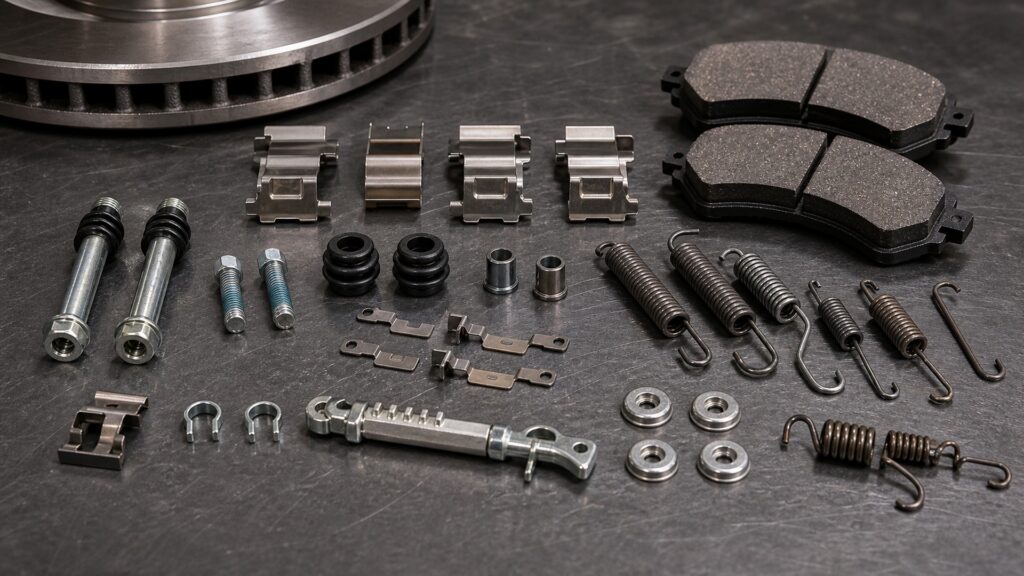
A practical explanation of brake hardware kits for brake-component comparison and service decisions.
Tip: Read the concept as part of a system, then connect it back to the use case.
These definitions connect the main idea to the variables, limits, and practical signals readers need to compare options.
A metal contact surface where disc pad ears slide.
A rubber cover protecting caliper guide pins.
A spring or clip that controls pad or shoe noise.
A drum-brake part that keeps shoes against the backing plate.
A threaded drum component that maintains shoe clearance.
A thin layer used behind pads to manage vibration or contact.
Tip: Keep the definitions connected; the strongest answer usually comes from the whole system, not one term.
Brake hardware sits between the major parts and the friction material.
Hardware controls motion around the braking force.
Disc kits often help pads slide and calipers float without binding.
Small disc hardware determines whether pads move freely.
Drum kits manage shoe position inside a hidden assembly.
Drum hardware is a movement system.
Worn hardware can make new friction parts drag or sit crooked.
Hardware can decide how long the brake job lasts.
A kit only helps when each piece matches the brake design and is installed in the right position.
Correct installation turns small parts into useful control.
Hardware kits help when support parts, not major hydraulic or friction surfaces, are the issue.
They explain why small clips and springs matter during brake service.
They help separate movement support from caliper, drum, rotor, or shoe replacement.
They cannot repair leaking hydraulics or damaged drums.
They cannot compensate for wrong pads, shoes, or brackets.
Common shortcuts and misunderstandings can make the topic seem simpler than it is.
They support movement and retention; they do not increase clamp force by themselves.
Old clips can be distorted or backed by rust that binds pads.
Spring shape and tension are specific to the assembly.
Noise can also come from pads, shoes, rotors, drums, calipers, or installation.
Tip: Treat strong claims as starting points for comparison, not final answers.
Concise answers to common questions readers may have after the main explanation.
It can include clips, boots, pins, springs, retainers, shims, or adjuster parts depending on the brake design.
They can help when noise comes from loose or binding hardware, but they are not a universal noise cure.
No. Disc kits usually support pads and calipers; drum kits manage shoes, springs, and adjusters.
Often it should be inspected closely because worn hardware can shorten the life of new friction parts.
No. Leaks require hydraulic repair or replacement.
Brake hardware kits work by managing movement, retention, adjustment, and noise around the friction parts.
The practical takeaway is that small parts are not decorative; they keep pads and shoes working in the right path.
Use these Review Streets paths to connect the explainer to related categories, comparisons, and next decisions.
Explore related Review Streets coverage in Automotive Replacement Parts.
Explore related Review Streets coverage in Brake Components.
Explore related Review Streets coverage in Brake Hardware Kits.
Review drum brake parts and service decisions.
Choose a retailer
Prices checked regularly. We may earn a commission at no cost to you.