
Telephone Number
A routable public identifier assigned through a carrier and mapped to a business call destination.
- Inbound: directs callers toward service
- Outbound: presents authorized identity
- Porting: moves assignment between carriers
A business phone system is the combination of call-control software, user and device identities, endpoints, routing rules, public telephone connectivity, media services, administration, and records that turns a dialed destination into a managed conversation. It decides who should ring, when to redirect, which carrier path to use, and what happens when nobody answers.
The system carries two related flows. Signaling establishes, changes, and ends a call; media carries the participants' audio after capabilities and paths are negotiated. Features such as auto attendants, queues, hunt groups, forwarding, voicemail, recording, conferencing, and reporting modify those flows. Reliable operation also depends on numbers, emergency locations, power, local networks, internet or trunks, security at the voice edge, and tested alternatives when a component fails.
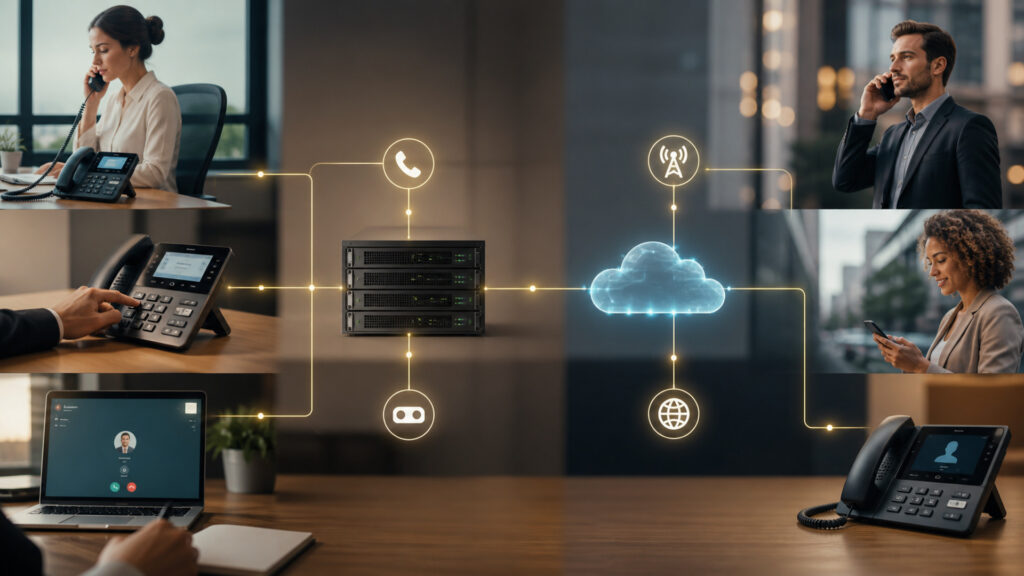
Trace identities, signaling, routing, endpoint negotiation, media, carrier interconnection, applications, records, emergency handling, and continuity.
Tip: Trace one inbound, outbound, internal, transferred, queued, voicemail, and emergency call. Record the signaling path, media path, identity, number, policy, endpoint, carrier, logs, and behavior when each dependency is unavailable.
These terms describe the identities, control messages, real-time streams, carrier edges, and applications involved in a managed business call.
A routable public identifier assigned through a carrier and mapped to a business call destination.
An internal dialing identity associated with a user, device, location, function, or application.
Messages that request, route, alert, answer, modify, transfer, and end a communication session.
The real-time flow carrying encoded audio or video between endpoints or media services.
A logical IP connection providing call sessions between a business voice environment and a carrier or another system.
A voice-edge system that mediates signaling and media across trust or network boundaries.
Tip: Do not troubleshoot a call as one path. Signaling may reach a cloud controller while audio flows directly between endpoints, through a carrier, or through a media relay; each can fail independently.
The endpoint normalizes digits or resolves a directory identity, authenticates the user or device, and sends signaling to call control. The system checks permissions, number plans, time schedules, availability, and routing policy.
Call setup matters because a telephone number is not the final endpoint; policy must translate public or internal identity into an authorized, reachable destination.
Inbound rules can apply schedules, menus, language, priority, caller context, and agent availability. Internal calls may ring a user across desk phone, softphone, or mobile endpoints, then forward or enter voicemail.
Call control converts business availability rules into state transitions, so callers receive a deliberate outcome rather than endless ringing or an unexplained disconnect.
Endpoints advertise compatible codecs and network information. Once answered, audio is sampled, encoded, packetized or carried through a circuit, transmitted, buffered, decoded, and played. Media may take a different route from signaling.
A call can signal perfectly and still sound poor because successful setup proves control reachability, not the quality or symmetry of the media path.
A gateway, SBC, SIP trunk, or traditional circuit connects business call control with a carrier and the public switched telephone network. Number ownership, caller identity, fraud controls, capacity, and interoperability meet at this edge.
The public voice edge matters because internal extensions become externally reachable numbers only through carrier routing, contractual assignment, and compatible signaling and media exchange.
Call detail records capture signaling metadata; recordings capture content where authorized; voicemail stores messages; emergency configuration associates callers with dispatchable location. Continuity rules redirect service when platforms, sites, circuits, or power fail.
A phone system is operationally complete only when exceptional calls, evidence, privacy, location, recovery, and caller communication receive the same design attention as normal conversations.
The system can route and record calls while endpoints, networks, carriers, power, people, and public services determine the final outcome.
It centralizes identities, permissions, routing, device registration, features, carrier paths, records, administration, and consistent caller treatment.
It can also expose APIs and context to service workflows.
Audio quality depends on capture devices and transport, while human response depends on staffing, training, schedules, and process.
Carrier reachability, emergency handling, local power, internet, and upstream platforms remain distinct dependencies.
These shortcuts blur signaling, media, carriers, endpoints, and business routing into one undifferentiated telephone service.
A business number can route to an auto attendant, queue, group, user, application, mobile endpoint, voicemail, or external destination. Call-control rules determine the current treatment behind the public identifier today.
Ringing proves that enough signaling completed to alert an endpoint. The audio stream may use different addresses, ports, relays, codecs, and routes, so one-way sound, delay, loss, or silence can still occur.
Cloud call control still relies on endpoints, local power, LAN or Wi-Fi, addressing, DNS, security, internet access, headsets, and often emergency-location data. Removing a local PBX does not remove the local service path.
Recording changes privacy, notice, consent, access, encryption, retention, discovery, monitoring, and deletion duties. It can also fail independently of the call, so organizations must verify recording state and governance rather than assume completeness.
Tip: Diagnose by call phase: identity resolution, authentication, route selection, alerting, answer, codec negotiation, media flow, feature transition, carrier exchange, teardown, record creation, and business follow-up.
These questions explain components, capacity, call paths, public numbers, emergency configuration, and failure handling.
Typical components include call control, identities, numbers, endpoints, routing policy, media services, carrier trunks or circuits, administration, network and power, security, voicemail, records, and emergency location. Exact architecture varies by deployment.
Capacity can be limited by licenses, SIP trunk sessions, circuits, SBCs, codecs, bandwidth, firewalls, media relays, recording resources, contact-center services, endpoints, and carrier policy. Busy-hour concurrency matters more than employee count alone.
Signaling can complete while media addresses, ports, NAT translation, firewall state, routing, encryption, or SBC negotiation fail in one direction. Capture signaling and media evidence at boundaries instead of repeatedly changing handsets.
Number porting transfers routing authority between carriers through an authorized process. Inventory numbers, account records, service addresses, emergency data, dependencies, dates, temporary routing, validation calls, rollback options, and old-service cancellation carefully.
Follow applicable law and provider capabilities. Associate users and movable endpoints with accurate dispatchable locations, enable direct access, transmit callback identity, notify designated personnel where required, and test through approved non-emergency procedures.
Plan for endpoint, switch, power, internet, carrier, trunk, controller, identity, DNS, and site loss. Define alternate routing, mobile access, emergency behavior, caller announcements, capacity, administration, restoration, and reconciliation of missed communications.
Business phone systems work by translating numbers and extensions into signaling decisions, routing sessions to endpoints or applications, carrying negotiated media, and interconnecting off-network calls through carriers and the public telephone system.
A complete design also governs identities, permissions, queues, voicemail, records, emergency location, fraud, quality, power, network paths, and failure behavior. Signaling success, audio quality, caller outcome, and business recovery are separate results to verify.
These explainers deepen the real-time IP mechanism, the coordination of calling with other channels, and the operational boundary between cloud and customer-run call control.
Follow audio encoding, packets, delay, jitter, loss, QoS, NAT traversal, and media security across IP networks.
See how presence, messaging, meetings, calling, identity, and workflow context are coordinated across channels.
Compare call-control location, carrier boundary, administration, failure behavior, lifecycle, security, cost, and fit.
Choose a retailer
Prices checked regularly. We may earn a commission at no cost to you.