
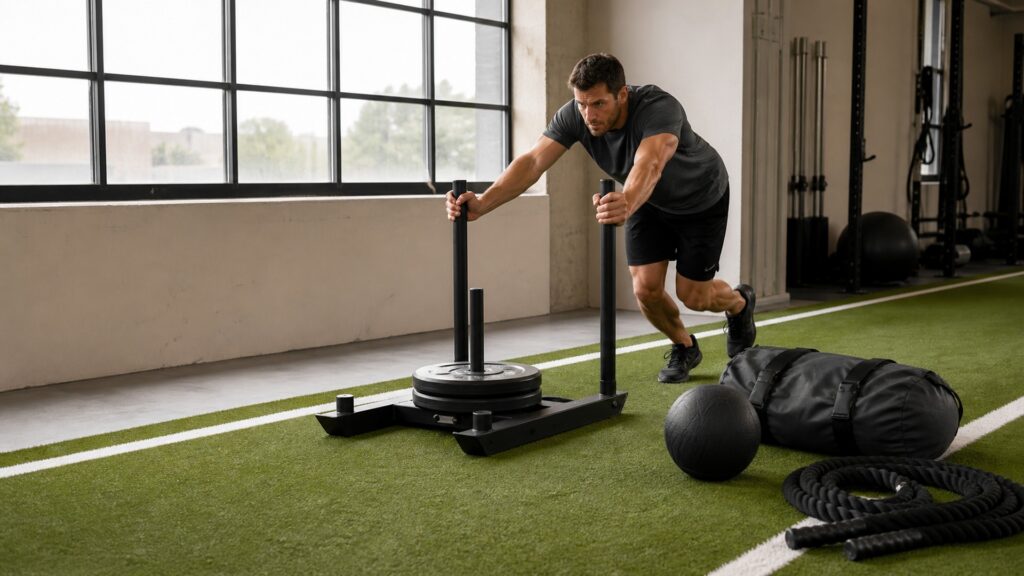
How Functional Training Equipment Works

Functional training equipment works by loading or guiding practical movement patterns. Instead of isolating one narrow machine path, these tools usually train actions such as pushing, pulling, squatting, hinging, carrying, rotating, bracing, jumping, throwing, dragging, or balancing.

The category can include kettlebells, resistance bands, medicine balls, sandbags, cables, sleds, boxes, suspension straps, battle ropes, balance tools, and bodyweight stations. Each tool changes resistance, range, speed, stability, or coordination in a different way.

By: Review Streets Research Lab
Updated: October 2, 2026
Explainer · 8-12 min read
functional training equipment explainer hero image for Review Streets
What You'll Learn

How Functional Equipment Changes Movement

A practical explanation of load, resistance direction, stability, range, and progression in functional training tools.

  • How functional tools load movement patterns
  • Why resistance direction matters
  • Where stability and range change the exercise
  • How different tools support power, strength, mobility, or conditioning
  • Why setup and progression matter more than tool variety

Tip: Judge functional training equipment by the movement it improves and the progression it supports.

Definitions

Key Concepts Behind Functional Training Equipment

These concepts explain how different tools create practical training effects.

Movement Pattern

A movement pattern is a basic action such as pushing, pulling, squatting, hinging, carrying, rotating, or bracing.

  • Example: a kettlebell deadlift training a hinge pattern
  • Check: name the pattern before choosing the tool
  • Limit: a pattern label does not guarantee good setup

External Load

External load is resistance added by a tool outside the body.

  • Example: a kettlebell, medicine ball, sandbag, sled, or cable stack
  • Check: match load to skill and goal
  • Limit: heavier is not always better

Resistance Direction

Resistance direction is the line of pull, push, drag, or tension the tool creates.

  • Example: a band pulling backward during a press
  • Check: make sure resistance matches the exercise goal
  • Limit: awkward direction can distort movement

Stability Demand

Stability demand is the amount of balance and control the exercise requires.

  • Example: a sandbag carry requiring trunk control
  • Check: increase instability gradually
  • Limit: too much instability can reduce useful strength work

Power And Conditioning

Power and conditioning tools support faster or repeated efforts.

  • Example: medicine ball throws, sled pushes, or battle ropes
  • Check: manage volume and recovery
  • Limit: fatigue can hide poor technique

Progression

Progression is the planned increase or refinement of difficulty over time.

  • Example: adding load, distance, speed, range, or complexity
  • Check: change one main variable at a time
  • Limit: random variety is not progression

Tip: Functional equipment works best when the tool, movement pattern, and progression path fit together.

Movement

The Tool Starts With A Movement Pattern

Functional training equipment is most useful when it supports a clear pattern. The tool should make the push, pull, hinge, squat, carry, brace, or rotation easier to train.

  • Choose kettlebells or sandbags for carries and hinges.
  • Choose bands or cables for directional resistance.
  • Choose medicine balls for throws and power.

The movement pattern gives the tool its purpose.

Resistance

Different Tools Load The Body Differently

A kettlebell, band, cable, medicine ball, and sled can all train useful movement, but each creates a different type of resistance.

  • Free load responds to gravity.
  • Bands add elastic tension.
  • Cables guide resistance through a set line.

The resistance type should match the goal.

Control

Stability And Range Shape The Challenge

Functional tools often require more control than fixed machines. That can be useful, but only when the user can maintain safe positions.

  • Start with stable versions first.
  • Add range gradually.
  • Avoid instability that hides the target movement.

Control makes the movement trainable.

Conditioning

Some Tools Add Speed And Repeat Effort

Sleds, ropes, medicine balls, and circuits can train conditioning or power. These tools need sensible volume so fatigue does not ruin the movement.

  • Keep power work crisp.
  • Use rest periods that fit the goal.
  • Stop when technique breaks down.

Fast or repeated work still needs quality control.

Progression

A Good Setup Makes Progress Trackable

Functional equipment can invite endless variation. Useful training requires a clear progression variable such as load, reps, distance, range, speed, or complexity.

  • Track the variable that matters.
  • Avoid changing everything at once.
  • Repeat enough to measure improvement.

Progression turns a tool collection into a training system.

Quick Reality Check

Where Functional Equipment Helps And Where It Has Limits

Functional tools are useful when they match a real movement goal.

Where It Helps

It trains practical movement patterns with varied resistance options.

It can support strength, power, mobility, balance, and conditioning.

Where It Falls Short

It can become random variety without progression.

Some goals still need machines, coaching, or more precise loading.

Common Myths

Misconceptions About Functional Training Equipment

The label does not automatically make a tool useful.

Functional means every exercise is practical

A tool is practical only when it supports the user's goal and movement quality.

More tools make a better setup

A smaller set with clear roles can beat a cluttered collection.

Instability always improves function

Instability helps only when the user can control the target movement.

Conditioning tools do not need technique

Fast or repeated work still needs safe mechanics.

Tip: Functional equipment should make training clearer, not just more varied.

FAQ

Frequently Asked Questions About Functional Training Equipment

Short answers about load, movement patterns, and equipment choice.

What makes equipment functional?

It supports practical movement patterns and has a clear role in the training plan.

Which tool should beginners start with?

Beginners should start with tools that are easy to control and progress, such as bands, light kettlebells, or simple bodyweight supports.

Does functional equipment replace machines?

Not always. Machines can still be useful for controlled loading or specific goals.

How do I avoid random workouts?

Pick a movement pattern, choose the tool that fits, and track one progression variable at a time.

What is the practical takeaway?

Functional training equipment works by matching useful movement patterns with suitable resistance and progression.

Bottom Line

Functional training equipment works by loading practical movement patterns in different ways.

The best tools match the user's goal, resistance needs, control level, space, and progression path.

Next Steps

Go Deeper or Compare Your Options

Use these Review Streets paths to compare related categories and practical next decisions.