
Surfactant System
A blend that helps water lift oil, particles, and product from scalp and hair.
- Use: choose cleansing strength
- Variable: blend, dose, and wash frequency
- Tradeoff: More removal may mean more roughness
Hair care products work by changing soil removal, water exposure, surface friction, fiber alignment, static, film deposition, and styling behavior. Shampoo mainly cleans scalp and hair through a surfactant system; conditioners and treatments leave selected ingredients behind to improve slip, softness, manageability, and appearance.
Those effects occur mostly on hair that has already emerged from the scalp. A product can reduce friction or temporarily reinforce a damaged-feeling surface, but it cannot restore a weathered fiber to untouched biological tissue. Results depend on scalp needs, curl pattern, strand diameter, porosity, chemical history, water quality, dose, placement, rinsing, and the next wash. The useful routine is a repeatable cycle, not a collection of isolated miracle ingredients.
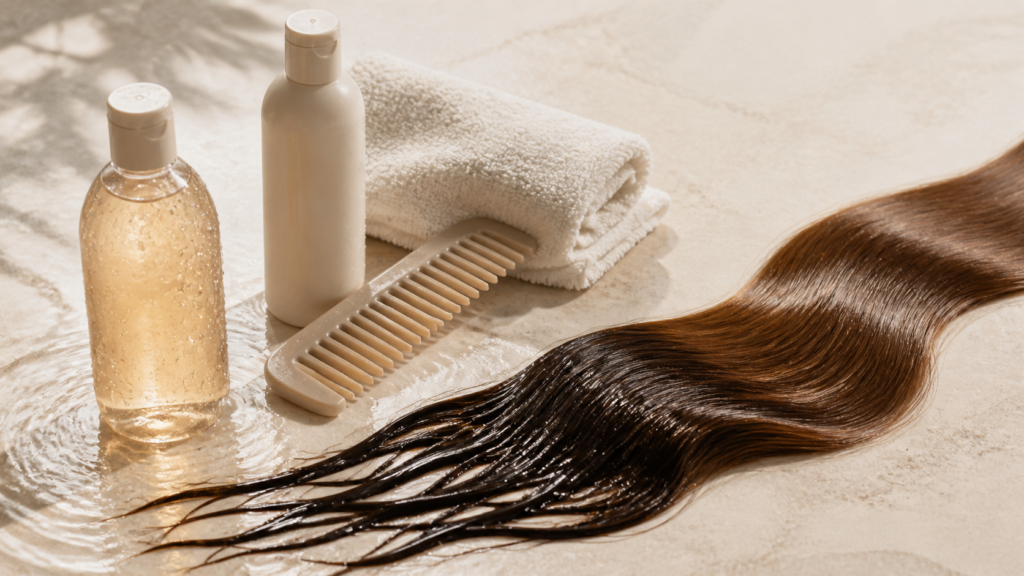
Follow products from scalp and wet fiber through cleansing, conditioning, deposition, drying, styling, buildup, and wash-cycle reset while separating cosmetic improvement from biological growth claims.
Tip: A modern shampoo is a system, not one hero detergent.
These hair care products concepts separate formula behavior, application choices, limits, and purchasing consequences before the mechanisms are compared.
A blend that helps water lift oil, particles, and product from scalp and hair.
Ingredients left on or attracted to the hair surface after application and rinsing.
Resistance where overlapping outer scales and neighboring fibers rub.
How readily different areas take up and release water and products.
Accumulation that changes feel, appearance, or response across wash cycles.
Temporary improvement in strength-related behavior, smoothness, or appearance without recreating virgin hair.
Tip: Use the terms to test hair care products rather than relying on a front-label promise.
Shampoo combines several surfactants plus thickeners, conditioners, and other support ingredients. Water, massage, contact time, and rinsing help remove sebum and residue; foam volume alone does not measure cleaning quality.
A modern shampoo is a system, not one hero detergent.
Conditioners use cationic agents, fatty materials, polymers, silicones, oils, or combinations to improve combing and surface feel. Different technologies can work; the decision is whether the finished formula gives enough slip without unwanted weight.
Conditioning performance is measured in handling, not ingredient ideology.
Water swells fibers and changes bonds that help determine temporary shape. Wet or chemically treated hair may be more vulnerable to rough detangling, towel friction, and heat, so the routine should reduce force before styling begins.
A product helps most when technique does not immediately undo its slip.
The scalp may need effective cleansing while older ends need more conditioning. Applying every product everywhere can leave roots coated or lengths underprotected; use zones and adjust only one variable when the routine misbehaves.
One head can contain several care zones.
A first use may reflect styling technique, residual products, humidity, or novelty. Track cleansing interval, detangling, drying time, volume, frizz, breakage during handling, and scalp comfort before deciding that a formula repairs or fails.
Hair care evidence lives across the cycle, not only in shower feel.
Products can clean, lubricate, coat, detangle, style, and temporarily improve damaged-fiber behavior; they cannot make an emerged shaft biologically new.
The scalp feels appropriately clean and comfortable for the chosen interval.
Lengths comb, dry, and style with less friction and acceptable weight.
Persistent burning, rash, sudden shedding, or scalp disease symptoms need appropriate evaluation.
No topical cosmetic can universally reverse structural damage or guarantee faster growth.
These hair care products claims collapse several variables into one rule and can lead to poor application or unnecessary purchases.
Foam reflects surfactants, water, soil, technique, and formula design. Low foam can clean effectively, while abundant lather does not prove mildness, complete rinsing, or suitability for the scalp and lengths.
A routine can appear to stop working because of buildup, weather, water, chemical services, haircut, or changing scalp needs. The fiber does not develop biological tolerance to conditioner in the way this phrase implies.
Origin does not establish deposition, stability, purity, dose, compatibility, or performance. Plant oils and synthetic polymers can each be useful or unsuitable; evaluate the complete formula and the hair's response.
A treatment may coat, lubricate, or temporarily bind a frayed area so it looks and behaves better. It cannot recreate the original continuous fiber; trimming remains the definitive removal of a split end.
Placement depends on the job. Cleanser often targets scalp and runoff cleans lengths, while rich conditioners usually target older hair. Follow directions and adjust zones to prevent irritation, residue, or underconditioning.
Tip: Test the exact hair care products product, dose, and routine before generalizing from a category label.
The remaining hair care products decisions concern application, compatibility, frequency, safety, and value in an ordinary routine.
Allow several normal wash and styling cycles unless irritation, burning, unusual shedding, or marked worsening occurs. Keep other variables stable and judge scalp comfort, cleansing interval, detangling, weight, and breakage during handling.
No. Porosity is one imperfect description alongside strand diameter, curl pattern, density, damage, climate, water, and preference. Home float tests are especially unreliable; use actual wetting, drying, and product response.
Some routines use cleansing conditioners or alternate wash methods, but they still require adequate scalp and residue management. FDA notes adverse-event reports involving some cleansing conditioners, so stop and seek care for concerning reactions.
Ends are older and may have more weathering, chemical exposure, and friction. Roots are newer and closer to scalp oil. Zoned application can provide slip where needed without flattening or coating the scalp area.
Order can suggest relative quantity under labeling rules, but it cannot reveal exact percentages, interactions, processing, or performance. A low-level ingredient may still matter; the finished formula and directions remain essential.
Seek qualified care for persistent scalp pain, rash, sores, sudden or patchy loss, substantial shedding, or symptoms that continue after stopping a product. Cosmetic routines should not be used to diagnose these problems.
Hair care products work as interacting systems across cleansing, deposition, water exposure, friction, drying, and styling. Their useful effects are usually surface-level and repeatable rather than permanent biological reconstruction.
Match cleansing to the scalp, conditioning to the lengths, and testing to several complete cycles. Product format, dose, placement, rinsing, and handling technique matter as much as any highlighted ingredient.
These Review Streets paths narrow the next hair care products choice by format, goal, and routine fit.
Compare masks, oils, serums, and bond-focused formulas by goal and format.
Explore intensive conditioning options for slip, softness, damage, and moisture needs.
Choose a retailer
Prices checked regularly. We may earn a commission at no cost to you.