How Health Products Work

Consumer health products do very different jobs: a monitor estimates a body signal, a filter changes the surrounding air, a support product redistributes force, and a supplement delivers ingredients. The useful question is not whether a product is simply “healthy,” but what enters the system, what the product changes, and what output a person can reasonably observe.

This explainer uses one practical model—input, mechanism, output, and feedback—to connect those categories without pretending they are interchangeable. It also shows where calibration, user technique, evidence quality, and individual context affect results, helping buyers separate a plausible function from an inflated promise.

By: Review Streets Research Lab
Updated: August 13, 2026
Explainer · 8-12 min read
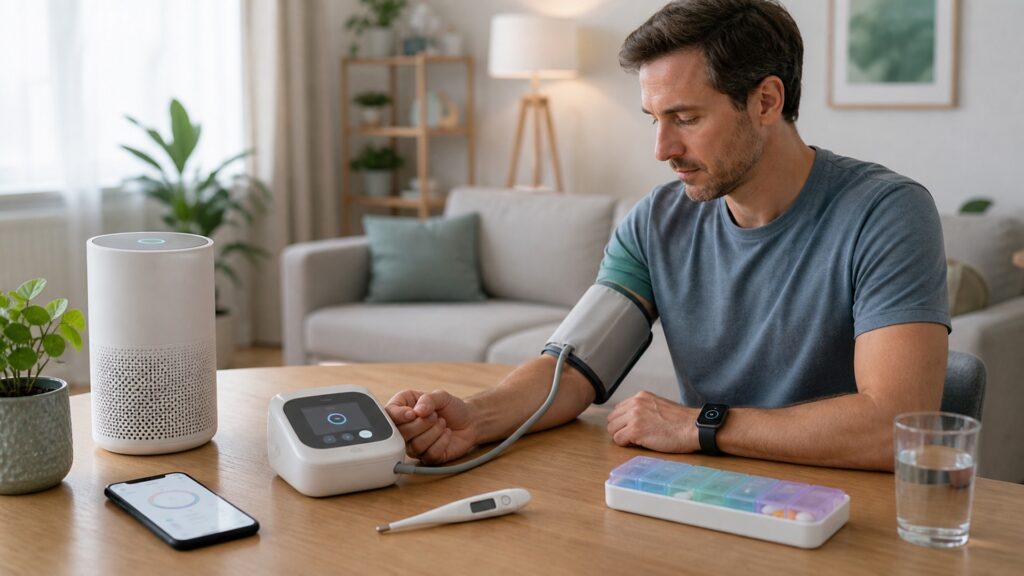
Person using an unbranded blood pressure monitor beside several consumer health products at home
What You'll Learn

The System Behind Consumer Health Products

A category-wide framework for tracing what a product measures, delivers, changes, or supports—and for recognizing where uncertainty enters the result.

  • How intended use defines the job a health product is designed to perform
  • Why every product begins with an input such as a signal, substance, force, or environmental condition
  • How sensors, materials, filters, electronics, or active ingredients create an output
  • Where settings, timing, placement, and user technique change performance
  • Why a displayed reading can be precise without being accurate or clinically meaningful
  • How feedback helps users adjust a routine without turning the product into a diagnosis
  • Which evidence and limitation checks matter before comparing features

Tip: Read the concept as part of a system, then connect it back to the use case.

Definitions

Key Concepts That Define Consumer Health Products

These definitions connect the main idea to the variables, limits, and practical signals readers need to compare options.

Intended Use

The specific job a product is designed and described to perform for a defined user and situation.

  • Scope: Separates a product's actual purpose from broader wellness language
  • Comparison: Keeps unlike products from being judged by the same outcome
  • Limit: Does not guarantee the intended result for every user

Input

The signal, substance, force, behavior, or environmental condition that enters the product's working pathway.

  • Examples: Pulse wave, airborne particles, body weight, light, sound, or an ingredient
  • Quality: Poor or inconsistent input can weaken the output
  • Control: Placement, timing, and technique often shape the input

Active Mechanism

The physical, chemical, electrical, optical, or mechanical process that converts the input into a change or measurement.

  • Measurement: Sensors translate signals into data
  • Intervention: Materials or energy alter a condition
  • Support: Structure redistributes motion, pressure, or load

Operating Range

The conditions in which a mechanism is expected to work within stated tolerances or practical limits.

  • Boundaries: Includes temperature, fit, concentration, load, and signal strength
  • Failure mode: Results may drift or stop outside the range
  • Buyer check: Look for limits relevant to the actual setting

Accuracy and Precision

Accuracy is closeness to a valid reference; precision is repeatability. A product can repeat the same biased result.

  • Accuracy: Depends on reference quality, calibration, and conditions
  • Precision: Shows consistency, not necessarily correctness
  • Interpretation: Trend usefulness and decision thresholds are different questions

Feedback Loop

The cycle in which an output informs the next action, setting, measurement, or routine.

  • Output: May be a reading, alert, physical change, or subjective response
  • Adjustment: Users alter behavior or setup based on that output
  • Boundary: Feedback supports decisions but may not establish a diagnosis

Tip: Keep the definitions connected; the strongest answer usually comes from the whole system, not one term.

Function Path

How an Input Becomes a Useful Output

A health product works through a chain. It receives something measurable or changeable, applies a mechanism, produces an output, and presents that output in a form the user can interpret.

  • A monitor captures a signal before software estimates a value
  • A filter moves air through media that traps selected particle sizes
  • A support product changes how force is distributed across contact points
  • A supplement delivers ingredients that must be released, absorbed, and used by the body
  • The final output may be a reading, an environmental change, mechanical support, or a biological exposure

The strongest product claims identify each step in this chain instead of jumping directly from a feature to a broad health outcome.

Mechanism Types

Why Different Health Products Need Different Evidence

Measurement, environmental, support, and ingestible products do not prove their value in the same way. The mechanism determines what should be tested and which comparison is meaningful.

  • Measuring devices need valid references, repeatability, and realistic-use testing
  • Environmental products need performance data tied to room size, airflow, or exposure conditions
  • Support products need fit, load, comfort, and movement considered together
  • Ingestible products require attention to ingredient identity, amount, formulation, and evidence for the claimed use
  • A plausible mechanism is a starting point, not proof of a meaningful outcome

Evidence is most useful when its test conditions match the product's intended use and the buyer's real setting.

Settings and Dose

How Amount, Timing, and Intensity Shape Results

Many health products adjust how much of an intervention is delivered or how often a signal is sampled. Too little may be unnoticeable; more can create discomfort, noise, cost, false alerts, or other tradeoffs.

  • Sampling frequency affects detail, battery life, and the number of alerts a monitor produces
  • Fan speed changes air movement, particle removal rate, noise, and energy use
  • Compression, firmness, or tension changes support as well as comfort and mobility
  • Ingredient amount and schedule matter, but serving size does not establish effectiveness by itself
  • The useful setting is the one that stays inside instructions and fits the actual task

Treat settings as controls within a tested range, not as a simple scale where maximum always means best.

Sources of Error

Where Real-World Conditions Distort Performance

Products leave the laboratory and enter messy homes, routines, and bodies. Placement, motion, temperature, maintenance, interfering substances, and inconsistent use can all separate real-world output from a controlled test result.

  • Loose sensor contact or movement can contaminate a reading
  • A clogged filter reduces airflow and changes environmental performance
  • Poor fit can move pressure to the wrong location or discourage use
  • Storage conditions can affect batteries, test materials, or ingredient stability
  • Natural day-to-day variation can be larger than the change a product detects

A trustworthy comparison looks for known error sources and explains how users can control them.

Human Factors

Why Usability Is Part of How the Product Works

A mechanism has little practical value if setup is confusing, feedback is hard to interpret, or the routine is too burdensome to repeat. Usability affects whether the product receives consistent inputs and produces useful information over time.

  • Clear instructions improve placement, timing, cleaning, and repeatability
  • Readable feedback helps users distinguish a trend from a single fluctuation
  • Comfort, noise, charging, and maintenance influence whether a routine continues
  • Accessible controls matter when vision, dexterity, or cognition is limited
  • Useful products make limits and next actions as clear as the headline result

Ease of use is not cosmetic; it can determine whether the working pathway remains consistent enough to be informative.

Quick Reality Check

What Health Products Can Do—and What They Cannot Establish

A practical boundary between a product's measurable function and the larger health conclusion that marketing may imply.

Where the Model Is Useful

A well-matched product can measure a defined signal, change a controllable condition, deliver a known material, or provide repeatable physical support. Those functions can make routines easier to observe and manage.

Products are easier to compare when intended use, mechanism, operating range, evidence, and maintenance requirements are stated clearly.

Where the Model Stops

A consumer product generally cannot explain every cause behind a reading, symptom, or perceived change. Outputs may be affected by technique, context, normal variation, and factors outside the product's design.

A product result should not be stretched into a diagnosis, treatment decision, or guaranteed outcome. Important health decisions belong with an appropriately qualified healthcare professional.

Common Myths

Misconceptions About Consumer Health Products

Common shortcuts and misunderstandings can make the topic seem simpler than it is.

If a health product is sold to consumers, its claims must all be clinically proven

Rules and evidence requirements vary by product type, intended use, claim, and jurisdiction. Availability alone does not confirm that every advertised benefit was clinically tested, so buyers should examine the specific claim and supporting evidence.

More sensors and features automatically make a product more useful

Additional features can create helpful context, but they can also add false alerts, charging demands, confusing dashboards, and cost. Usefulness depends on whether each feature supports a defined decision or routine reliably.

A precise digital number is necessarily an accurate health measurement

A display can show many digits even when placement, motion, calibration, or the estimation method introduces error. Precision describes repeatability; accuracy requires comparison with a suitable reference under relevant conditions.

A change after using a product proves the product caused it

Timing alone cannot separate the product's effect from normal variation, expectation, other behavior changes, or measurement noise. Stronger evidence uses appropriate comparisons and repeated observations while accounting for plausible alternative explanations.

A product that works for one person should work the same way for everyone

Bodies, environments, routines, fit, and starting conditions differ. Even when the mechanism is sound, the size and importance of an effect can vary, so individual context and product instructions still matter.

Tip: Treat strong claims as starting points for comparison, not final answers.

FAQ

Frequently Asked Questions About Consumer Health Products

Concise answers to common questions readers may have after the main explanation.

What is the simplest way to understand how a health product works?

Identify the product's intended use, then trace its input, active mechanism, output, and feedback. This reveals what the product directly does, which conditions affect it, and where a broader marketing claim needs additional evidence.

How can I tell whether a health-product claim is meaningful?

Look for a specific population, outcome, comparison, time period, and test method. A meaningful claim explains what changed and under which conditions, rather than relying only on words such as clinically tested, smart, natural, or advanced.

Are wellness products and medical devices evaluated the same way?

No. Oversight and evidence expectations can differ according to intended use, risk, claims, and jurisdiction. Check the product's stated purpose and applicable regulatory information instead of assuming every item marketed for health has identical review.

Why do readings from two health devices sometimes disagree?

Devices may use different sensors, algorithms, sampling intervals, placement rules, or reference standards. User motion and normal biological variation also matter. Compare trends only after following each product's instructions and checking known accuracy limits.

Does a plausible mechanism prove that a product improves health?

No. A plausible mechanism explains how an effect could occur, but meaningful benefit also requires evidence at the relevant dose, duration, population, and outcome. Laboratory changes do not automatically translate into noticeable real-world improvement.

When should a product reading be discussed with a healthcare professional?

Seek qualified guidance when instructions recommend it, a reading is unexpected or persistent, symptoms are concerning, or the result may change care. Do not delay urgent evaluation because a consumer device appears normal or reassuring.

What maintenance details affect how health products work?

Sensor cleaning, filter replacement, battery condition, software updates, storage, calibration checks, and inspection for wear can all matter. Follow the manufacturer's instructions because neglected maintenance may change inputs, outputs, or the reliability of feedback.

Bottom Line

Health products become easier to judge when you trace the full pathway: intended use, input, mechanism, output, and feedback.

Choose products whose evidence matches that pathway and your real setting. Then account for technique, maintenance, uncertainty, and individual context instead of treating a feature, reading, or ingredient as a guaranteed health result.

Next Steps

Go Deeper or Compare Your Options

Use these Review Streets paths to connect the explainer to related categories, comparisons, and next decisions.

Personal Health Devices

Explore monitors, trackers, and other devices that turn body or behavior signals into readings, trends, reminders, and user feedback.

Air & Environmental Health

See how filtration, humidity control, sensing, and ventilation products change measurable conditions in a room or home.

Sleep

Compare products that measure sleep-related signals or change light, sound, temperature, support, and nighttime routines.

Quick Summary

Consumer Health Products Explained

  • Every health product begins with an input and applies a defined mechanism.
  • The output may be a reading, environmental change, delivered ingredient, or physical support.
  • Settings, placement, maintenance, and user technique can alter performance.
  • Precision, accuracy, and clinical meaning are separate questions.
  • A consumer product can inform a routine without establishing a diagnosis or guaranteed outcome.