
Abrasive particle
A solid bit that exfoliates by rubbing the skin's surface.
- Example: Pumice beads are one kind.
- Contact: The action happens on contact.
- Properties: A facial cleanser study examined particle size and springiness separately.
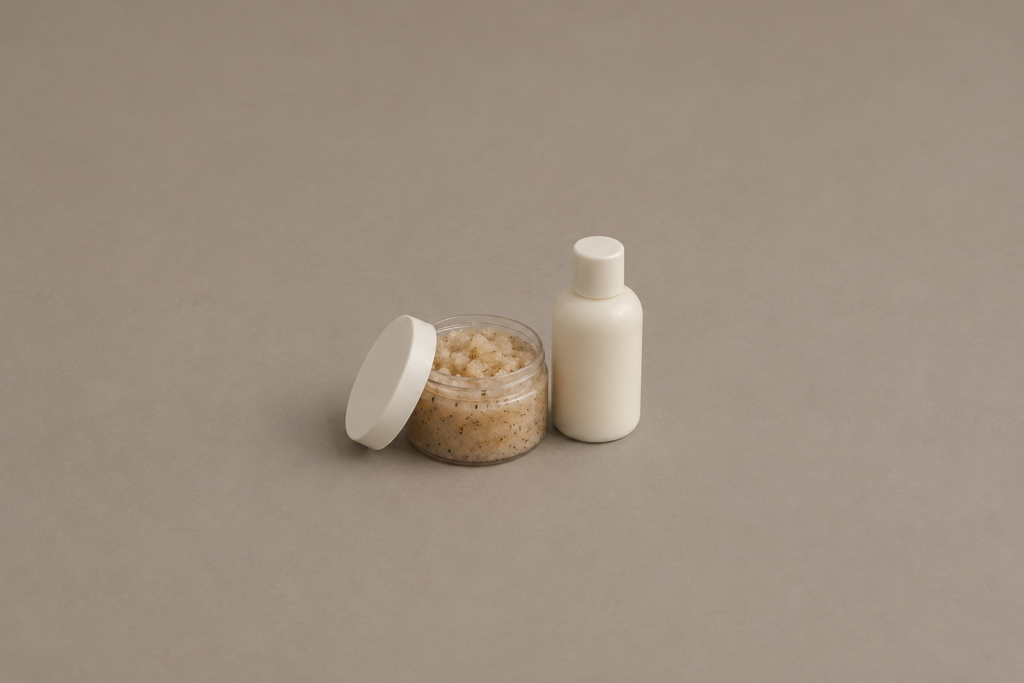
First Aid Beauty says KP Bump Eraser’s pumice rubs away surface cells. In one tested formula, glycolic acid helped loosen the links between the outermost skin cells. An acid’s amount can change skin turnover, and a surfactant can change where acid ends up in a lab test. A matched comparison can show what one ingredient adds.
Start with the ingredient's job. Then follow it to the result someone actually looked for.
Tip: When a label says a product works, finish the sentence in your own words. Works at doing what?
These terms connect the name on a label to the question a study can answer.
A solid bit that exfoliates by rubbing the skin's surface.
A member of a family of acids used in cosmetics.
The amount of a material relative to the whole mixture.
A scale for how acidic or alkaline something is.
The base that carries an ingredient.
A test of one base with and without an ingredient.
Tip: Read the percentage and pH as answers to separate questions.
The name becomes more informative when you can put a job next to it.
Treat the intended job as a question a study could answer.
To put the ingredient's role in context, picture the change a researcher would have to record.
When evaluating an ingredient's possible contribution, look for the exact change it was supposed to produce.
To make sense of an acid percentage, place it next to the other conditions of the test.
A matching percentage settles one question. Ask what else the comparison held steady.
An ingredient can change what happens to another ingredient in the same formula. In one lab test, researchers followed where the acid went.
Seeing ingredients listed together raises a question. Which contribution did anyone test?
Start by identifying what changed between the versions people tried.
Keep the names of the versions beside the result. They tell you what the experiment can give credit to.
Two hypothetical cases put the limits of a label and a study into everyday terms.
Imagine two body treatments with equal amounts of the same AHA. Suppose they have different pH readings.
Holding the amount steady still left room for different shedding responses in the lactic acid study. The percentage alone leaves the two products' relative effects open.
Imagine trying Palmer’s massage lotion for stretch marks and noticing that your skin feels softer. The label highlights cocoa butter. Could a pregnancy prevention trial of a different lotion tell you what cocoa butter contributed to that softer feel?
The pregnancy trial counted new marks and compared its own lotion with a placebo. It leaves open whether cocoa butter, another ingredient or the formula as a whole accounts for the softer feel in your example.
Each statement below takes a claim a step further. The evidence sets a limit on that step.
The FDA’s historical summary includes reports of burning and irritation after AHA use. It gives neither a side-by-side acid comparison nor a measure of how much skin shed. A ranking would need results on that same outcome for each acid.
In the forearm experiment, the junction changes appeared at the very surface. The outermost skin layer looked more compact under the microscope, and the study did not show that the whole layer came off.
Palmer’s lists collagen in its firming lotion. A separate study observed new collagen and elastic fibers in skin samples treated outside the body with a whole firming lotion. That experiment leaves the effect of the collagen on Palmer’s label open.
Even with better photo ratings, the caffeine cream showed no significant difference from the base in how thigh circumference changed.
A separate study tested Centella triterpenes, components of the plant, with rosehip oil, vitamin E and another ingredient. That blend showed no significant overall reduction in new pregnancy stretch marks. The earlier favorable result belongs to the particular combination that was tested.
Tip: When a claim jumps from one finding to another, put the two measurements side by side and look for the missing step.
Use these answers when a label or study leaves a question unresolved.
The list establishes that the acid is present. Its purpose needs other evidence, since an AHA may be there to adjust acidity.
Dove's US Crushed Macadamia & Rice Milk Body Scrub lists macadamia seed oil, rice bran oil and hydrated silica. The name alone leaves the source of the grit open.
Position gives a clue about relative amount within the formula, with no exact share of the blend. Under a US cosmetic labeling option, non-color ingredients above 1% are listed by decreasing amount. Those at 1% or less may appear in any order after that group.
Palmer's highlights cocoa butter in a lotion marketed for firming and in a separate massage lotion marketed for the appearance of stretch marks. The shared name leaves the outcome and the rest of each formula open.
First Aid Beauty’s softer-feel panel tested the complete scrub. It gives no separate result for pumice.
The study leaves that open. Its authors called for longer follow-up to see what happens after treatment.
One glycolic acid study measured the ingredient's penetration through isolated skin. The readout tracks how much entered or passed through the skin. A visible change would need a measure of appearance.
The firming trial assigned a different outcome to the thighs and tested a whole lotion. A claim about an individual ingredient on a different body area would require a comparison designed for that area and ingredient.
Tip: Keep the exact wording of the label alongside the study question. It is easier to spot where the two pull apart.
Give the ingredient a job you can name. That makes it possible to ask what would count as evidence that it did that job.
A controlled test of matching bases can show what one added ingredient contributed. When several ingredients vary together, any measured difference belongs to the combination.
Visit the category archive for the format you want to browse.
Browse the category's list archive.
Open the archive for side-by-side coverage.
Visit the archive for buying guides in this category.
Choose a retailer
Prices checked regularly. We may earn a commission at no cost to you.