
Humectant
An ingredient that helps the skin’s outer layer hold water.
- Familiar example: Glycerin is one example.
- Another example: Urea can play this role too.
- Where it acts: The outermost skin layer is called the stratum corneum.
In foot care, glycerin can help the outer skin hold water, while a pumice surface works by rubbing against rough skin. To understand what either contributes, start with the job it does. Then ask how it reaches the skin and whether the evidence isolated its contribution or compared finished products.
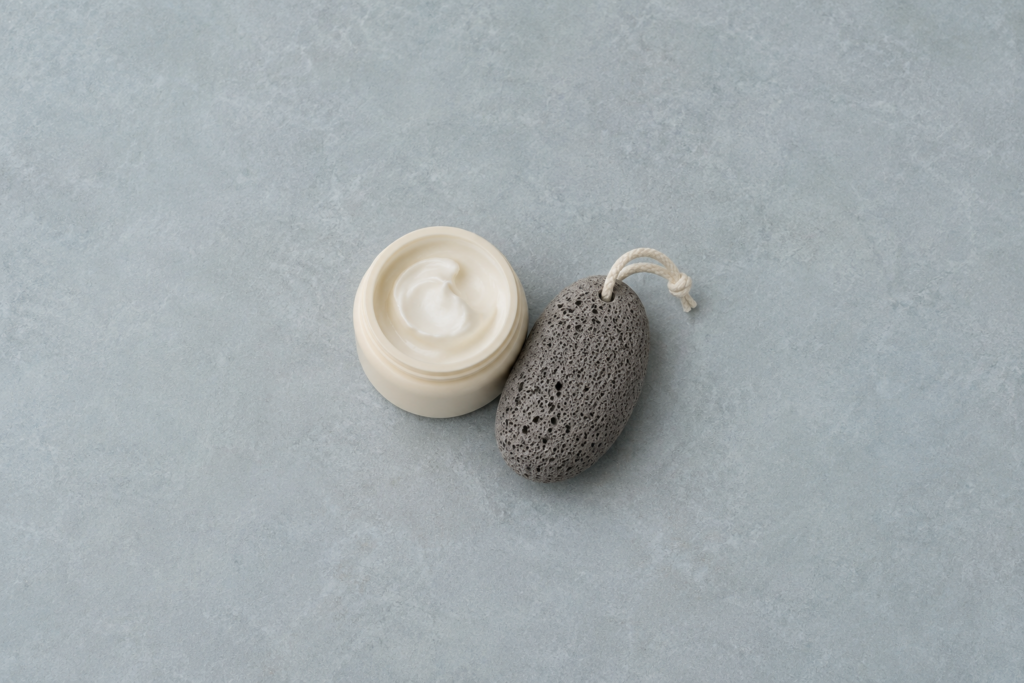
The ingredient in a cream and the abrasive on a foot sponge give you different starting points for understanding how the product works.
Tip: Put a name to the result you’re asking about. A change in roughness and a change in hydration call for different observations.
These terms cover the skin’s outer layer, the part of a tool that touches it and the result a test records.
An ingredient that helps the skin’s outer layer hold water.
An ingredient that helps slow water loss through skin.
The shedding of cells from the skin’s outer layer.
The share of a formula made up by one ingredient.
The outside face of a foot tool that rubs against the skin.
The particular result a study tracks to see what changed.
Tip: When a claim says skin improved, the endpoint tells you what kind of improvement the test looked for.
A cream ingredient can change how water is held in the outer skin. A rough working face acts where it rubs the surface.
A claim about water retention and a claim about smoothing rough skin describe two different jobs. For a rough heel, those claims tell you which change the product is meant to address.
A percentage on a foot cream can describe its contents. In an application study, researchers can separately measure how much cream goes on a patch of skin.
Read a stated percentage as a measure of composition. To read it as a difference in performance, you need a test that can show what changing that share does.
A named ingredient might be in a scrub that rinses away or a cream that stays on. With a foot file, the abrasive makes contact directly.
Even if two products name the same component, a rinse instruction gives you a reason to ask how long each product is meant to stay against the skin.
Ingredients in a cream can affect different readings. The base that carries an ingredient can also matter to the reading you get.
The useful detail may be what carries the ingredient in a cream or what supports the abrasive in a tool. Each relationship puts the named component in the context where it does its job.
A test can give one ingredient credit when it varies that ingredient and holds the rest of the formula steady. Other comparisons answer a broader question about the products.
When the comparison changes several ingredients at once, the finding belongs to the finished products. The test leaves the contribution of any one ingredient unresolved.
These hypothetical examples show how to match a study result to the variable researchers changed and a listed finish to the face it describes.
Imagine two foot products list different lactic acid percentages and the same pH. You want to understand what the difference in percentage could change. One study summary mentions a change in surface shedding.
That part of the study varied pH while keeping the percentage fixed. For the concentration question, look at the separate comparison that kept pH fixed and measured how fast the outer layer renewed itself. The result describes the conditions tested.
Suppose two foot-file packages say ceramic and both list a coarse face and a finer face. The first shows which face is which in a diagram. The second lists the two finishes without labeling the faces.
Earth Therapeutics describes the two faces of its Big Ceramic Foot File as having different textures. In the hypothetical, the diagram gives you an extra detail. It matches each listed texture to the face it describes.
Each of these shortcuts takes one piece of information and asks it to stand in for something else.
The trial on dry soles compared a urea cream and sorbolene. It compared complete formulas, so it leaves open how changing urea alone would affect those dryness scores.
U.S. retail cosmetic labels generally list ingredients from most to least. Ingredients at 1% or less, excluding color additives, can go after the higher-concentration ingredients in any order within that group. A place on the list gives you no exact percentage.
An occlusive such as petroleum jelly can slow water loss. That describes the direction of the effect. Its size would take a measurement.
A paired moisturizer study assessed roughness and hydration separately. If the skin feels smoother, that describes a change in feel. A hydration reading would address water in the outer layer.
Earth Therapeutics identifies the working faces of its Big Ceramic Foot File as ceramic. That detail alone leaves the handle’s material open.
Tip: A direction to use a small amount describes the portion. A percentage describes what share of that portion is the named ingredient.
Here are the remaining questions about ingredient names, tool specifications and the details behind a study result.
Glycerol is another name for the glycerin in this article’s opening.
The comparison changed the base that held the moisturizing ingredients. It tracked hydration and water loss separately. That leaves open how much the mixtures’ thickness contributed to the readings.
The material specification is the place to look. Earth Therapeutics lists silicon carbide as the abrasive on its Soft Stone sponge. Its Natural Sierra stone explicitly lists natural pumice.
Washable describes what can be done to the file itself. STALEKS says its Classic 10 Type 1 can be washed. OPI’s dual-sided model explicitly lists wet filing as a use.
A U.S. retail cosmetic ingredient list gives ingredient names and follows rules about their order. A pH value describes the acidity of the mixture. Seeing an acid in the list leaves the mixture’s pH unanswered.
In the dry-forearm cream study, researchers took readings for 12 hours after applying the cream. Any change after their last reading lay outside the study.
The arm results describe what happened there. Even foot studies can be site-specific. The foam study took readings below the ankles, so a heel-specific claim would need evidence for the heel.
On the OPI model, 80 and 120 describe the texture of the replaceable strips. Those ratings give no weight for the abrasive on either strip.
Tip: Keep the measurement and body site together when reading a study result.
When a cream names an ingredient, read it first as a statement about what’s inside. When a tool names a material, ask whether it describes the part your foot touches. A performance claim takes another step beyond either statement.
Try putting the subject back into the claim. Did the ingredient account for the change, or did the product show a change? If a test changed several things at once, the finished product belongs in that sentence.
Browse the Review Streets Foot Care archives by format.
Go to the category’s lists archive.
Open the Foot Care comparisons archive.
Browse buying guides for Foot Care.
Choose a retailer
Prices checked regularly. We may earn a commission at no cost to you.