
Pigment Load
Amount and type of insoluble color dispersed in a formula.
- Use: control opacity and color
- Variable: dispersion and dose
- Tradeoff: High load can emphasize texture
Makeup products work by leaving selected colorants and other materials on the skin, lashes, lips, or nails in a controlled film or powder layer. Pigments create color and coverage; oils, waxes, water, silicones, powders, volatile carriers, and polymers determine spread, adhesion, flexibility, shine, and removal.
Performance emerges after application. Dose, tool, skin preparation, layer order, drying time, facial movement, sebum, sweat, humidity, friction, and later removal can matter as much as the ingredient list. In the United States, makeup is generally regulated as cosmetics; color additives must be permitted for the intended use, and products making sunscreen claims also carry drug requirements.
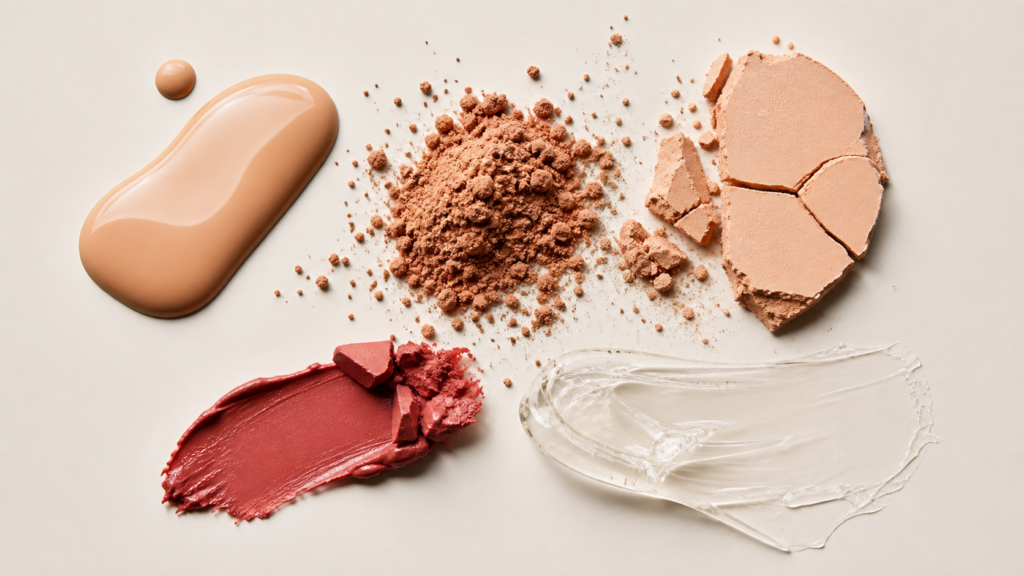
Explain makeup as controlled deposition of pigments, powders, oils, waxes, water, volatile carriers, and polymers that change color, contrast, texture, and light reflection while interacting with skin preparation, tools, layering, movement, oil, moisture, and removal.
Tip: Coverage is a deposited layer, not a fixed number on the bottle.
These makeup products concepts separate mechanism, application, limits, and purchasing consequences.
Amount and type of insoluble color dispersed in a formula.
Liquid, oil, wax, gel, or powder phase carrying other ingredients.
Polymer helping deposited material cohere after application.
Ingredient designed to evaporate after spreading.
Change in how a surface scatters, absorbs, or reflects light.
Ability of products to spread and set without pilling, lifting, or separating.
Tip: Use these terms to test makeup products instead of relying on a front-label promise.
Coverage depends on pigment load, particle distribution, color, opacity, and the thickness left behind. A thin even layer can look more natural than a high-load product applied unevenly.
Coverage is a deposited layer, not a fixed number on the bottle.
Absorbent or light-scattering particles can reduce visible shine; emollient films can increase reflectivity and movement. Neither effect changes pore size or permanently smooths skin.
Makeup changes the view of texture more readily than the texture itself.
Liquid and cream products often transform as water or volatile ingredients leave. Blending too long can disturb the forming film; layering too quickly can trap excess or cause pickup.
Wet application feel is not the final film.
A primer and foundation can share ingredients yet still pill because of dose, friction, drying, or incompatible films. Test the complete combination and change one variable at a time.
Compatibility is a system result, not a silicone-versus-water slogan.
FDA notes that color approvals can differ by use area, especially around eyes. Do not share eye makeup; clean brushes regularly; replace products after contamination or meaningful odor, color, or texture change.
Good performance includes hygienic use and straightforward removal.
Makeup can alter visible color, contrast, texture, and reflection temporarily; it cannot permanently change skin structure or make hygiene and compatibility irrelevant.
The product deposits evenly at a controllable dose and reaches its stated visual job.
The dried layer remains comfortable and removable within the intended routine.
Pigment, film, and wear vary with application and the surface beneath them.
A cosmetic finish does not diagnose, treat, or universally improve a skin condition.
These claims flatten the variables that determine how makeup products performs in a real routine.
Most decorative effects come from material remaining on the surface. Penetration is not required for pigment, blur, shine, or adhesion and is not proof of effectiveness.
Finished formulas contain multiple phases and emulsifiers. Pilling depends on dose, order, drying, friction, polymers, and skin preparation—not one ingredient category.
Strategic spot coverage and thin even layers can provide a more stable result. Excess film often increases texture, transfer, creasing, and removal burden.
Natural is not a uniform safety standard. Evaluate labeling, intended use, contamination control, allergens, color additives, and individual reaction history.
Products marketed for sun protection are regulated as cosmetics and drugs, but makeup application may not deliver an adequate uniform labeled dose. Follow sunscreen directions separately.
Tip: Test the exact makeup products tool, setting, and routine before generalizing from its category.
The remaining decisions about makeup products concern technique, compatibility, safety, upkeep, and value.
Common causes include excess skin care, insufficient set time, incompatible or overbuilt films, rubbing, and repeated correction. Reduce layers and test one change at a time.
Sebum, sweat, water, friction, uneven preparation, excess emollient, and a brittle or poorly formed film can create localized breakup. Map where and when it begins.
Some products can contribute to acne cosmetica. AAD advises acne-prone users to consider oil-free, non-comedogenic or won't-clog-pores labeling, remove makeup, cleanse gently, and keep tools clean.
AAD recommends cleaning makeup brushes weekly and not sharing them. Eye-area tools and products deserve especially careful hygiene because contamination can cause infection.
Only if the product is intended for the eye area. FDA color-additive permissions are use-specific, so a color acceptable generally may not be permitted around eyes.
Assess dose control, shade, finish, wear, comfort, packaging, hygiene, removal, return policy, and cost per successful use rather than prestige or ingredient count.
Makeup works through controlled surface deposition: colorants create visible change while vehicles, powders, waxes, volatile carriers, and polymers determine application and the final film.
Judge the complete routine from preparation through removal. Thin layers, suitable tools, set time, intended-area safety, clean applicators, and repeatable performance matter more than simplified formula labels.
These Review Streets paths narrow the next makeup products decision by format, goal, and routine fit.
Browse face, eye, lip, brow, primer, and setting categories.
Compare liquid foundation coverage, finish, shade, and wear.
Choose a retailer
Prices checked regularly. We may earn a commission at no cost to you.