
How Meditation Headbands Works

Muse 2 measures small voltage differences through electrodes. In Mind mode, the app uses the EEG recording to estimate whether your attention is steady or has drifted. That estimate controls changes in a weather sound.

By: Review Streets Research Lab
Updated: November 25, 2026
Explainer · 7–9 min read
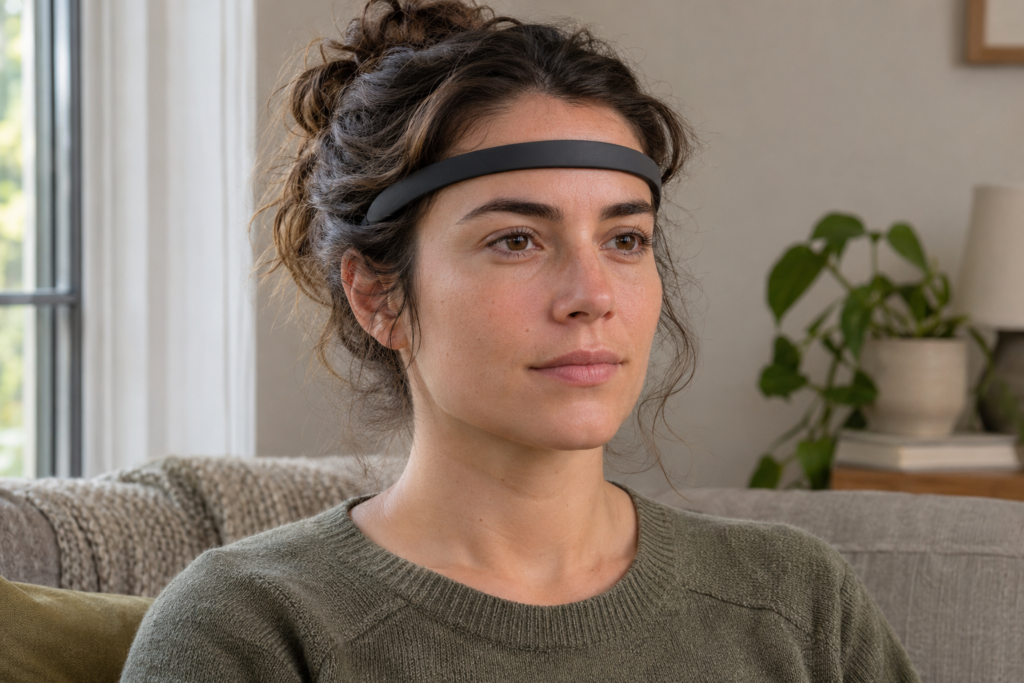
An adult wearing a charcoal meditation headband sits on a sofa beside a window.
What you’ll learn

Follow the signal

Follow a Muse 2 reading from the headband to your headphones.

  • What the voltage difference in an EEG channel represents
  • What motion and optical sensors pick up in other modes
  • Where a loose electrode and a Bluetooth dropout differ
  • Why calibration takes a fresh reference reading
  • How a jaw clench can show up in an EEG recording
  • Why birdsong sometimes joins the track
  • How instructor audio and post-session graphs can coexist

Tip: Start with the mode name. In Body, that points you to movement.

Key terms

Six terms for tracing the signal

Start with the signal and follow it through the app.

Sensor

A part that turns a physical input into a readable signal.

  • Electrical: Electrodes register a difference in voltage between two points.
  • Light: An optical detector can pick up light that returns from tissue.
  • Motion: An accelerometer measures acceleration.

Contact

Where the sensor meets the skin.

  • Placement: Each contact sits at a specific point on the head.
  • Obstruction: Hair under a Muse 2 electrode can obstruct the signal.
  • Sensor movement: Shifting an optical sensor against the skin can alter how much light reaches its detector.

Artifact

Part of the recording that comes from something other than the activity you’re trying to capture.

  • Muscle activity: A jaw clench can add its own electrical activity to the recording.
  • Slow drift: Changes where a sensor meets your skin can gradually shift the electrical trace.
  • Depends on the task: A change in posture is information the Body mode is designed to pick up.

Signal feature

A property the software calculates from the recording.

  • Frequency: Frequency describes how fast a pattern repeats.
  • Power in a band: Power here describes signal strength within a chosen frequency range.
  • Multiple features: Features can summarize the same recording in several ways.

Processing

How software turns a recording into something it can use or display.

  • Trace: The app can plot detected electrical activity as a waveform.
  • Calibration: An opening sample gives the session a point of comparison.
  • Classification: Software can group readings by pattern.

Feedback

A cue whose behavior depends on a measured signal.

  • Live: A sound can respond to movement during the session.
  • Afterward: A recorded session can also provide information as graphs once you finish.
  • Invitation to act: A cue can remind you to refocus on your breathing.

Tip: Start by asking whether a display shows the trace itself or a calculation made from it.

The input

What the band picks up

Muse 2 has more than one kind of sensor.

  • In electroencephalography, or EEG, the voltage difference between two measurement points is recorded as a channel.
  • Muse 2 has four EEG measurement sites, two on the forehead and one behind each ear. All four channels use a forehead reference electrode.
  • Muse 2 also has an optical pulse sensor. This kind of sensor shines light into tissue and detects what comes back.
  • In Muse Body, the accelerometer and gyroscope register shifts in position or movement.
  • Strength mode on the separate Muse S Athena model uses near-infrared light for an oxygenation-related reading.

The mode tells you which input to look for. In Heart, it comes from the optical pulse sensor. In Body, it’s movement.

Signal acquisition

From skin contact to the app

Muse 2’s contacts pick up signals at the skin.

  • A gap under an earpiece can interfere with pickup at that spot.
  • The startup display points to the sensor position that needs checking.
  • Bluetooth carries the readings the band picks up to the app.

A phone can stay connected over Bluetooth while a contact loses its signal.

The software

What the app does with a reading

The app receives the EEG for processing.

  • Normally, calibration follows the sensor check. That opening sample becomes the reference for the session.
  • A blink can add electrical activity to the recording. Muse also monitors signal quality during use and tries to recover a lost sensor signal.
  • Mind combines EEG characteristics to categorize the reading. In a separate live view, the app calculates signal power within frequency ranges.

Muse keeps Mind’s rule proprietary. A band-power graph alone can’t show how the app chose a sound.

The cue

Why the weather sound changes

Muse 2 can deliver the Mind cue through headphones while you’re still practicing.

  • Wind can build when Mind infers that attention has wandered.
  • The weather quiets when Mind infers focus.
  • If the app keeps detecting focus, it can add birdsong.

The app makes its estimate audible.

The listener

What happens after a cue

You decide how to respond to the cue.

  • The sound can remind you to return to the exercise.
  • Premium Guided Meditation can play instruction with the band disconnected.
  • In a connected Muse 2 session with a usable signal, the app can save readings for graphs. You hear the instructor during the session.

In that mode, the instructor’s voice is playback. Recording can run with the live feedback sound off.

Reality check

Two moments in a Mind session

Both examples are hypothetical. A steady fit still leaves room for muscle noise.

A quiet stretch

Picture yourself sitting by a window with Muse 2 on. The contacts have passed the check.

Quieter weather reflects the app’s estimate of focus, even if you still felt distracted.

A clenched jaw

Imagine clenching your jaw with the contacts still in place. Muscle activity can add electrical noise to the recording.

The band can still send a reading with muscle noise in it. If an earpiece instead loses contact, tracking can have a gap. A Bluetooth dropout interrupts the link to the app.

Myths

What the headband actually does

Start with the voltage the band measures and the sound the listener hears.

Do the electrodes sense calm directly?

Electrodes record voltage differences between points on the head.

Can posture change a headband cue?

If you straighten up during a Muse 2 Body session with Wind Chimes, the chime sound can change with that movement.

Am I hearing the electrical signal?

You hear a weather effect the app plays.

Does an instructor’s voice mean the headband is sensing?

Muse’s Premium Guided Meditation plays the instructor’s voice with or without a connected band. Playback alone tells you which track is playing.

Does a changing cue show a health benefit?

The sound tells you that the software responded to a reading. A health benefit would need to be measured separately.

Tip: When a sound catches your attention, check what input the app mode ties it to.

Common questions

Using the app during a session

Internet access and which audio you play are separate parts of the setup.

Do I need internet during a session?

Muse sends readings to the phone over Bluetooth. The app can run downloaded sessions offline if you’re already signed in.

Does live feedback tell me how quickly the cue arrives?

BrainCo says FocusCalm compares brain activity with a target twice a second. That’s the frequency of the comparison. Timing the whole trip from a signal change to a sound in your ear would require a separate measurement.

Can a Muse session start while a sensor is still being checked?

If the app offers an option to proceed, you can start while it keeps checking the remaining sensors.

Can I choose what triggers a cue?

With Flowtime Premium, you can set thresholds for certain feedback goals and hear a cue when readings meet the selected condition.

Does the soundscape timer in Muse Premium External Audio also end tracking?

That timer applies to the soundscape audio. With a usable signal and connection, tracking continues until you end the session.

Can I keep tracking with the live cue muted?

In Premium External Audio, Tracking Only can record with the live feedback muted.

Can I see the electrical trace as the band takes readings?

Muse’s Live Brain Activity shows the detected electrical trace. The separate Live Brainwave Powerbands view summarizes activity by frequency range.

Can the mobile app process readings directly on my phone?

In FocusCalm, yes. BrainCo says its app processes the raw electrical and motion readings on the mobile device.

Tip: Check the tracking setting and signal status when you want to know if a quiet session is still collecting data.

The takeaway

A loose contact can degrade the recording at the band. A dropped Bluetooth link can interrupt delivery to the app.

Identify your mode and ask what it uses to make a cue. Separate what you hear now from what the app saves for review.

Related reading

Meditation Headbands archives

Explore the archives for this category by format.