
Zinc Oxide Coverage
The broad-spectrum contribution zinc oxide can provide when it is formulated well.
- Strength: Helpful across UVA and UVB
- Tradeoff: Can add opacity
- Decision: Often important in mineral face SPF
Zinc oxide and titanium dioxide are the two mineral sunscreen filters shoppers see most often, but their roles are not interchangeable. They differ in wavelength coverage, opacity, particle behavior, and how they influence texture and visible finish.
Understanding those differences helps readers compare mineral formulas more intelligently. The product is not just a list of minerals; it is a film-forming system that has to spread, cover, remain stable, and feel acceptable enough to apply properly.
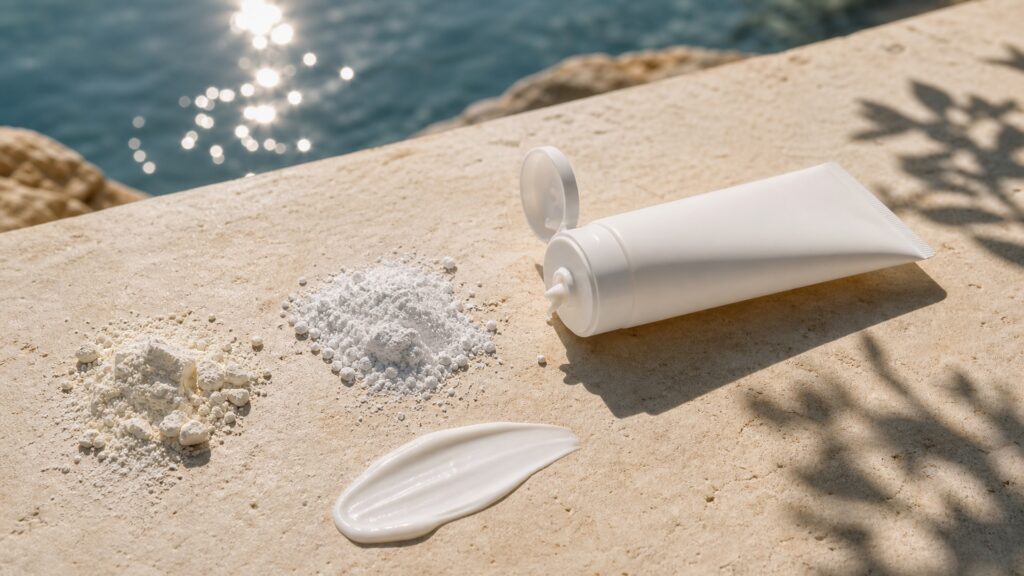
A practical explanation of mineral filter roles, particle behavior, surface films, and cosmetic tradeoffs.
Tip: Read the concept as part of a system, then connect it back to the use case.
These definitions connect the main idea to the variables, limits, and practical signals readers need to compare options.
The broad-spectrum contribution zinc oxide can provide when it is formulated well.
The UV protection role titanium dioxide plays, especially in UVB and shorter UVA ranges.
A surface treatment applied to mineral particles to improve dispersion, stability, or feel.
How evenly particles are suspended in the product and spread on skin.
The interaction that can make mineral sunscreens look pale or chalky.
How well the sunscreen layer resists sweat, water, rubbing, and time.
Tip: Keep the definitions connected; the strongest answer usually comes from the whole system, not one term.
Mineral filters protect when particles are distributed in a film across the skin. They absorb and scatter UV energy, with zinc oxide and titanium dioxide contributing differently across the spectrum.
The protection comes from the formulated particle system, not loose minerals alone.
Mineral particles need to stay separated and evenly suspended. Coatings, dispersants, and the base formula help prevent gritty feel, clumping, streaking, and uneven coverage.
Particle engineering turns mineral powders into usable sunscreen.
A formula may combine zinc oxide and titanium dioxide to balance UVA coverage, SPF efficiency, cost, texture, and appearance. The blend is a design decision.
The best blend depends on the formula goal, not a universal mineral ranking.
Mineral filters protect partly because they interact strongly with light. That same behavior can create cast, thickness, or flashback in some products.
The cosmetic challenge is not separate from protection; it affects whether people use enough.
Use the active list to understand the filter system, then judge the tested claims and wear experience. A mineral sunscreen should meet both protection and usability needs.
A mineral label is the starting point; the finished product is the decision.
Knowing zinc oxide and titanium dioxide roles helps, but it cannot replace tested claims and personal wear testing.
It explains why some mineral formulas rely heavily on zinc oxide while others blend both filters.
It helps readers understand cast, texture, and broad-spectrum tradeoffs.
It does not prove the sunscreen will look good on every skin tone.
It does not show whether the film will survive sweat, rubbing, or under-application.
Common shortcuts and misunderstandings can make the topic seem simpler than it is.
They are different mineral filters with different coverage strengths and cosmetic effects.
It can contribute useful protection, but broad UVA coverage depends on the full formula and testing.
Particle engineering balances transparency, dispersion, and UV interaction; the tested formula is what matters.
Mineral actives may suit many users, but bases, preservatives, fragrance, and skin condition can still affect tolerance.
Tip: Treat strong claims as starting points for comparison, not final answers.
Concise answers to common questions readers may have after the main explanation.
Zinc oxide is often valued for broad UVA and UVB coverage, while titanium dioxide is especially useful for UVB and shorter UVA support.
They can do both. The simple reflection-only explanation is incomplete.
Coatings can improve stability, dispersion, feel, and compatibility inside the formula.
Not universally. Zinc oxide often broadens coverage, but the finished formula and tested claims matter most.
Mineral particle load, base ingredients, film formers, and powders can all contribute to thickness or drag.
Zinc oxide and titanium dioxide are useful mineral filters with different strengths, not interchangeable magic powders.
A good mineral sunscreen depends on the blend, dispersion, surface film, tested coverage, and whether the finish supports proper use.
Use these Review Streets paths to connect the explainer to related categories, comparisons, and next decisions.
Explore Review Streets coverage in Skincare for related sunscreen context and product paths.
Explore Review Streets coverage in Sun Protection for related sunscreen context and product paths.
Explore Review Streets coverage in Mineral Sunscreens for related sunscreen context and product paths.
Choose a retailer
Prices checked regularly. We may earn a commission at no cost to you.