
How Mobility & Support Products Works

Mobility and support products work by changing the relationship between a person, a movement task, and the surrounding environment. A cane shifts part of a load, a walker enlarges the base of support, a rail provides a stable handhold, and a transfer aid changes how assistance is delivered.

Because these products act mechanically, correct selection depends on the user's strength, balance, coordination, body dimensions, and usual settings. A product can help one task while obstructing another, so evaluation should follow real routes, surfaces, transfers, and caregiver involvement.

By: Review Streets Research Lab
Updated: August 20, 2026
Explainer · 8-12 min read
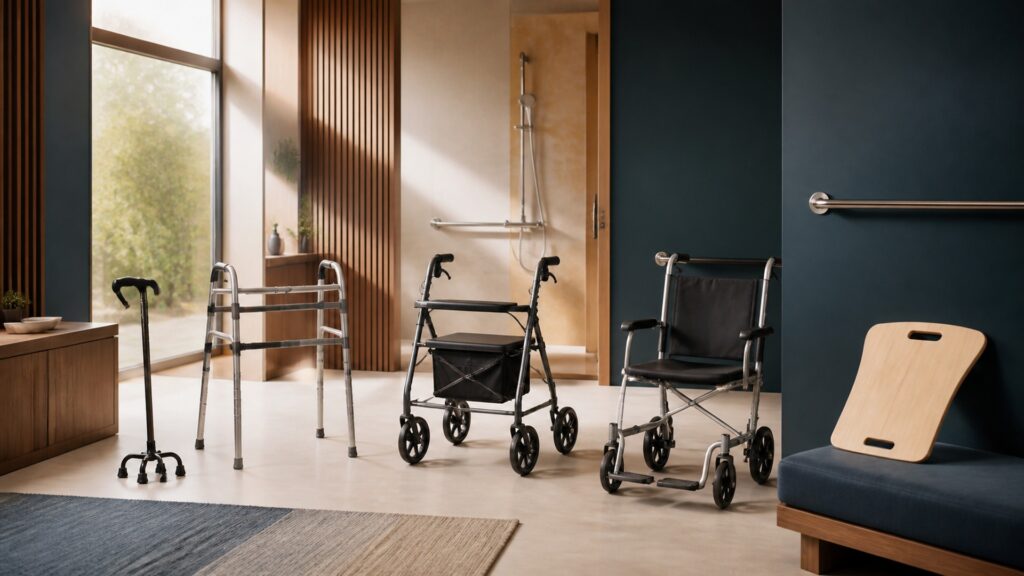
People-free editorial still life illustrating mobility & support products
What You'll Learn

Trace support from contact point to completed movement

See how fit, load transfer, stability, technique, and environmental clearance determine whether a mobility product provides useful assistance.

  • Define the movement task
  • Locate each contact point
  • Follow how force is transferred
  • Check fit and clearance
  • Practice technique safely
  • Review real-world performance

Tip: Read the concept as part of a system, then connect it back to the use case.

Definitions

Six Concepts That Shape This Decision

These definitions connect the main idea to the variables, limits, and practical signals readers need to compare options.

Base of support

The area bounded by the points where a person and mobility aid contact the supporting surface.

  • A wider, well-positioned base can increase stability but may require more space to maneuver.
  • Observe the base during standing, turning, and reaching rather than only while moving straight ahead.
  • A large footprint does not prevent tipping when weight moves outside it.

Load transfer

The redistribution of body weight through hands, arms, a frame, seat, or another support surface.

  • Effective transfer can reduce demand on a painful or weak limb and change balance requirements.
  • Check where pressure is accepted and whether the upper body can tolerate it.
  • Many aids reduce load without eliminating it, and misuse can create new strain.

Fit

The relationship between product dimensions, adjustment settings, body proportions, posture, clothing, and footwear.

  • Fit affects reach, joint position, clearance, braking, and the ability to keep the aid close enough for control.
  • Set height and width for the specific user, then reassess during movement.
  • A labeled size range cannot account for every posture, deformity, or task.

Stability

Resistance to an unwanted loss of balance, collapse, slide, or tip during a defined movement.

  • Stability depends on geometry, surface friction, product condition, technique, and the direction of applied force.
  • Test ordinary starts, stops, turns, thresholds, and transfers under appropriate supervision.
  • A stable device cannot compensate for every sudden medical event or unsafe surface.

Maneuverability

The ability to position, turn, advance, and stop a mobility product within the available space.

  • A product that feels secure in an open clinic may be difficult in bathrooms, narrow halls, vehicles, or crowded rooms.
  • Measure critical openings and rehearse the actual route before routine reliance.
  • Tighter turning can trade against stability, complexity, or user effort.

Transfer

A movement between surfaces, such as bed to chair, chair to toilet, or sitting to standing.

  • Transfers often impose different balance and force demands than steady walking.
  • Plan hand placement, product position, surface height, brakes, footwear, and helper roles before moving.
  • A walking aid is not automatically designed to be pulled on during a transfer.

Tip: Keep the definitions connected; the strongest answer usually comes from the whole system, not one term.

Task

Begin with the movement that needs support

Identify whether the person needs help with balance, unloading, endurance, propulsion, standing, transfers, or environmental access. These goals lead to different products. Buying a general mobility aid before defining the task can create unnecessary bulk or inadequate support.

  • Describe the exact route
  • Name the difficult phase
  • Consider pain and fatigue
  • Include transportation needs

A useful product solves a particular movement problem in a known setting.

Mechanics

Follow force through the product

When a user presses on a handle, force travels through joints, tubing, tips, wheels, or mounting hardware into the floor or wall. Every interface must remain secure. Flex, looseness, worn tips, weak brakes, and poor wall attachment interrupt that force path.

  • Inspect structural joints
  • Check tips and wheels
  • Confirm mounting strength
  • Respect load ratings

Support is only dependable when every connection carries the expected load.

Fit

Place controls where the user can reach them

Handles that are too high may elevate shoulders and reduce leverage; settings that are too low may encourage forward collapse. Seats, armrests, brakes, and belts also need usable reach. Fit should be checked with usual footwear and any orthoses.

  • Adjust with ordinary footwear
  • Observe elbow and trunk position
  • Check brake reach
  • Allow clothing clearance

Correct dimensions support technique without forcing a compensatory posture.

Environment

Test the spaces that determine daily usefulness

Door width, rugs, thresholds, slopes, curb cuts, bathroom layout, storage, and vehicle loading can decide whether a product is practical. Indoor and outdoor needs may justify different aids. A safer option in one location can become an obstruction elsewhere.

  • Measure narrow passages
  • Remove avoidable trip hazards
  • Plan wet-surface use
  • Confirm storage and transport

Environmental fit is part of product fit, not an afterthought.

Review

Reassess as ability and routines change

Mobility needs can change after illness, surgery, medication changes, pain flares, deconditioning, or recovery. Inspect the product and observe technique periodically. New falls, breathlessness, dizziness, weakness, or difficulty controlling the aid deserve timely review.

  • Schedule condition checks
  • Watch for technique drift
  • Review after health changes
  • Escalate unexplained decline

Continued suitability must be demonstrated in current conditions.

Quick Reality Check

Mechanical assistance is specific, not universal

Mobility products can redistribute load, widen support, provide a handhold, or assist movement. They cannot identify every cause of instability or make an unsuitable environment safe by themselves.

What practical trials can show

A supervised trial can reveal fit, control, clearance, effort, and whether the aid supports the intended route.

Routine inspection can detect wear, looseness, brake problems, and changes in user technique.

What remains outside the product

A mobility aid cannot diagnose dizziness, weakness, pain, neurological change, medication effects, or repeated falls.

Equipment cannot replace adequate assistance, accessible design, emergency planning, or professional assessment when these are needed.

Common Myths

Misconceptions That Distort the Decision

Common shortcuts and misunderstandings can make the topic seem simpler than it is.

Myth: the most supportive-looking product is always safest

More contact points or a larger frame can improve stability for some tasks while increasing turning difficulty, lifting burden, or dependence on upper-body control. Safety depends on fit, technique, environment, and the user's actual abilities.

Myth: one mobility aid should work everywhere

A device suited to level indoor floors may be awkward on slopes, gravel, stairs, bathrooms, or vehicles. Some users need different solutions by setting, with clear instructions about when each option applies.

Myth: height adjustment is only about comfort

Handle height changes leverage, posture, load transfer, foot clearance, and control. An uncomfortable setting may also be mechanically ineffective. Adjustment should be observed during the intended task, not chosen solely while standing still.

Myth: equipment can prevent every fall

Mobility products may reduce selected risks, but falls can still result from medical events, rushing, poor lighting, obstacles, unsuitable footwear, incorrect technique, or product failure. A broader prevention and response plan remains necessary.

Tip: Treat strong claims as starting points for comparison, not final answers.

FAQ

Questions to Ask Before Choosing

Concise answers to common questions readers may have after the main explanation.

Who should help select a mobility product?

Selection may involve a physical or occupational therapist, clinician, rehabilitation supplier, caregiver, or accessibility professional, depending on the task. Qualified assessment is especially important after repeated falls, major weakness, surgery, or neurological change.

What should be checked before each use?

Look for loose fasteners, damaged tubing, worn tips, unstable wheels, ineffective brakes, wet contact surfaces, and incorrect adjustment. Confirm the route is clear and that the user has appropriate footwear and assistance.

Can a used mobility product be safe?

Possibly, if its history, frame, adjustments, wear parts, brakes, accessories, cleanliness, and load rating are verified. Missing instructions, incompatible parts, hidden damage, or improvised repairs should trigger professional inspection or replacement.

When should the product be reassessed?

Reassess after falls, hospitalization, surgery, new pain, strength or vision changes, medication effects, weight change, altered living space, or difficulty following the established technique. Do not wait for complete loss of control.

Bottom Line

Mobility and support products work through fit, contact, geometry, and force transfer. Define the exact task, test the real environment, teach technique, and inspect every load-bearing interface.

The product is one part of a mobility system that may also require rehabilitation, accessible spaces, caregiver planning, medical evaluation, and emergency response. Reassess whenever the person, equipment, or environment changes.

Next Steps

Go Deeper or Compare Your Options

Use these Review Streets paths to connect the explainer to related categories, comparisons, and next decisions.

Why Mobility Support Matters

Compare mobility Support Matters with the principles in this mobility & Support Products Works explainer before choosing a practical next step.

Why Fall Prevention Matters

Use the fall Prevention Matters guide to examine a closely related decision that follows naturally from mobility & Support Products Works.