
How Network Infrastructure Works

Network infrastructure carries traffic through a chain of physical and logical decisions. An endpoint first needs a working access link and appropriate local-network assignment. Switches forward frames, routers select packet paths, shared services provide addresses and names, and security systems permit or deny the resulting flow.

Success is end to end, while faults are often local to one layer or direction. A link light cannot prove VLAN assignment, a route cannot prove return traffic, a DNS answer cannot prove application health, and one reachable server cannot certify every path. Operations therefore correlate topology, state, telemetry, configuration, and application tests.

By: Review Streets Research Lab
Updated: September 2, 2026
Explainer · 8-12 min read
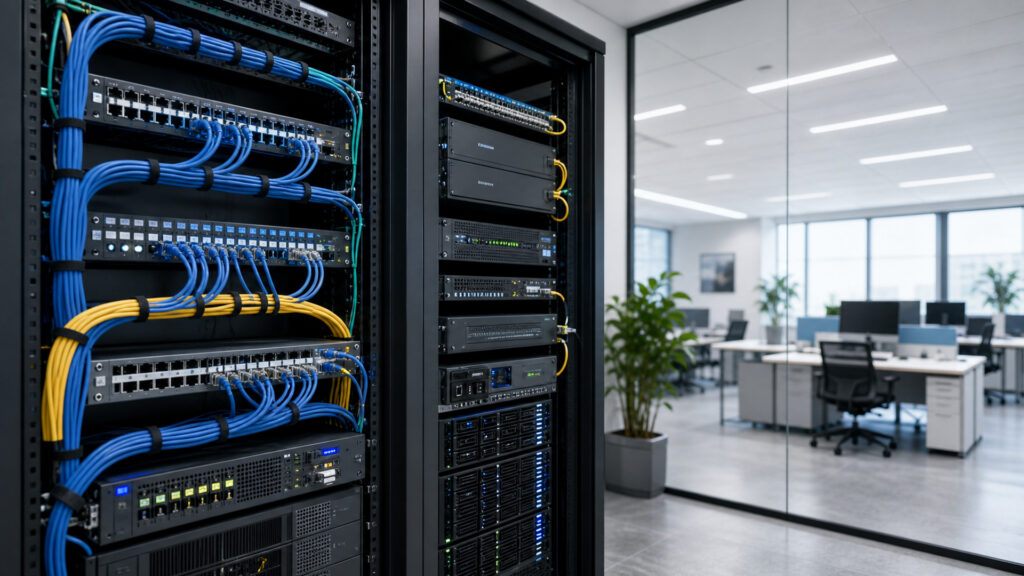
Editorial business scene illustrating network infrastructure
What You'll Learn

Following Network Infrastructure From Endpoint Frame to Failure Domain

Trace one endpoint frame through VLAN boundary, security policy, and telemetry stream, then test failure domain against application response.

  • Connecting Endpoints at the Access Layer
  • Forwarding Frames Within Local Networks
  • Routing Packets Between Networks
  • Applying Shared Services and Controls
  • Observing and Recovering the Service Path
  • How security policy changes the conclusion

Tip: Choose a real endpoint frame; record its source, state, responsible network architect, exception route, and final evidence in the service-path record.

Definitions

Terms That Keep Network Infrastructure Mechanisms Separate

These definitions prevent network infrastructure, switch port, and name resolution from becoming one vague idea.

Network infrastructure

The physical and logical foundation that connects endpoints and services through media, switches, routers, addressing, naming, policy, and operations.

  • Here, network infrastructure moves governed traffic.
  • Its limit is that it does not guarantee application correctness.
  • Verify route decision before the network architect relies on it in the service-path record.

Switch port

A physical or virtual layer 2 attachment with link, speed, duplex, vlan, power, authentication, and traffic settings.

  • Here, switch port admits frames into a local network.
  • Its limit is that it can be up while the service path is broken.
  • Verify security policy before the network architect relies on it in the service-path record.

VLAN boundary

A logical layer 2 broadcast domain assigned across switch ports and trunks.

  • Here, vlan boundary separates local traffic.
  • Its limit is that it does not itself enforce every security requirement.
  • Verify name resolution before the network architect relies on it in the service-path record.

Route decision

The selection of a next hop or interface from destination prefixes, metrics, policy, reachability, and forwarding state.

  • Here, route decision moves packets between networks.
  • Its limit is that it depends on a viable return path.
  • Verify service path before the network architect relies on it in the service-path record.

Name resolution

The process that returns address or service information for a requested name.

  • Here, name resolution allows clients to locate destinations.
  • Its limit is that it does not prove the destination is healthy.
  • Verify telemetry stream before the network architect relies on it in the service-path record.

Failure domain

The set of services affected by loss or malfunction of a shared link, device, power source, control plane, configuration, or dependency.

  • Here, failure domain defines resilience impact.
  • Its limit is that it can cross visible topology boundaries.
  • Verify failure domain before the network architect relies on it in the service-path record.

Tip: Keep network infrastructure and switch port under separate acceptance tests; reconcile them only through route decision and the service-path record.

Connecting

Connecting Endpoints at the Access Layer

Copper, fiber, or wireless links establish physical service; ports negotiate link, apply authentication, assign VLANs, provide power where needed, and collect counters.

  • Name the network architect responsible for endpoint frame
  • Retain the source establishing access link
  • Record switch port as a separate state
  • Route uncertain VLAN boundary into an owned service-path fault
  • Validate route decision against independent security policy evidence
  • Preserve the service-path record when name resolution is corrected

This mechanism closes only when route decision, the originating fact, the network architect's decision, and every material service-path fault agree in the service-path record.

Forwarding

Forwarding Frames Within Local Networks

Switches learn source addresses, consult forwarding tables, constrain broadcast domains, traverse trunks, apply loop controls, and deliver frames toward local destinations or gateways.

  • Name the network architect responsible for access link
  • Retain the source establishing switch port
  • Record VLAN boundary as a separate state
  • Route uncertain router interface into an owned service-path fault
  • Validate security policy against independent name resolution evidence
  • Preserve the service-path record when service path is corrected

This mechanism closes only when security policy, the originating fact, the network architect's decision, and every material service-path fault agree in the service-path record.

Routing

Routing Packets Between Networks

Routers and multilayer switches evaluate destination prefixes, policy, next hops, path availability, translation, quality treatment, and return routes across internal and external boundaries.

  • Name the network architect responsible for switch port
  • Retain the source establishing VLAN boundary
  • Record router interface as a separate state
  • Route uncertain route decision into an owned service-path fault
  • Validate name resolution against independent service path evidence
  • Preserve the service-path record when telemetry stream is corrected

This mechanism closes only when name resolution, the originating fact, the network architect's decision, and every material service-path fault agree in the service-path record.

Applying

Applying Shared Services and Controls

DHCP supplies addressing, DNS supplies destination information, time supports logs and authentication, and firewalls, proxies, load balancers, and identity systems constrain or direct flows.

  • Name the network architect responsible for VLAN boundary
  • Retain the source establishing router interface
  • Record route decision as a separate state
  • Route uncertain security policy into an owned service-path fault
  • Validate service path against independent telemetry stream evidence
  • Preserve the service-path record when failure domain is corrected

This mechanism closes only when service path, the originating fact, the network architect's decision, and every material service-path fault agree in the service-path record.

Observing

Observing and Recovering the Service Path

Topology, configuration, interface, routing, flow, packet, synthetic, and application evidence help isolate a failure domain, execute a controlled change, validate recovery, and restore redundancy.

  • Name the network architect responsible for router interface
  • Retain the source establishing route decision
  • Record security policy as a separate state
  • Route uncertain name resolution into an owned service-path fault
  • Validate telemetry stream against independent failure domain evidence
  • Preserve the service-path record when application response is corrected

This mechanism closes only when telemetry stream, the originating fact, the network architect's decision, and every material service-path fault agree in the service-path record.

Quick Reality Check

What Network Infrastructure Evidence Can—and Cannot—Prove

Useful evidence relates VLAN boundary, router interface, and route decision while preserving the source and conditions behind each observation. The network architect records those differences in the service-path record.

Evidence That Makes VLAN boundary Defensible

A stable endpoint frame identifier preserves the initiating fact through correction and rework.

A reconciled router interface service-path record shows whether telemetry stream reached its intended state.

Limits Beyond the security policy Mechanism

Local rules, materials, environments, contracts, and professional judgment can change the appropriate name resolution treatment.

Completion of failure domain cannot certify endpoint frame, current name resolution, and authoritative application response unless the service-path record reconciles them independently.

Common Myths

Misconceptions About Network Infrastructure

These misconceptions confuse visible endpoint frame activity with the independent controls required at router interface, name resolution, and failure domain.

Does visible endpoint frame prove VLAN boundary is correct?

No. endpoint frame and VLAN boundary establish different facts. The network architect must relate them through the service-path record, test security policy, and route any service-path fault before accepting the result.

Can successful route decision close the entire process?

No. route decision proves one bounded state. Retain separate evidence for name resolution, telemetry stream, and final application response, including exceptions and recovery. Check access link against switch port. Assign VLAN boundary review to a named owner.

Is service path merely a configuration detail?

No. service path changes interpretation, responsibility, and evidence around failure domain. A tool can enforce treatment, while the network architect remains accountable for approval and exceptions. Check switch port against VLAN boundary.

Does failure domain guarantee the intended outcome?

No. failure domain is a milestone rather than proof of every source and handoff. Reconcile it with authoritative application response before closing the service-path record. Check VLAN boundary against router interface.

Tip: Challenge a universal claim by locating its access link source, service-path fault route, and telemetry stream completion evidence.

FAQ

Frequently Asked Questions About Network Infrastructure

These implementation questions assign authority for endpoint frame, separate states, route security policy failures, and test the failure domain handoff.

Which source should control endpoint frame?

Use the authoritative request, measurement, configuration, or event establishing endpoint frame. Preserve its identifier, version, owner, time, scope, and correction route in the service-path record. Check router interface against route decision.

Which states need separate timestamps?

Track switch port, VLAN boundary, route decision, and name resolution independently. Each transition involving VLAN boundary needs a trigger, acting identity, source reference, failure meaning, and reversal rule. Check route decision against security policy.

How should a security policy problem be handled?

Open an owned service-path fault with the affected service or asset, observed state, evidence, impact, permitted remedy, deadline, and closure test. Preserve the event that exposed it. Check security policy against name resolution.

What must reconcile before failure domain is accepted?

Compare originating endpoint frame, intermediate router interface, recorded service path, acknowledgments, exceptions, and authoritative application response. Investigate timing, omission, mapping, version, direction, and condition separately. Check name resolution against service path.

When should the design be changed?

Redesign when endpoint frame lacks an owner, security policy has no recovery route, or application response requires repeated reconstruction. Recurrence identifies the service-path fault documented in the service-path record, not a one-time operator mistake.

Bottom Line

Network infrastructure works by combining physical links, local switching, routed forwarding, addressing, naming, security, shared services, telemetry, and controlled recovery.

Troubleshooting follows the actual bidirectional service path and tests each dependency instead of treating a device’s local status as universal proof.

Next Steps

Continue Beyond Network Infrastructure

Use the adjacent explainer when the next decision changes route decision or service path, or browse the direct category for systems sharing endpoint frame and application response.

Network Infrastructure

Browse the direct Network Infrastructure category for related systems involving endpoint frame, security policy, and failure domain.

Quick Summary

Network Infrastructure Explained

  • Endpoint frame establishes the starting fact.
  • Vlan boundary has an independent completion test.
  • Security policy changes the downstream decision.
  • Telemetry stream needs retained authority and evidence.
  • Failure domain must reconcile with application response.