How Off-Road Vehicles Work

Off-road vehicles work by combining a usable path for the body with enough tire contact and controlled drive to move across uneven ground. The engine or motor provides power, but geometry, gearing, differentials, suspension, and tires determine how effectively that power can be used. Protective hardware and electronic aids support particular tasks without removing the limits of the surface or the vehicle.

The details vary. A vehicle intended for slow rocky terrain can use different equipment from one intended for another kind of unpaved travel. Here, the focus is terrain-capable passenger vehicles rather than ATVs or motorcycles. Following the forces from the powertrain to the ground explains both their capability and the reasons they sometimes cannot proceed.

By: Review Streets Research Lab
Updated: October 5, 2026
Explainer · 8-12 min read
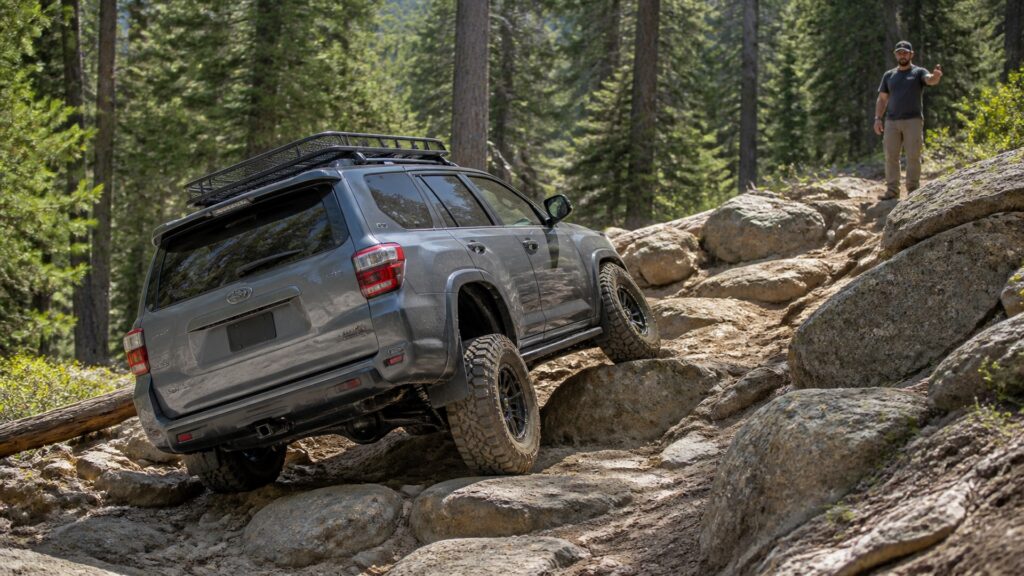
off-road vehicles explainer hero image for Review Streets
What You'll Learn

From Powertrain Output to Progress Over Terrain

Trace the relationships between drive, tire contact, wheel movement, and obstacle clearance.

  • Follow how torque reaches the driven wheels.
  • Understand how reduction gearing changes low-speed behavior.
  • See why wheel loading and surface grip influence progress.
  • Connect suspension movement with body clearance.
  • Place protective equipment and electronic assistance in context.

Tip: When progress stops, the limiting factor may be grip, geometry, or system limits rather than a shortage of power.

Definitions

Six Mechanisms Behind Off-Road Capability

Each mechanism performs a different physical job.

Torque multiplication

An increase in output torque through reduction gearing, accompanied by reduced rotational speed and subject to losses.

  • Example: greater gear reduction producing slower wheel rotation for a given input speed
  • Check: consider the transmission, final drive, and any low range together
  • Limit: gearing does not create extra power

Transfer case

A drivetrain assembly used in many four-wheel-drive vehicles to deliver drive toward the front and rear axles.

  • Example: a two-speed unit also providing a low range
  • Check: check the actual design and available modes
  • Limit: not every all-wheel-drive arrangement uses the same mechanism

Differential

A gear mechanism that accommodates different output speeds while transmitting drive.

  • Example: the two wheels on an axle following different-length paths during a turn
  • Check: identify open, limited-slip, or locking functions where fitted
  • Limit: the name alone does not describe every torque-management strategy

Tire loading

The force pressing a tire against the supporting surface.

  • Example: uneven ground reducing load on one wheel
  • Check: consider the surface and suspension position together
  • Limit: more driven wheels do not guarantee that every tire has useful grip

Suspension articulation

The ability to accommodate different wheel positions over uneven ground.

  • Example: wheels following high and low areas across a track
  • Check: consider movement range and tire loading
  • Limit: finite travel cannot accommodate every obstacle

Obstacle geometry

The relationship between the shape of the ground and the vehicle's body, wheelbase, and underbody.

  • Example: a crest approaching the underside between the axles
  • Check: check the front, center, and rear constraints
  • Limit: a single ground-clearance number is incomplete

Tip: Think of drive, grip, movement, and clearance as connected requirements. Strength in one does not erase a limit in another.

Power path

Gearing Carries Drive From the Powertrain to the Wheels

An engine or motor supplies torque through the drivetrain. In a conventional four-wheel-drive arrangement, transmission gearing and the final drives set the relationship between powertrain speed and wheel speed, while a transfer case directs drive to the axles. Some systems add a low range. This extra reduction supports slow movement with greater torque multiplication rather than requiring the vehicle to travel quickly to use its powertrain.

  • Identify the drivetrain layout before assuming how it operates.
  • Distinguish low-range gearing from a named electronic mode.
  • Follow the specific selection conditions for fitted ranges.

Toyota's four-wheel-drive 4Runner configurations provide an example of high and low ranges through a two-speed transfer case. The mechanism is useful evidence about that equipment, not proof that every SUV has it.

Contact with the ground

Tires Must Turn Delivered Torque Into Usable Force

Drive only produces useful motion when the tire and surface can transmit the needed force. Tread, construction, load, inflation, and ground conditions all influence that interaction. Uneven terrain can unload a wheel while loose material can move beneath another. The vehicle therefore needs to manage more than total engine output. Tire suitability remains important even when the drivetrain has extensive traction equipment.

  • Use tires and inflation appropriate to the vehicle and supported use.
  • Consider how the surface supports the tires.
  • Remember that steering and braking also depend on tire forces.

A wheel can spin without producing the intended forward movement. Adding power does not necessarily improve the contact or prevent the surface beneath the tire from giving way.

Unequal grip

Differentials and Traction Aids Manage Differences Between Wheels

Differentials allow wheel-speed differences needed during turns. When available grip is unequal, the drivetrain design influences how much useful drive can be delivered. Limited-slip mechanisms, locks, and brake-based traction strategies address this in different ways. A lock constrains relative output speeds; electronic intervention may brake a spinning wheel or change power delivery. These methods have distinct operating limits and should not be treated as interchangeable controls.

  • Identify which differential or axle a feature affects.
  • Distinguish mechanical locking from brake intervention.
  • Use only the settings permitted for the conditions.

If one wheel has less usable grip than the other, the system's response can influence whether the better-supported wheel receives useful drive. The exact result depends on the mechanism and the ground.

Uneven surfaces

Suspension Follows the Ground While Geometry Sets Contact Limits

Springs support load and allow movement, dampers control the rate of that movement, and suspension links guide the wheels. Articulation helps accommodate different ground heights across the vehicle. Meanwhile, body and underbody geometry determine whether an obstacle can pass beneath or beside it. Wheel contact and body clearance are related to the same terrain but remain separate constraints. Neither one alone proves the route is suitable.

  • Consider wheel movement and underbody shape together.
  • Account for overhangs and wheelbase at changes in slope.
  • Include load and equipment in the actual configuration.

The wheels may remain usefully supported while a ridge threatens the middle of the underside. Alternatively, the body may clear an obstacle while suspension travel limits how well a wheel follows the ground.

Support systems

Protection and Electronics Help With Defined Tasks

Protective hardware can shield specified vulnerable areas from certain contacts. Electronic assistance can coordinate throttle, braking, and other fitted systems for supported terrain conditions. Toyota describes available terrain selection and low-speed CRAWL Control as different assistance functions. Such features help manage particular demands; they do not establish an obstacle's safety, eliminate component limits, or create missing clearance. The driver must still assess the route and conditions.

  • Know what is protected and what remains exposed.
  • Read what each assistance system controls.
  • Treat temperature warnings or faults as information requiring attention.

A system can regulate a low-speed control task while the driver observes and steers. It cannot determine that an unseen washout or an obstacle outside the vehicle's limits is acceptable to cross.

Quick Reality Check

Capability Comes From the Combination

A useful off-road design coordinates several requirements at once.

The systems can work together to

Deliver controlled drive while accommodating changing wheel positions and grip.

Reduce some contact risks through suitable geometry and protective equipment.

They cannot guarantee

Progress across every surface or obstacle, regardless of loading and conditions.

That more throttle, another mode, or more ground clearance will solve every limitation.

Common Myths

Misconceptions About How Off-Road Vehicles Work

Capability is not produced by a single dramatic component.

Engine power is the main answer to every obstacle

Grip and physical clearance can limit progress even when ample power is available.

Low range creates extra horsepower

Reduction gearing changes speed and torque relationships. It does not create power.

A lock makes all wheels equally effective

A lock constrains a particular speed relationship. Tire loading and surface conditions still matter.

Protective plates make impacts harmless

Protection covers specified areas and has limits. It does not make all contact acceptable.

Tip: Identify the limiting physical requirement before assuming a different control setting can solve it.

FAQ

Questions About Off-Road Vehicle Mechanics

The principles are shared, but the arrangement and instructions vary.

Do all off-road vehicles have the same four-wheel-drive system?

No. Layouts, ranges, differentials, and electronic strategies differ by model and equipment.

Why does suspension movement matter to traction?

It influences how wheels follow uneven ground and how they remain loaded. It works alongside tire and drivetrain behavior.

What is the difference between a spring and a damper?

A spring supports load and permits movement. A damper controls the rate of movement and reduces continued oscillation.

Can electronics replace missing hardware?

They can manage fitted systems, but cannot supply every mechanical function or remove physical clearance limits.

How should I learn the controls on my vehicle?

Use the correct owner manual and suitable instruction for the vehicle and intended terrain. Similar control names can have different procedures and restrictions.

Bottom Line

Off-road vehicles work by coordinating gearing, drive distribution, tire forces, suspension movement, and geometry around uneven terrain.

Protection and electronic aids support that combination. Effective use still depends on the exact equipment, its condition, the load, and the ground it must cross.

Next Steps

Go Deeper or Compare Your Options

Use these Review Streets paths to compare related categories and practical next decisions.

Vehicles

Explore how vehicle systems work.

Further reading: Toyota 4Runner drivetrain and assistance examples; NHTSA tire principles and care; Ford Bronco equipment and geometry examples.