
Pre-opened bag
A ready-made bag with an open end for inserting goods.
- Bottom seam: Audion SpeedBags already have a sealed bottom.
- Mouth: The open end provides access to the inside.
- Perforation: Connected bags have a breakaway line between them.
Packing machines move packaging into position and close an opening. A bagger can feed, open and seal a bag; a carton sealer can instead apply glue to flaps. Understanding either starts with separating material movement from closure, while keeping the particular machine’s construction in view.
Bag feeding, opening and sealing are separate actions. Following them separately makes the machine easier to understand.
Tip: Follow the action being described: advancing a bag is different from opening it or sealing it.
These terms distinguish the bag supply from the equipment that moves it and makes its closure.
A ready-made bag with an open end for inserting goods.
The connected bag material travelling through a bagger.
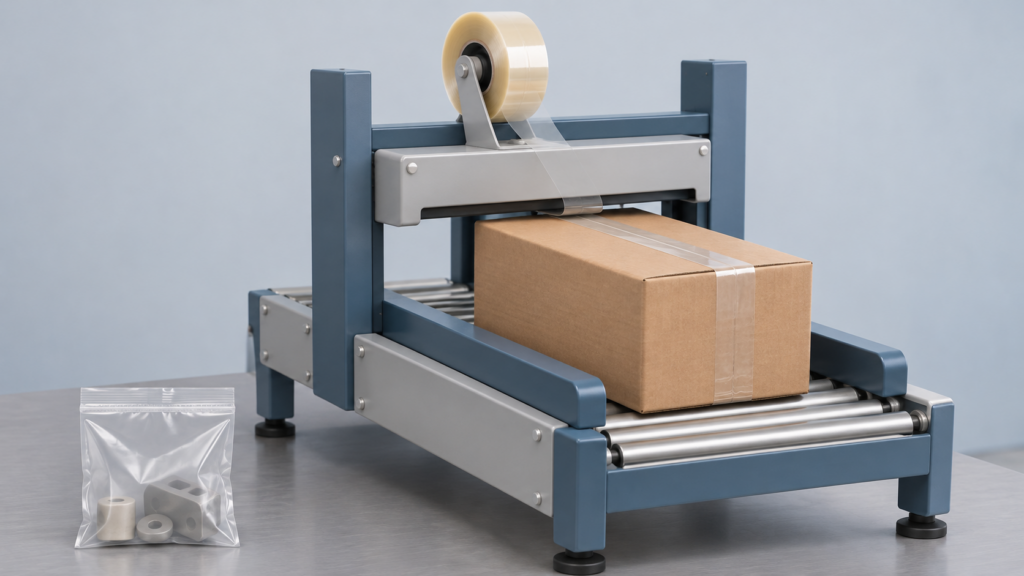
On the 700a-s, these carry the carton through the machine.
The assembly that applies and cuts carton-sealing tape.
A tape pattern that wraps over the box and onto its ends.
The closing component at a bagger’s sealing area.
Tip: A bag supply can already contain individual bags. “Film” does not necessarily mean the machine starts with an unformed sheet.
Some of the package exists before the machine closes it. Audion SpeedBags, for example, arrive with a bottom seam and an open end.
On the AUTOBAG 500, feeding and opening prepare the bag for loading; sealing closes it afterward. Each action has its own job.
Pre-opened describes an available opening; holding that opening wide enough to load is another job. The AUTOBAG 800S illustrates the distinction.
Advancing packaging and holding its mouth open solve different physical problems. On the 800S, the gripping mechanism is what maintains the loading opening.
A tape head works on a moving case. The 3M examples below distinguish the equipment carrying the carton from the parts managing the tape.
The carton’s travel and the tape roll’s controlled unwinding are related movements with different jobs. The brake does not replace the belts carrying the case.
Bag closure also involves movement around the sealing action. The following mechanisms belong to their named machines and options.
The Highspeed also has an optional support that tips the finished package away once it is closed. Release has its own mechanism.
A machine’s closing action operates under material and package conditions. Watching the motion alone does not establish every property of the resulting pack.
Under that dated guidance, a statement about carton movement cannot replace the stated adhesive application conditions.
These hypothetical examples illustrate the explanation; they are not reported tests.
Hypothetical example: a DT bagger heat-seals a bag mouth; a carton sealer adds tape across the seam between its flaps.
Both close packaging. One closes the bag’s existing mouth, while the other adds a strip spanning a carton opening.
Hypothetical example: a DT closes a bag after loading. That action closes the mouth; it does not establish the identity or quantity of what was inserted.
Nor does a closed mouth settle every property of the packaging. Audion’s SpeedBags range includes vented variants; the bag’s construction still matters to an airtightness claim.
These are misleading conclusions to avoid, not claims about how widely anyone believes them.
Ready-made bags are a documented alternative. Standard AUTOBAG bags are pre-opened pouches, so their machine does not need to create every part of the bag from an unformed sheet.
SIAT’s HM11-T uses hot-melt glue on the top flaps before they fold. It is a different closure construction from applying a strip of backed tape.
The AUTOBAG PS 125 brochure describes an all-electric system requiring no compressed air. An air-assisted example cannot establish a requirement for the whole category.
The closing mechanism can remain shut during a separate delay after heating. Ending the heat input and opening the mechanism are distinct events in that example.
That dated sheet describes a pressure-sensitive hot-melt adhesive on a backing. SIAT’s HM11 instead dispenses hot-melt glue through injectors. The shared adhesive terminology does not make those machine constructions equivalent.
Tip: An exception can settle a category-wide assumption: the PS 125’s all-electric design is enough to show that compressed air is not universal.
These details help distinguish packaging formats and optional actions without changing the basic explanation.
No. Standard AUTOBAG bags are offered on rolls or fanfolded in a box. These are supply formats for compatible equipment, not a promise that every bagger accepts both.
A resealable ziplock is a separately specified pouch feature. SidePouch offers it as an option; the word “sealed” alone does not identify that feature.
Yes. Audion’s SpeedBags tables distinguish air-relief versions from versions without vents. Closing a mouth therefore does not, by itself, establish that the whole bag is airtight.
Sealed Air says optional embossing helps its bags slip apart when leaving the roll or box. That texture concerns separation of adjacent bags, rather than the closure made after loading.
Placement matters. In the 2+ example above, the unit closes one of those joints; its name does not establish that it reaches both.
No. Standard AUTOBAG pouches are described as non-shrink. Shrinking film around goods is a different action from closing an existing mouth; heat at a bag seal does not make the whole pack a shrink wrap.
On the Highspeed, an optional device reduces how much air remains in the pack before closure. That description does not establish vacuum packaging.
On the SX, one documented sequence detaches the filled bag first. Its jaw keeps the material in place, and sealing follows. The available function determines the order.
Tip: An optional device adds a function; it does not establish a feature of every bagger.
Identify the action behind sealing. Energising an impulse wire on the SX is a different mechanism from the HM11 dispensing glue onto carton flaps.
That distinction makes a machine description easier to read: first establish the action it performs, then the conditions attached to that action. The dated guidance above, for example, qualifies adhesive behaviour independently of carton movement.
Choose the format that matches your next question.
Browse the Packing Machines lists archive.
Open the category’s comparison archive for a closer look at alternatives.
Visit the buying-guide archive when your question turns to selection.
Choose a retailer
Prices checked regularly. We may earn a commission at no cost to you.