
Percussive Motion
Percussive motion is the rapid back-and-forth movement of the massage head.
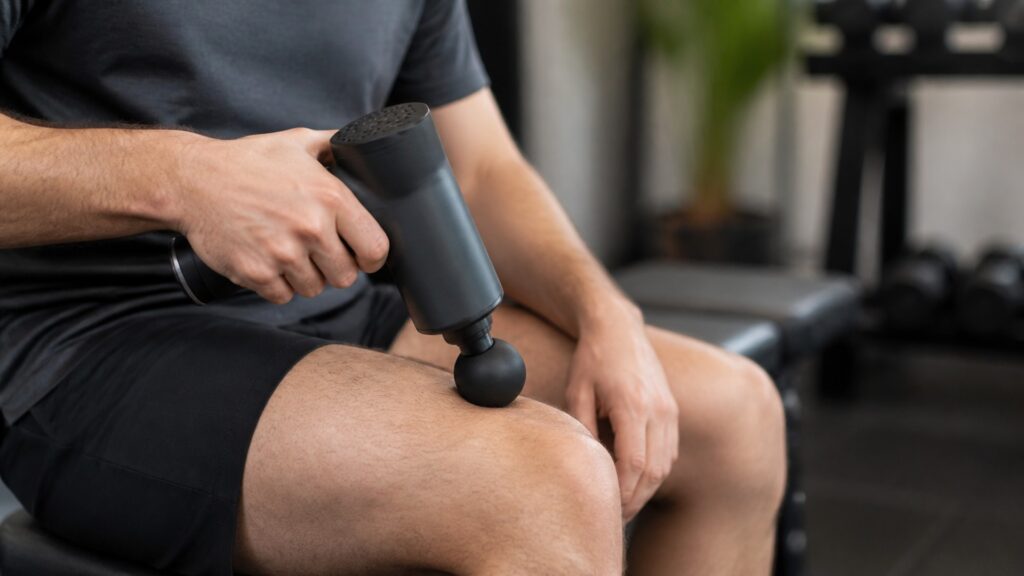
- Example: a massage gun pulsing against the quadriceps
- Check: look for controllable speed and smooth feel
- Limit: faster motion is not automatically better
Percussion massagers work by moving a massage head back and forth rapidly against soft tissue. The device creates repeated pulses that can make muscles feel less stiff and easier to prepare for movement.
The practical differences come from amplitude, speed range, stall force, attachment shape, handle design, noise, battery life, and how well the user controls pressure. The device is a recovery aid, not a cure for every soreness or injury.
A practical explanation of motion, pressure, attachments, and realistic recovery use.
Tip: Start with light pressure and a broad attachment before increasing speed or force.
These concepts explain how percussion massagers create rapid pressure and why control matters.
Percussive motion is the rapid back-and-forth movement of the massage head.
Amplitude is how far the massage head travels with each stroke.
Stall force is how much pressure the motor can resist before slowing or stopping.
Attachment shape changes how force spreads across the body.
Pressure control is the user's ability to keep force tolerable and targeted.
Recovery role is how the device supports warmup, cooldown, or comfort around training.
Tip: A percussion massager should feel controlled and useful, not like a test of pain tolerance.
A percussion massager uses a motor to move the head in fast pulses. The user places that motion against a muscle area and controls the angle, pressure, and time spent there.
The tool is simple in concept, but control matters.
Amplitude affects how deep each stroke feels. Speed affects how quickly the pulses arrive. The strongest setting is not always the most useful setting.
Useful sensation is not the same as maximum force.
Broad attachments spread force across larger muscles. Smaller or firmer attachments focus pressure more sharply and need more caution.
The attachment should match the target area and tolerance.
The device can support warmup, cooldown, or general comfort, but it does not replace training load management, sleep, hydration, or professional care for persistent symptoms.
Percussion works best as part of a sensible routine.
A good percussion massager should be easy to hold, aim, adjust, and stop. If the user cannot control pressure or reach the area comfortably, extra power is not helpful.
Control is what makes the device usable.
Percussion can support comfort and preparation, but it has limits.
It can make tight areas feel easier to move before or after training.
It gives users a quick way to apply repeated pressure at home or in a gym.
It does not diagnose injuries or erase poor recovery habits.
Aggressive pressure can irritate sensitive tissue.
Power is only useful when it stays controlled.
A lower speed may be more comfortable and easier to control.
High force can be too aggressive for some areas or users.
Attachment shape changes how force reaches the body.
Persistent pain or injury needs more than a device.
Tip: Use the device as a controlled pressure tool, not a pain challenge.
Short answers about speed, attachments, pressure, and limits.
Start with short sessions on one area and adjust based on comfort.
It may feel intense, but sharp pain, numbness, or worsening symptoms are reasons to stop.
A broad or softer attachment is usually the safer starting point.
Not always. Higher amplitude feels deeper and may be too strong for some users.
Choose a device you can control comfortably and use for specific recovery-support moments.
Percussion massagers work by applying rapid, user-controlled pulses to soft tissue around training.
The best results come from controlled pressure, suitable attachments, realistic limits, and a routine that supports movement rather than chasing intensity.
Use these Review Streets paths to compare related fitness categories and practical buying decisions.
Explore massage-gun features, attachments, and recovery use cases.
Compare related recovery and muscle-therapy tools.
Compare another recovery-tool category before deciding.
Choose a retailer
Prices checked regularly. We may earn a commission at no cost to you.