
Service Protocol
Ordered instructions covering preparation, application, monitoring, removal, and aftercare.
- Use: control the whole service
- Variable: product and provider
- Tradeoff: Skipping one step changes risk
Professional and salon beauty products work as parts of a service system. Concentrated colorants, developers, adhesives, peels, smoothing products, disinfectants, and device consumables may require measurement, mixing, controlled contact time, ventilation, protective equipment, compatible tools, documentation, and trained response to an adverse event.
The label “professional” is not a universal safety or quality certification. In the United States, most cosmetics do not receive FDA premarket approval, though companies remain responsible for safety and labeling and color additives have specific rules. Workplace exposure is a separate concern: salons use safety data sheets, ventilation, training, and protective equipment when hazardous chemicals are present.
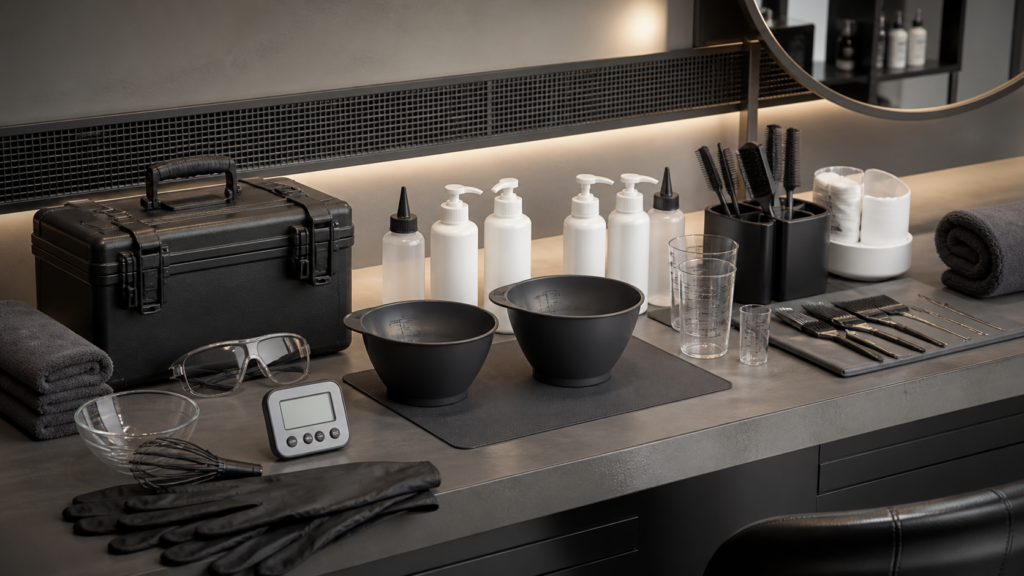
Explain professional beauty products as components of controlled service systems whose concentration, mixing, timing, delivery, ventilation, PPE, documentation, licensing, training, and aftercare determine performance; separate professional-only access from proof of superiority.
Tip: Professional selection begins before the product is opened.
These how professional and salon beauty products work concepts separate mechanism, application, limits, and purchasing consequences.
Ordered instructions covering preparation, application, monitoring, removal, and aftercare.
Product created by combining components shortly before use.
Duration a formula remains on hair, skin, or nails.
Workplace document describing hazards, handling, storage, PPE, and emergency information.
Equipment or design that reduces exposure, such as local exhaust ventilation.
Documentation of products, ratios, timing, observations, and outcomes.
Tip: Use these terms to test how professional and salon beauty products work instead of relying on a front-label promise.
A consultation should define the desired change, starting condition, previous services, allergies or reactions, medicines when relevant, and reasons to defer or refer.
Professional selection begins before the product is opened.
Use compatible containers and applicators, measure components, prepare ventilation, wear suitable PPE, protect adjacent tissue, and keep emergency materials accessible.
The room and tools are part of the formula.
Apply only to intended zones, track start times, keep reactive products off eyes and skin when required, and stop after unexpected burning, breathing symptoms, swelling, or equipment fault.
A protocol is active monitoring, not a countdown alone.
Some systems require rinsing, neutralization, curing, cooling, or residue removal. Inspect the result and give precise home-care and warning signs.
Safe completion is a chemical step of its own.
Compare ingredient disclosure, claim evidence, provider training, service controls, maintenance, cost, and recourse. A restricted distribution channel does not prove superiority.
Professional is a context, not a performance grade.
Professional products can expand service control when the full protocol is followed; they cannot make incompatible chemistry, poor sanitation, or an unqualified provider safe.
The product has a defined service step, dose, time, and stop rule.
The provider can explain training, sanitation, ventilation, and emergency response.
Concentration and exclusivity do not prove better results.
Skin, scalp, eye, respiratory, and cumulative worker exposure all matter.
These claims flatten the variables that determine how how professional and salon beauty products work performs in a real routine.
Some are concentrated or configurable; others differ mainly in packaging, support, or distribution. Strength is not synonymous with quality.
Most cosmetics are not preapproved by FDA. Salon distribution is not a government endorsement.
Training and regulation reduce some risks but cannot eliminate allergy, irritation, burns, or unpredictable response.
Odor does not reliably measure hazardous exposure. Ventilation and SDS guidance address airborne chemicals beyond comfort.
Clear aftercare protects the service outcome and helps identify complications, though recommendations should have a defined purpose.
Tip: Test the exact how professional and salon beauty products work tool, setting, and routine before generalizing from its category.
The remaining decisions about how professional and salon beauty products work concern technique, compatibility, safety, upkeep, and value.
The term can refer to distribution, concentration, system complexity, packaging, technical support, or intended operator; it is not one regulated performance class.
SDSs are workplace documents for hazardous chemicals. A salon should have applicable sheets available to workers and can explain relevant hazards and precautions.
Review applicable state licensing, manufacturer or device training, experience with the service and skin or hair characteristics, and complication procedures.
No. It may identify some reactions when required and performed correctly, but it cannot predict every allergy or irritation.
Goal, history, prior services, current condition, realistic outcome, contraindications, alternatives, cost, aftercare, and consent.
Unexpected intense burning, swelling, breathing symptoms, eye exposure, severe pain, equipment failure, or another protocol stop condition requires immediate action.
Professional and salon beauty products work through controlled systems of selection, preparation, mixing, delivery, timing, monitoring, removal, sanitation, and aftercare. The surrounding protocol often matters as much as the formula.
Judge professional products by evidence, labeling, provider competence, ventilation, PPE, documentation, and response planning—not exclusivity or strength. A complete service includes safe stopping and clear aftercare.
These Review Streets paths narrow the next how professional and salon beauty products work decision by format, goal, and routine fit.
Browse professional products, equipment, and salon-focused beauty categories.
Compare professional-inspired skincare and beauty device technologies.
Choose a retailer
Prices checked regularly. We may earn a commission at no cost to you.