
Surface Cutting
Severing a hair shaft near the skin with a blade or guarded cutter.
- Use: understand shaving
- Variable: blade geometry and direction
- Tradeoff: Does not alter growth rate
Shaving and hair-removal products do not all remove the same part of a hair. Manual and electric razors cut the shaft at or just above the skin surface. Wax, sugaring, tweezers, and epilators pull hair from the follicle. Depilatory creams chemically weaken hair-shaft keratin so it can be wiped away. Laser and intense pulsed light deliver energy absorbed mainly by pigment to impair growth in treated follicles over repeated sessions.
That depth and mechanism explain most differences in speed, smoothness, regrowth, discomfort, and risk. Surface cutting is fast and repeatable; root extraction stays smoother longer but can hurt and promote ingrown hairs; depilatories avoid a blade but can irritate or burn; light-based systems require compatible hair and skin contrast, careful parameters, multiple growth-cycle sessions, and maintenance.
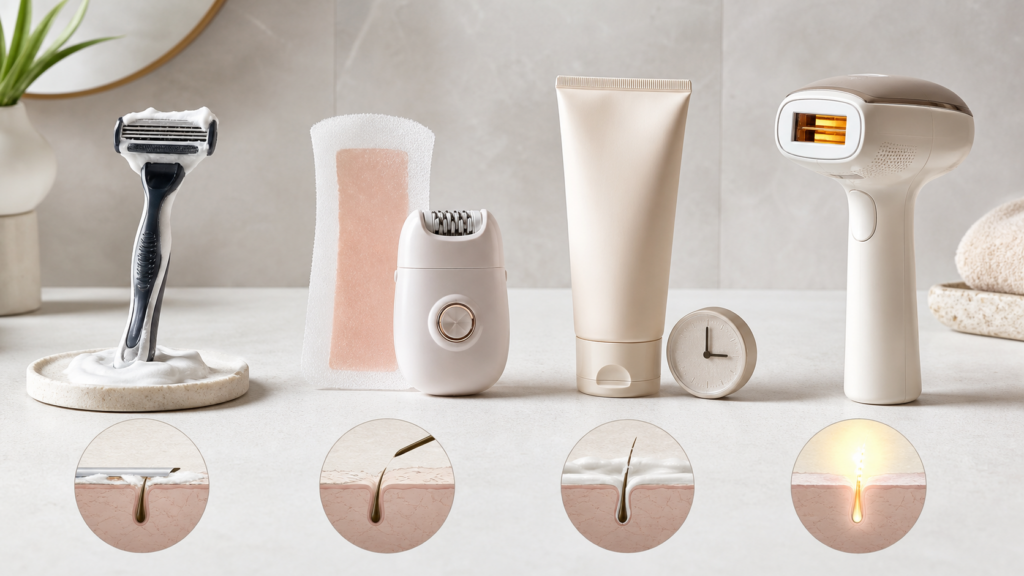
Explain the main mechanisms—surface cutting, root extraction, keratin dissolution, and pigment-targeted light—then connect mechanism to regrowth timing, feel, irritation, skin and hair compatibility, technique, safety, maintenance, and purchase choice.
Tip: A closer pass is not always a calmer pass.
These how shaving and hair removal products work concepts separate mechanism, application, limits, and purchasing consequences.
Severing a hair shaft near the skin with a blade or guarded cutter.
Pulling a hair out from within its follicle.
Removal of visible hair, often at or near the surface.
Chemical weakening of hair protein by a depilatory formula.
Use of absorbed light to heat a target more than surrounding tissue.
Repeated sessions timed to treat follicles as hairs enter responsive growth phases.
Tip: Use these terms to test how shaving and hair removal products work instead of relying on a front-label promise.
Wet skin and hair, use a suitable shaving cream, move with hair growth initially, rinse the blade, and avoid repeated passes over irritated skin.
A closer pass is not always a calmer pass.
Wax, sugar, tweezers, and epilators need enough hair to grip and clean technique. Avoid traumatized skin and use cautious aftercare to reduce friction and picking.
Longer smoothness trades for discomfort and follicle irritation.
Patch test as directed, use only on approved body areas, apply for the stated interval, remove gently, rinse thoroughly, and never extend time to chase stubborn hair.
Chemical hair removal is not a leave-on treatment.
Laser and IPL performance depends on optical design, energy, pulse, cooling, skin pigment, hair pigment, hair diameter, and growth cycle. Home devices are not miniature equivalents of every clinic system.
Light treatment is a course, not one flash.
Balance closeness, time, pain, irritation, ingrowns, body area, portability, disposables, cleaning, appointment access, contraindications, and long-term cost.
The best mechanism is the one your skin and schedule can sustain.
Every method can reduce visible hair; none guarantees permanent removal of every hair or freedom from irritation.
Preparation and technique fit the body area and mechanism.
The product is used only on labeled skin tones, hair colors, areas, and conditions.
More pressure, longer contact, or higher energy can increase harm without proportionate benefit.
A sustainable schedule includes cleanup, replacement parts, regrowth, and skin recovery.
These claims flatten the variables that determine how how shaving and hair removal products work performs in a real routine.
Cut hair can feel blunt or look darker at first, but shaving does not change follicle number, diameter, or growth rate.
It removes hair from the root, but most follicles produce new hair; long-term patterns vary.
Most formulas weaken the exposed shaft at or near the skin surface rather than eliminating the follicle.
Both use light and pigment targeting, but their light sources and optical characteristics differ.
Extra closeness may increase irritation or ingrowns; comfort, skin condition, and frequency matter.
Tip: Test the exact how shaving and hair removal products work tool, setting, and routine before generalizing from its category.
The remaining decisions about how shaving and hair removal products work concern technique, compatibility, safety, upkeep, and value.
Light-based reduction can produce longer-term change after a course; root extraction generally outlasts shaving or depilatories between sessions.
A hair can curve or become trapped as it grows, especially with close cutting, curl pattern, friction, or follicular inflammation.
Yes, but light-based programs commonly require shaving rather than root extraction between sessions; follow device or provider instructions.
Yes, exactly as labeled, even if another formula was tolerated previously.
White, gray, and very light blond or red hair often have insufficient target pigment; device eligibility varies.
Seek care for spreading redness, pus, severe burns, persistent painful bumps, scarring, or unexplained hair and skin changes.
Shaving cuts, wax and epilators extract, depilatories weaken hair keratin, and laser or IPL target pigment with light. The mechanism determines how fast the method works, how regrowth feels, and which risks require attention.
Match the method to body area, skin and hair characteristics, desired interval, pain tolerance, time, contraindications, and maintenance. Never compensate for poor results with extra pressure, contact time, heat, or unapproved energy settings.
These Review Streets paths narrow the next how shaving and hair removal products work decision by format, goal, and routine fit.
Browse shaving, epilation, and light-based hair-removal categories.
Compare at-home beauty devices, including light-based hair-removal systems.
Choose a retailer
Prices checked regularly. We may earn a commission at no cost to you.