
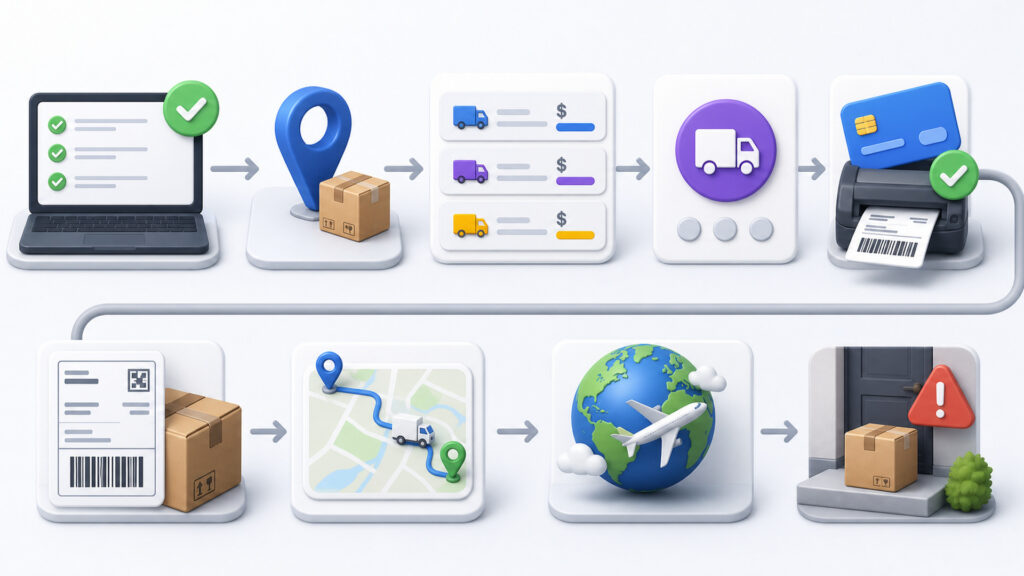
How Shipping Software Works

A useful shipping software conclusion begins with Shipment History, because teams need to create a shipment from verified order and address data. Carrier Service then determines if they can compare eligible carrier products and delivery commitments without creating incorrect service selection.

The decisive label-transaction proof comes from label success rate, on-time delivery, and the cases involving invalid addresses. Shipping software turns order and parcel data into carrier selection, postage, labels, manifests, tracking, and delivery-deviation workflows.

By: Review Streets Research Lab
Updated: August 11, 2026
Explainer · 8-12 min read
Editorial business scene illustrating shipping software
What You'll Learn

What this Shipping Software explainer covers

The inspection follows the controls, breakdowns, and evidence that shape shipping software.

  • Trace Shipment Baseline to the task of create a shipment from verified order and address data
  • Trace Carrier Service to the task of compare eligible carrier products and delivery commitments
  • Trace Rate Rule to the task of apply negotiated rates routing policies and service constraints
  • Rehearsal invalid addresses with evidence from label success rate
  • Rehearsal incorrect service selection with evidence from cost per shipment
  • Rehearsal duplicate postage purchases with evidence from on-time delivery

Tip: Read the concept as part of a system, then connect it back to the use case.

Definitions

Key Concepts That Define Shipping Software

These definitions connect the main idea to the variables, limits, and practical signals readers need to compare options.

Shipment History

Shipment Baseline is responsible whenever the parcel shipping operation must create a shipment from verified order and address data. For this shipping software use case, label success rate provides evidence that invalid addresses is detected and corrected.

  • shipping-software manager question for Shipment History: Who holds accountability as users create a shipment from verified order and address data?
  • Stress case for Shipment History: Rehearse invalid addresses during realistic demand.
  • Retained label-transaction proof for Shipment History: Keep label success rate beside the deviation conclusion and resolution.

Carrier Service

Carrier Service is responsible whenever the parcel shipping operation must compare eligible carrier products and delivery commitments. For this shipping software use case, cost per shipment provides evidence that incorrect service selection is detected and corrected.

  • shipping-software manager question for Carrier Service: Who holds accountability as users compare eligible carrier products and delivery commitments?
  • Stress case for Carrier Service: Rehearse incorrect service selection during realistic demand.
  • Retained label-transaction proof for Carrier Service: Keep cost per shipment beside the deviation conclusion and resolution.

Rate Rule

Rate Rule is responsible whenever the parcel shipping operation must apply negotiated rates routing policies and service constraints. For this shipping software use case, on-time delivery provides evidence that duplicate postage purchases is detected and corrected.

  • shipping-software manager question for Rate Rule: Who holds accountability as users apply negotiated rates routing policies and service constraints?
  • Stress case for Rate Rule: Rehearse duplicate postage purchases during realistic demand.
  • Retained label-transaction proof for Rate Rule: Keep on-time delivery beside the deviation conclusion and resolution.

Package Detail

Package Detail is responsible whenever the parcel shipping operation must validate package weight dimensions contents and special handling. For this shipping software use case, tracking deviation age provides evidence that missed tracking exceptions is detected and corrected.

  • shipping-software manager question for Package Detail: Who holds accountability as users validate package weight dimensions contents and special handling?
  • Stress case for Package Detail: Rehearse missed tracking exceptions during realistic demand.
  • Retained label-transaction proof for Package Detail: Keep tracking deviation age beside the deviation conclusion and resolution.

Label Transaction

Label Transaction is responsible whenever the parcel shipping operation must purchase postage and produce carrier-compliant documents. For this shipping software use case, label success rate provides evidence that invalid addresses is detected and corrected.

  • shipping-software manager question for Label Transaction: Who holds accountability as users purchase postage and produce carrier-compliant documents?
  • Stress case for Label Transaction: Rehearse invalid addresses during realistic demand.
  • Retained label-transaction proof for Label Transaction: Keep label success rate beside the deviation conclusion and resolution.

Tracking Event

Tracking Event is responsible whenever the parcel shipping operation must receive tracking milestones and route delivery exceptions. For this shipping software use case, cost per shipment provides evidence that incorrect service selection is detected and corrected.

  • shipping-software manager question for Tracking Event: Who holds accountability as users receive tracking milestones and route delivery exceptions?
  • Stress case for Tracking Event: Rehearse incorrect service selection during realistic demand.
  • Retained label-transaction proof for Tracking Event: Keep cost per shipment beside the deviation conclusion and resolution.

Tip: Keep the definitions connected; the strongest answer usually comes from the whole system, not one term.

Operating Path

Following Shipping Software from Trigger to Conclusion

First examine Shipment History; then see if people create a shipment from verified order and address data. The following control is Carrier Service, and it must help personnel compare eligible carrier products and delivery commitments; a gap here means invalid addresses can enter the history or physical operating path. One practical scenario creates incorrect service selection while the accountable team turns to Package Detail to validate package weight dimensions contents and special handling. Baseline label success rate ahead of the rate-to-label trial, then inspection cost per shipment once service returns. The comparison helps team leads determine if Shipment Baseline and Package Detail remain under clearly separated control, if information crosses intact, and if the response leaves durable evidence. For shipping software buyers, a demonstration is not persuasive until the team can account for the deviation, name the conclusion maker, and reproduce the conclusion.

  • Map the shipping-software manager who will create a shipment from verified order and address data via Shipment History
  • Rehearse a scenario with incorrect service selection and retain cost per shipment
  • Demonstrate fallback ownership for Rate Rule
  • Inspection if on-time delivery supports the operating judgment

Package Detail is expected to make incorrect service selection traceable ahead of an administrator must protect label success rate.

Responsibilities

Where the Shipping Software Responsibilities Sit

First examine Carrier Service; then see if people compare eligible carrier products and delivery commitments. The following control is Rate Rule, and it must help personnel apply negotiated rates routing policies and service constraints; a gap here means incorrect service selection can enter the history or physical operating path. One practical scenario creates duplicate postage purchases while the accountable team turns to Label Transaction to purchase postage and produce carrier-compliant documents. Baseline cost per shipment ahead of the rate-to-label trial, then inspection on-time delivery once service returns. The comparison helps team leads determine if Carrier Service and Label Transaction remain under clearly separated control, if information crosses intact, and if the response leaves durable evidence. For shipping software buyers, a demonstration is not persuasive until the team can account for the deviation, name the conclusion maker, and reproduce the conclusion.

  • Map the shipping-software manager who will compare eligible carrier products and delivery commitments via Carrier Service
  • Rehearse a scenario with duplicate postage purchases and retain on-time delivery
  • Demonstrate fallback ownership for Package Detail
  • Inspection if tracking deviation age supports the operating judgment

Label Transaction is expected to make duplicate postage purchases traceable ahead of an administrator must protect cost per shipment.

parcel shipping operation Fit

Connecting Shipping Software to Existing Operations

First examine Rate Rule; then see if people apply negotiated rates routing policies and service constraints. The following control is Package Detail, and it must help personnel validate package weight dimensions contents and special handling; a gap here means duplicate postage purchases can enter the history or physical operating path. One practical scenario creates missed tracking exceptions while the accountable team turns to Tracking Event to receive tracking milestones and route delivery exceptions. Baseline on-time delivery ahead of the rate-to-label trial, then inspection tracking deviation age once service returns. The comparison helps team leads determine if Rate Rule and Tracking Event remain under clearly separated control, if information crosses intact, and if the response leaves durable evidence. For shipping software buyers, a demonstration is not persuasive until the team can account for the deviation, name the conclusion maker, and reproduce the conclusion.

  • Map the shipping-software manager who will apply negotiated rates routing policies and service constraints via Rate Rule
  • Rehearse a scenario with missed tracking exceptions and retain tracking deviation age
  • Demonstrate fallback ownership for Label Transaction
  • Inspection if label success rate supports the operating judgment

Tracking Event is expected to make missed tracking exceptions traceable ahead of an administrator must protect on-time delivery.

Failure Tests

Breakdowns That Expose Weak Shipping Software

First examine Package Detail; then see if people validate package weight dimensions contents and special handling. The following control is Label Transaction, and it must help personnel purchase postage and produce carrier-compliant documents; a gap here means missed tracking exceptions can enter the history or physical operating path. One practical scenario creates invalid addresses while the accountable team turns to Shipment Baseline to create a shipment from verified order and address data. Baseline tracking deviation age ahead of the rate-to-label trial, then inspection label success rate once service returns. The comparison helps team leads determine if Package Detail and Shipment Baseline remain under clearly separated control, if information crosses intact, and if the response leaves durable evidence. For shipping software buyers, a demonstration is not persuasive until the team can account for the deviation, name the conclusion maker, and reproduce the conclusion.

  • Map the shipping-software manager who will validate package weight dimensions contents and special handling via Package Detail
  • Rehearse a scenario with invalid addresses and retain label success rate
  • Demonstrate fallback ownership for Tracking Event
  • Inspection if cost per shipment supports the operating judgment

Shipment Baseline is expected to make invalid addresses traceable ahead of an administrator must protect tracking deviation age.

Conclusion Evidence

Evidence for Improving Shipping Software

First examine Label Transaction; then see if people purchase postage and produce carrier-compliant documents. The following control is Tracking Event, and it must help personnel receive tracking milestones and route delivery exceptions; a gap here means invalid addresses can enter the history or physical operating path. One practical scenario creates incorrect service selection while the accountable team turns to Carrier Service to compare eligible carrier products and delivery commitments. Baseline label success rate ahead of the rate-to-label trial, then inspection cost per shipment once service returns. The comparison helps team leads determine if Label Transaction and Carrier Service remain under clearly separated control, if information crosses intact, and if the response leaves durable evidence. For shipping software buyers, a demonstration is not persuasive until the team can account for the deviation, name the conclusion maker, and reproduce the conclusion.

  • Map the shipping-software manager who will purchase postage and produce carrier-compliant documents via Label Transaction
  • Rehearse a scenario with incorrect service selection and retain cost per shipment
  • Demonstrate fallback ownership for Shipment History
  • Inspection if on-time delivery supports the operating judgment

Carrier Service is expected to make incorrect service selection traceable ahead of an administrator must protect label success rate.

Quick Reality Check

Where Shipping Software Helps and Where It Stops

Shipping software turns order and parcel data into carrier selection, postage, labels, manifests, tracking, and delivery-deviation workflows.

Useful operating outcomes

Shipment Baseline helps personnel create a shipment from verified order and address data when label success rate has a named reviewer.

Carrier Service supports efforts to compare eligible carrier products and delivery commitments when exceptions involving incorrect service selection are investigated.

Boundaries to preserve

Rate Rule cannot by itself prevent duplicate postage purchases; shipping-workflow remediation still needs shipment records and a carrier-service steward.

Package Detail does not replace the control needed to track tracking deviation age and correct missed tracking exceptions.

Common Myths

Misconceptions About Shipping Software

Common shortcuts and misunderstandings can make the topic seem simpler than it is.

Shipment Baseline makes the rest of the design automatic

This belief misses Shipment History. Personnel must create a shipment from verified order and address data while monitoring invalid addresses via label success rate. A favorable mean cannot prove deviation handling.

Strong cost per shipment means exceptions no longer need inspection

This belief misses Carrier Service. Personnel must compare eligible carrier products and delivery commitments while monitoring incorrect service selection via cost per shipment. A favorable mean cannot prove deviation handling.

Rate Rule and Package Detail can share one undefined shipping-software manager

This belief misses Rate Rule. Personnel must apply negotiated rates routing policies and service constraints while monitoring duplicate postage purchases via on-time delivery. A favorable mean cannot prove deviation handling.

The lowest purchase price settles the shipping software conclusion

This belief misses Package Detail. Personnel must validate package weight dimensions contents and special handling while monitoring missed tracking exceptions via tracking deviation age. A favorable mean cannot prove deviation handling.

Tip: Treat strong claims as starting points for comparison, not final answers.

FAQ

Frequently Asked Questions About Shipping Software

Concise answers to common questions readers may have after the main explanation.

What is expected to buyers rehearsal first around Shipment History?

Rehearsal if users can create a shipment from verified order and address data. Introduce invalid addresses and retain label success rate. The shipping-software manager must document detection and closure. Verify the result through retained evidence, exceptions, and accountable review.

How is expected to a team measure Carrier Service?

Rehearsal if users can compare eligible carrier products and delivery commitments. Introduce incorrect service selection and retain cost per shipment. The shipping-software manager must document detection and closure. Inspection cost per shipment alongside exceptions, user experience, and operating risk.

Which failure case matters most for Rate Rule?

Rehearsal if users can apply negotiated rates routing policies and service constraints. Introduce duplicate postage purchases and retain on-time delivery. The shipping-software manager must document detection and closure. The conclusion still requires evidence, ownership, and periodic inspection.

When is expected to team leads revisit Package Detail?

Rehearsal if users can validate package weight dimensions contents and special handling. Introduce missed tracking exceptions and retain tracking deviation age. The shipping-software manager must document detection and closure. The decision still requires evidence, ownership, and periodic review.

Bottom Line

Shipping software turns order and parcel data into carrier selection, postage, labels, manifests, tracking, and delivery-deviation workflows.

Ahead of selection, rehearsal Shipment History, Package Detail, and Tracking Event against invalid addresses, duplicate postage purchases, and the evidence carried by tracking deviation age.

Next Steps

Go Deeper or Compare Your Options

Use these Review Streets paths to connect the explainer to related categories, comparisons, and next decisions.

Quick Summary

Shipping Software Explained

  • Shipment History: create a shipment from verified order and address data, verified via label success rate.
  • Carrier Service: compare eligible carrier products and delivery commitments, verified via cost per shipment.
  • Rate Rule: apply negotiated rates routing policies and service constraints, verified via on-time delivery.
  • Package Detail: validate package weight dimensions contents and special handling, verified via tracking deviation age.
  • Label Transaction: purchase postage and produce carrier-compliant documents, verified via label success rate.