
Surfactant
Molecule with oil- and water-compatible regions that helps lift and disperse soil.
- Use: understand cleansing
- Variable: type and concentration
- Tradeoff: Strong foam is not required
Skincare products work by changing what sits on the skin surface, how water moves through the outer layer, how ultraviolet radiation reaches tissue, or how skin cells respond to a delivered ingredient. Cleansers suspend oil and soil so water can remove them. Moisturizers combine water-binding humectants, surface-smoothing emollients, and water-loss-reducing occlusives. Sunscreens form a tested film that absorbs and, for mineral filters, also reflects some UV. Exfoliants loosen or remove surface cells, while retinoids and some drugs alter cellular processes.
A label ingredient is only part of the mechanism. Concentration, pH, solvent, emulsion, encapsulation, stability, packaging, application amount, contact time, layer order, and user tolerance determine whether an ingredient reaches its intended site in a useful form. More products can create more irritation without adding a meaningful function.
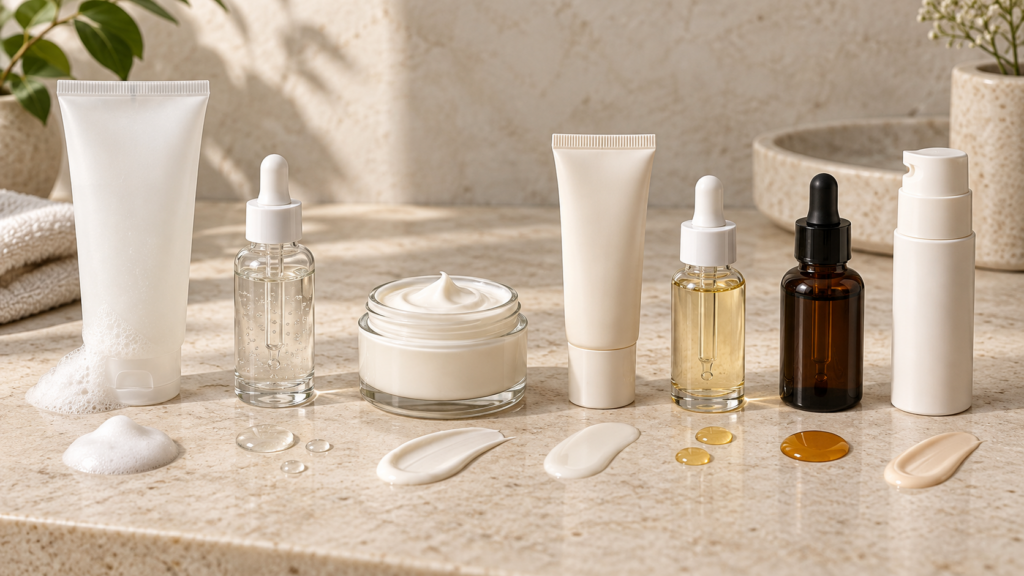
Explain how cleansers, moisturizers, sunscreens, exfoliants, antioxidants, retinoids, and targeted treatments act through removal, deposition, occlusion, hydration, UV filtering, chemical exfoliation, signaling, and drug action—then connect formulation, delivery, order, dose, tolerance, evidence, and routine design.
Tip: Cleansing prepares the surface but is not treatment for every concern.
These how skincare products work concepts separate mechanism, application, limits, and purchasing consequences.
Molecule with oil- and water-compatible regions that helps lift and disperse soil.
Ingredient that binds water in or near the outer skin layer.
Material that smooths gaps between surface cells and improves feel.
Film-former that slows evaporation from skin.
Ingredient intended to provide a defined cosmetic or drug function.
Cream, lotion, gel, serum, ointment, stick, or other system carrying ingredients.
Tip: Use these terms to test how skincare products work instead of relying on a front-label promise.
Use a suitable cleanser to lift sunscreen, makeup, oil, sweat, and soil while limiting unnecessary friction, hot water, and repeated washing.
Cleansing prepares the surface but is not treatment for every concern.
Moisturizers vary the balance of humectants, emollients, and occlusives. Apply a tolerable texture, often on damp skin, to match dryness and climate.
Moisture performance is a system, not one fashionable ingredient.
Broad-spectrum SPF depends on tested formulation and adequate uniform application. Water, sweat, towels, time, and missed areas reduce real-world coverage.
Sunscreen works as a maintained film, not a morning checkbox.
Antioxidants, exfoliants, retinoids, acne drugs, pigment treatments, and soothing products have different evidence, time horizons, and irritation profiles.
An ingredient cannot be judged outside its formula and routine.
A practical order is gentle cleansing, medication or treatment, moisturizer and sunscreen, then makeup. Exact directions and compatible textures override internet rules.
The best sequence is the one that preserves function and use.
Skincare can cleanse, protect, hydrate, and influence defined concerns; it cannot override diagnosis, formulation limits, inconsistent use, or individual biology.
Each product has one clear job and an observable reason to remain in the routine.
The vehicle and format fit the area, climate, skin response, and other layers.
Treatments are introduced slowly enough to identify benefit or irritation.
Painful, persistent, spreading, bleeding, infected, or changing skin concerns receive clinical assessment.
These claims flatten the variables that determine how how skincare products work performs in a real routine.
Many products act mainly at or within the outer layers; penetration depends on molecule, vehicle, dose, and barrier.
Plants and fragrance can irritate or cause allergy. Source does not predict tolerance.
Sensation may reflect irritation and is not a reliable measure of efficacy.
Extra layers can duplicate functions, pill, irritate, raise cost, and make adherence harder.
Products can reduce oil, debris, or appearance temporarily, but they do not erase normal follicular openings.
Tip: Test the exact how skincare products work tool, setting, and routine before generalizing from its category.
The remaining decisions about how skincare products work concern technique, compatibility, safety, upkeep, and value.
Many routines need only a gentle cleanser, suitable moisturizer, broad-spectrum sunscreen, and one targeted treatment when justified.
Incompatible films, excessive amount, rubbing, rapid layering, or dried product can roll into particles.
Feel and irritation can appear quickly; acne, pigment, and texture changes often need weeks or months. Follow directions and use comparable observations.
Only if instructions support it. Mixing can change dose, film formation, stability, or distribution.
It signals formulation intended not to clog pores, but it does not guarantee no breakout for every user.
For severe or persistent acne, rash, pain, bleeding, infection, scarring, hair loss, changing lesions, or reactions that do not settle after stopping a product.
Skincare products work through specific delivery jobs: cleansers lift and suspend, moisturizers bind and retain water, sunscreens build a UV-filtering film, exfoliants alter surface-cell cohesion, and treatments deliver ingredients that affect defined pathways.
Build a routine by function, formula, dose, sequence, tolerance, and evidence. Use fewer purposeful products consistently, maintain sunscreen coverage, and treat persistent or concerning skin changes as clinical questions rather than invitations to add more actives.
These Review Streets paths narrow the next how skincare products work decision by format, goal, and routine fit.
Browse cleansers, moisturizers, sunscreens, serums, and treatment categories.
Compare skincare devices and treatment technologies.
Choose a retailer
Prices checked regularly. We may earn a commission at no cost to you.