
Guided Bar Path
A guided bar path means the bar travels on rails instead of moving freely.
- Example: a Smith bar moving up and down during a press
- Check: test whether the path feels natural for the lift
- Limit: the fixed path may not fit every body
Smith machines work by guiding a barbell along fixed rails instead of letting the bar move freely through space. The user still lifts the weight, but the machine controls the bar path and usually includes hooks or catches that let the bar be racked at several points.
That guided path is the main difference from a power rack. A Smith machine can make some presses, squats, lunges, rows, and calf raises easier to set up, but the fixed track also means the movement has to fit the user's body and the exercise.
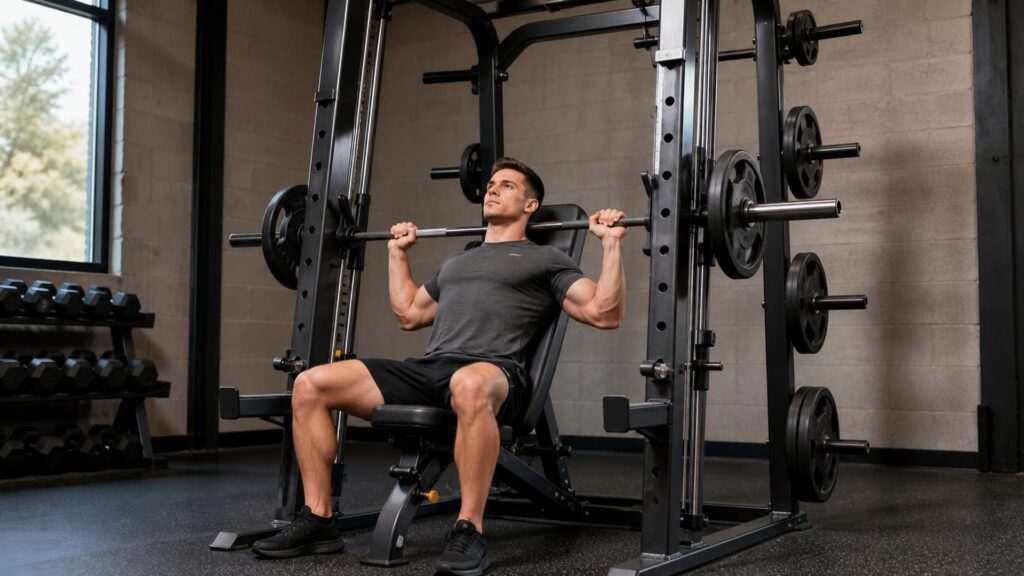
A practical look at rails, hooks, stops, counterbalance, and guided-bar movement.
Tip: Judge a Smith machine by how its guided bar path fits the lifts a person will repeat, not by the fact that the bar is guided.
These concepts clarify how Smith machines fit home strength training and equipment comparisons.
A guided bar path means the bar travels on rails instead of moving freely.
The rail system is the track that controls the bar's movement.
Rack hooks or catches let the user rotate or place the bar into a resting position.
Safety stops limit how low the bar can travel.
Counterbalance reduces the effective starting weight on some Smith machines.
Exercise fit is how well the fixed path matches the user's intended movement.
Tip: A Smith machine works best when the fixed path supports the exercise instead of forcing the lifter into an awkward line.
The defining feature of a Smith machine is that the bar travels along rails. That makes the path more predictable, but also less adaptable than a free barbell.
The rail path is the machine's main benefit and main limit.
Smith machines usually let the user rack the bar at several points and set stops below the movement. Those parts make setup easier when they are used correctly.
Good setup makes the guided bar easier to use confidently.
A fixed track does not automatically make a movement better. The user's height, stance, bench placement, and joint comfort all affect whether the path feels right.
The machine should guide the lift without fighting the lifter.
A power rack supports a free barbell. A Smith machine guides the bar. That difference changes balance, setup, and the muscles used to control the lift.
The two tools can overlap, but they train differently.
Smith machines are often useful for controlled pressing, squat variations, split squats, rows, and calf raises when the fixed path matches the movement.
The right exercise makes the guided path feel helpful rather than restrictive.
The guided bar can simplify setup, but it does not fit every movement.
They provide a predictable bar path and multiple rack points.
They can make selected presses, squats, rows, and accessory movements easier to set up.
They do not teach every free-barbell skill.
The fixed path can feel awkward for some bodies or exercises.
The guided bar changes the lift, but it does not remove all setup decisions.
It controls the bar path, but the user still controls load, stance, and body position.
The fixed path changes movement and stabilization demands.
The path, stops, and load still have to fit the exercise.
Rail angle, counterbalance, smoothness, and hooks can vary.
Tip: A guided bar is a tool, not a guarantee. The path, setup, and exercise choice still matter.
Short answers for choosing and using Smith machines.
It is used for guided-bar strength exercises such as presses, squat variations, rows, lunges, and calf raises.
No. A rack supports a free barbell, while a Smith machine guides the bar on rails.
Check bar path, hook operation, safety stops, starting resistance, and exercise fit.
They can be useful when setup is clear, but beginners still need appropriate load and movement instruction.
A Smith machine works by guiding the bar, which helps some movements and limits others.
Smith machines work by guiding a barbell along rails and giving the user multiple rack points and safety stops.
They are most useful when the fixed path fits the exercise, the user's body, and the training goal.
Use these Review Streets paths to compare related categories and practical next decisions.
Explore guided-bar strength equipment and setup tradeoffs.
Compare free-barbell rack training with guided-bar machines.
Review cable-focused equipment for accessory and angle-based work.
Choose a retailer
Prices checked regularly. We may earn a commission at no cost to you.