
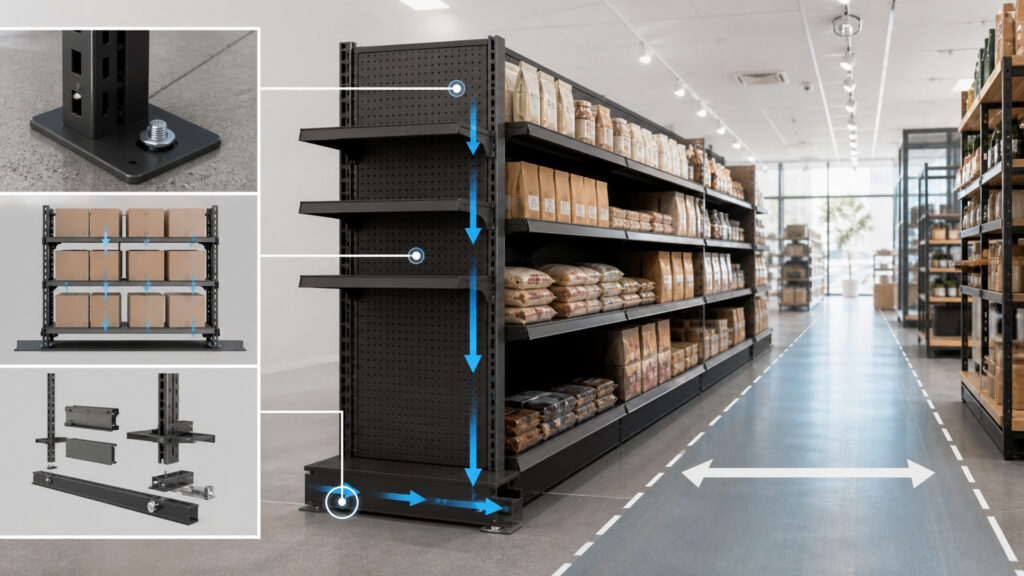
How Store Fixtures Work

Store fixtures turn retail space into physical capacity for presenting, storing, securing, demonstrating, dispensing, or serving merchandise. They include shelving, gondolas, racks, cases, counters, cabinets, tables, wall systems, hooks, bins, kiosks, and specialized assemblies. Their operation depends on more than appearance because merchandise and human forces must travel safely through connected components into a stable base, wall, or floor.

A fixture works as a load path, planning unit, access boundary, merchandising surface, and maintained asset. Product size and weight, component compatibility, anchorage, reach, circulation, replenishment, security, utilities, installation tolerances, inspection, and reconfiguration rules determine whether the installed system remains usable.

By: Review Streets Research Lab
Updated: September 1, 2026
Explainer · 8-12 min read
Editorial business scene illustrating store fixtures work
What You'll Learn

The Evidence Chain Behind Store Fixtures

Follow load path into bracket connection, observe the consequence at product capacity, and require inspection record to reconcile with reconfiguration limit.

  • Translating Retail Requirements into a Fixture Plan
  • Carrying Loads Through Components
  • Positioning Merchandise and Access
  • Installing and Commissioning the Assembly
  • Inspecting, Maintaining, and Reconfiguring
  • How product capacity changes the conclusion

Tip: Take one real load path case and mark each owner, version, place, exception, and completion artifact in the fixture commissioning file.

Definitions

Six Boundaries That Define Store Fixtures

These terms keep store fixture, fixture bay, and installation tolerance from being treated as interchangeable parts of one generic equipment category.

Store fixture

A physical structure that supports, contains, secures, presents, or makes merchandise and services accessible in a retail environment.

  • Its operating contribution is specific: it turns space into usable capacity.
  • The practical limit is equally important: it must suit load and circulation conditions.
  • The fixture engineer should verify product capacity before treating this boundary as complete.

Load path

The route by which merchandise weight and applied forces move through shelves, brackets, uprights, bases, anchors, floors, or walls.

  • Its operating contribution is specific: it determines structural behavior.
  • The practical limit is equally important: it changes with configuration.
  • The fixture engineer should verify access envelope before treating this boundary as complete.

Fixture bay

A defined section between uprights, frames, cabinets, or other boundaries.

  • Its operating contribution is specific: it provides a repeatable planning unit.
  • The practical limit is equally important: it has finite dimensions and capacity.
  • The fixture engineer should verify planogram position before treating this boundary as complete.

Access envelope

The clear space needed for shoppers, staff, mobility devices, replenishment, doors, drawers, ladders, carts, and emergency movement.

  • Its operating contribution is specific: it protects usable access.
  • The practical limit is equally important: it varies by activity and law.
  • The fixture engineer should verify installation tolerance before treating this boundary as complete.

Installation tolerance

The allowed deviation in level, plumb, alignment, spacing, anchorage, clearances, and component fit.

  • Its operating contribution is specific: it supports safe assembly.
  • The practical limit is equally important: it cannot excuse incompatible parts.
  • The fixture engineer should verify inspection record before treating this boundary as complete.

Reconfiguration limit

The approved boundary for changing shelves, arms, hooks, panels, casters, loads, or attachments.

  • Its operating contribution is specific: it preserves engineered behavior.
  • The practical limit is equally important: it may require manufacturer review.
  • The fixture engineer should verify reconfiguration limit before treating this boundary as complete.

Tip: Test store fixture through its own evidence boundary; do not infer it from load path or a neighboring device event.

Translating

Translating Retail Requirements into a Fixture Plan

Product dimensions, weights, quantities, shopping behavior, replenishment, security, accessibility, cleaning, utilities, and store geometry define the fixture type and layout.

  • Identify the source and current version of load path
  • Name the accountable owner for fixture bay
  • Capture independent evidence for upright standard
  • Test bracket connection under a realistic exception
  • Reconcile the observed shelf deck result with anchor point
  • Retain correction history when product capacity is reopened

Close this stage only when originating load path, the decision affecting bracket connection, and independent anchor point evidence agree in the fixture commissioning file. State the residual assumption and who can reopen it.

Carrying

Carrying Loads Through Components

Merchandise and applied forces transfer through decks, hooks, arms, brackets, uprights, frames, bases, anchors, walls, or floors according to the designed load path.

  • Identify the source and current version of fixture bay
  • Name the accountable owner for upright standard
  • Capture independent evidence for bracket connection
  • Test shelf deck under a realistic exception
  • Reconcile the observed anchor point result with product capacity
  • Retain correction history when access envelope is reopened

Close this stage only when originating fixture bay, the decision affecting shelf deck, and independent product capacity evidence agree in the fixture commissioning file. Name the threshold that would trigger a new review.

Positioning

Positioning Merchandise and Access

Bays, shelves, facings, reach ranges, sightlines, aisles, doors, drawers, and service clearances coordinate product capacity with shopper and staff movement.

  • Identify the source and current version of upright standard
  • Name the accountable owner for bracket connection
  • Capture independent evidence for shelf deck
  • Test anchor point under a realistic exception
  • Reconcile the observed product capacity result with access envelope
  • Retain correction history when planogram position is reopened

Close this stage only when originating upright standard, the decision affecting anchor point, and independent access envelope evidence agree in the fixture commissioning file. Record which local condition remains least certain.

Installing

Installing and Commissioning the Assembly

Teams verify parts, compatibility, substrate, anchors, level, plumb, connections, stability, utilities, guards, labels, capacities, and the as-built condition.

  • Identify the source and current version of bracket connection
  • Name the accountable owner for shelf deck
  • Capture independent evidence for anchor point
  • Test product capacity under a realistic exception
  • Reconcile the observed access envelope result with planogram position
  • Retain correction history when installation tolerance is reopened

Close this stage only when originating bracket connection, the decision affecting product capacity, and independent planogram position evidence agree in the fixture commissioning file. Preserve the counterexample considered during approval.

Inspecting,

Inspecting, Maintaining, and Reconfiguring

Damage, looseness, corrosion, wear, overloading, impact, unauthorized changes, cleaning, repairs, relocations, and retirement are controlled through recurring evidence.

  • Identify the source and current version of shelf deck
  • Name the accountable owner for anchor point
  • Capture independent evidence for product capacity
  • Test access envelope under a realistic exception
  • Reconcile the observed planogram position result with installation tolerance
  • Retain correction history when inspection record is reopened

Close this stage only when originating shelf deck, the decision affecting access envelope, and independent installation tolerance evidence agree in the fixture commissioning file. Identify the evidence owner after handoff.

Quick Reality Check

What Store Fixtures Can Demonstrate in Practice

Operational evidence can connect bracket connection, shelf deck, and anchor point to a defined result. It cannot invent missing source facts or turn inspection record into proof of every upstream decision.

Evidence That Makes bracket connection Credible

A versioned load path record preserves the initial condition through later configuration, execution, and correction.

Independent anchor point evidence shows whether installation tolerance reached the intended physical or system outcome.

Claims That inspection record Cannot Support Alone

Local assortment, space, policy, staffing, traffic, and environment can change the correct treatment for access envelope.

A completed inspection record cannot establish that the source, authority, physical state, and downstream record were all correct.

Common Myths

Misconceptions About Store Fixtures

These misconceptions confuse visible load path activity with control over shelf deck, access envelope, and inspection record.

Does visible load path prove bracket connection is correct?

No. load path and bracket connection establish different facts in store fixtures. The fixture engineer must relate them through the fixture commissioning file, test product capacity, and record any fixture condition exception before accepting the result.

Can successful anchor point close the entire process?

No. anchor point proves one bounded condition. Preserve independent evidence for access envelope, installation tolerance, and final reconfiguration limit, including failed attempts, authorized exceptions, and recovery. Check fixture bay against upright standard.

Is planogram position merely a configuration detail?

No. planogram position changes interpretation, responsibility, and evidence surrounding inspection record. Configuration can enforce a rule, but the fixture engineer still owns approval, exceptions, and change history. Check upright standard against bracket connection.

Does inspection record guarantee the business outcome?

No. inspection record is a milestone rather than proof that every source, handoff, and physical condition is correct. Reconcile it with authoritative reconfiguration limit before closing the fixture commissioning file.

Tip: Ask which source established fixture bay, who owned the fixture condition exception, and which independent artifact confirms installation tolerance.

FAQ

Frequently Asked Questions About Store Fixtures

These answers assign load path, separate adjacent states, define product capacity recovery, and reconcile installation tolerance with the final record.

Which source should control load path?

Use the authoritative request, record, or observed artifact establishing load path. Retain its identifier, version, owner, effective time, affected location, and correction route in the fixture commissioning file. Check shelf deck against anchor point.

Which states need separate timestamps?

Track upright standard, bracket connection, anchor point, and access envelope independently. A bracket connection transition needs its trigger, identity, source reference, failure meaning, and reversal rule. Check anchor point against product capacity.

How should a product capacity problem be handled?

Open an owned fixture condition exception containing the affected item or location, observed state, evidence, consequence, permitted remedy, deadline, and closure test. Preserve the event that exposed it. Check product capacity against access envelope.

What must reconcile before inspection record is accepted?

Compare originating load path, intermediate shelf deck, recorded planogram position, acknowledgments, exceptions, and authoritative reconfiguration limit. Investigate timing, duplication, omission, mapping, version, and condition separately. Check access envelope against planogram position.

When should the design be changed?

Redesign when load path lacks an owner, product capacity has no exception route, or reconfiguration limit requires recurring reconstruction. In store fixtures, that pattern identifies a failing system boundary. Check planogram position against installation tolerance.

Bottom Line

Store fixtures work by translating merchandising and access requirements into an assembly that carries loads through compatible components while preserving capacity, reach, circulation, security, and maintenance access.

Safe operation requires verified parts, load ratings, anchorage, clearances, commissioning, recurring inspection, controlled repairs, and reconfiguration within approved limits.

Next Steps

Continue From the Anchor Point Boundary

Use the neighboring explainer for the next decision involving planogram position, or browse the direct category for systems sharing load path and reconfiguration limit.

Store Fixtures

Browse the direct Store Fixtures category for related systems involving load path, product capacity, and inspection record.

Quick Summary

Store Fixtures Explained

  • Load path begins the controlled record.
  • Bracket connection needs independent evidence.
  • Product capacity changes the exception path.
  • Installation tolerance retains a named owner.
  • Inspection record reconciles with reconfiguration limit before closure.