
How Subscription Payment Gateways Work

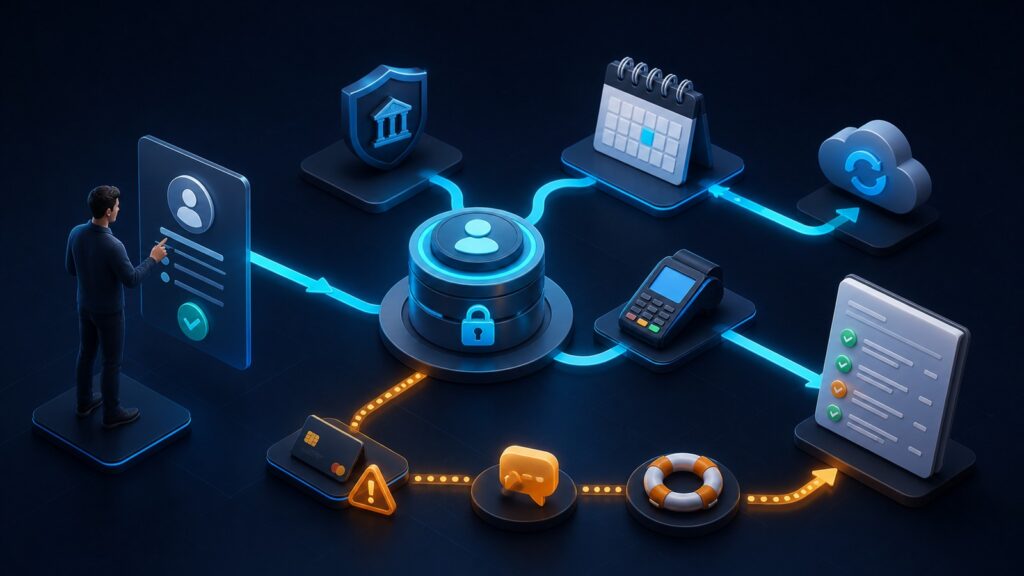
Subscription payment gateways help collect recurring payments using a customer's saved payment reference. A billing system decides what is due and when; the payment service attempts collection and reports the result. Some providers combine these functions, which can make them look like a single feature.

The recurring part is more than charging the same card every month. The system must handle permission to reuse the payment method, a changing subscription balance, failed attempts, customer authentication, cancellation, and the records that explain what was collected.

By: Review Streets Research Lab
Updated: September 25, 2026
Explainer · 8-12 min read
Editorial business scene illustrating subscription payment gateways work
What You'll Learn

Follow a Subscription From Signup to Renewal

See how billing instructions, saved payment methods, and payment results fit together.

  • Separate the billing schedule from the collection attempt
  • Understand saved payment references
  • Trace a renewal through success or failure
  • Connect payment results to customer access
  • Distinguish cancellation, refunds, and bank payouts

Tip: A saved payment method makes another attempt possible; it does not guarantee that the next renewal will succeed.

Definitions

Six Parts of a Recurring Payment

A subscription has both a commercial agreement and a payment history.

Subscription

A subscription records an ongoing arrangement to provide a product or service under agreed billing terms.

  • Example: A member pays monthly for access to an online service.
  • Check: Confirm price, interval, renewal, and cancellation terms.
  • Limit: The subscription record alone does not prove a payment succeeded.

Payment Token

A payment token is a reference used in place of directly reusing sensitive payment details in the merchant's systems.

  • Example: The provider stores a card reference for future authorized renewals.
  • Check: Check how payment details are collected and updated.
  • Limit: A token does not remove security responsibilities or prevent declines.

Billing Cycle

A billing cycle is the period used to determine when recurring charges become due.

  • Example: A monthly subscription creates a new amount due at renewal.
  • Check: Check the renewal date and how changes affect the amount.
  • Limit: Different products handle trials and partial periods differently.

Off-Session Payment

An off-session payment is attempted without the customer actively completing checkout at that moment.

  • Example: A scheduled renewal runs while the customer is away.
  • Check: Set up the payment method and customer agreement for intended future use.
  • Limit: The provider may still require the customer to authenticate.

Payment Recovery

Payment recovery is the process for resolving unsuccessful collection attempts.

  • Example: The customer updates an expired card after a failed renewal.
  • Check: Define retries, messages, and escalation.
  • Limit: Some failures require customer action rather than another automatic attempt.

Entitlement

An entitlement is the customer's right to use a service or feature.

  • Example: A paid membership grants access until the end of the purchased period.
  • Check: Specify how payment and cancellation affect access.
  • Limit: A subscription status label may not be sufficient on its own to decide access.

Tip: Keep the subscription, invoice, payment, and customer-access records linked without treating them as the same record.

Signup

Collect the Agreement and Payment Method Together

At signup, the customer needs to understand the recurring price, frequency, and how to end the arrangement. The payment setup should support the intended future use of the method. A provider-hosted collection flow can keep sensitive payment details out of ordinary merchant forms, while returning a reference the business can use through the service.

  • Show recurring terms before the customer agrees.
  • Use the provider's supported method for saving payment details.
  • Keep the agreement associated with the customer and subscription.

A successful first payment should not be treated as unlimited permission for unrelated future charges.

Renewal

Billing Calculates the Amount Before Collection

The billing layer determines the next amount due. A fixed plan may renew at the same price, while a change in quantity, an upgrade, or a credit can alter the bill. The gateway's job is to support the payment attempt for that amount. A bundled platform may perform both jobs, but they remain distinct steps.

  • Confirm the billing date and applicable plan.
  • Check how upgrades, credits, and partial periods are handled.
  • Tie the attempt to the correct invoice or billing record.

For example, adding a seat halfway through a period may affect a bill according to the service's stated proration rules, not a decision made by the card network.

Collection

The Payment Result Determines the Next Action

A recurring attempt may succeed, fail, remain pending, or require the customer's involvement. The application needs a reliable way to receive and interpret that result. Payment notifications should update the appropriate billing record and trigger the business's access policy without repeating the same action when an event is delivered again.

  • Use verified provider events or confirmed payment status.
  • Keep delayed results separate from definite failures.
  • Test repeated notifications and interrupted updates.

A membership service should know whether it is waiting for a payment result or asking the member to complete an authentication step.

Recovery

A Failed Renewal Needs a Suitable Response

A failed payment does not always mean the customer wants to leave. A card may need updating, funds may be temporarily unavailable, or authentication may be required. Recovery settings can combine appropriate retries with a clear message and a route to update payment details. Repeated blind attempts are not a substitute for understanding the failure.

  • Check the provider's failure information and retry guidance.
  • Tell the customer what action is needed.
  • Define whether access continues during a grace period.

The billing policy should state what happens when recovery is exhausted, including any cancellation or unpaid balance handling.

Changes and Records

Cancellation and Refunds Are Different Events

Canceling renewal stops future billing according to the effective date; it does not necessarily refund an earlier payment. Likewise, returning one charge does not necessarily end the subscription. Staff need to check both actions when resolving a request. Finance then needs the completed payments, fees, refunds, and payouts to explain the money received.

  • Confirm whether cancellation is immediate or at period end.
  • Decide separately whether an existing payment should be refunded.
  • Update access and financial records consistently with those decisions.

For a member who cancels after paying for the month, the agreed terms may preserve access until the period ends while preventing the next renewal.

Quick Reality Check

One Monthly Renewal, Several Possible Outcomes

The due date starts a collection attempt, not a guaranteed successful payment.

Payment Succeeds

The billing record shows the successful collection and the service applies its access rules.

The later payout is reconciled with fees and any other adjustments.

Customer Action Is Needed

The customer receives a clear route to authenticate or update the payment method.

Retries, grace periods, and eventual cancellation follow the business's defined recovery policy.

Common Myths

Misconceptions About Subscription Payments

Automation still needs clear billing and customer-service rules.

Saving a card guarantees renewals

Future attempts can still fail or require customer action. A saved reference does not guarantee available funds or approval.

The gateway decides the subscription price

The billing arrangement determines what is owed. Collection services attempt the instructed payment, although one platform may bundle both functions.

Canceling automatically refunds the last charge

Cancellation and refunds are separate operations. Check the terms, effective date, and actual actions performed.

Tip: Test cancellation and failed renewal as carefully as successful signup.

FAQ

Questions About Recurring Payment Gateways

Common distinctions when setting up or operating subscriptions.

Can any one-time payment be repeated automatically?

Do not assume so. The payment method, provider setup, and customer agreement must support the intended recurring use.

Who decides whether access continues after a failure?

The business defines that policy, and the application or subscription platform applies it using the relevant billing and payment information.

Do gateways handle upgrades?

A billing system normally calculates the change. Some payment platforms include subscription billing, but a gateway alone is not a complete plan-management system.

What should be tested before launch?

Test signup, renewal, payment failure, customer authentication, an updated payment method, cancellation, and refunds. Confirm that access and records match each result.

Bottom Line

Subscription payment gateways collect recurring amounts as part of a wider billing and customer-access system.

Reliable subscriptions connect clear terms, the amount due, confirmed payment results, recovery, and cancellation without confusing those separate steps.

Next Steps

Go Deeper or Compare Your Options

Use these Review Streets paths to compare related categories and practical next decisions.

Control Access to Payment Actions

A payment gateway's permission structure determines who can see transactions, issue refunds, change checkout settings, and connect other systems.

Quick Summary

Recurring Payments Explained

  • Billing decides the amount and timing.
  • Saved references support future payment attempts.
  • Failed renewals may need customer action.
  • Cancellation and refunds are separate decisions.