
How to Choose a Travel Accessory for Packing Fit
You’ve packed your bag and found one spot left for a neck pillow. The purchase comes down to what the pillow looks like after you deflate it or roll it into its case. Use the pocket opening, the space behind it, and the maker’s packed measurements to narrow your options before buying.
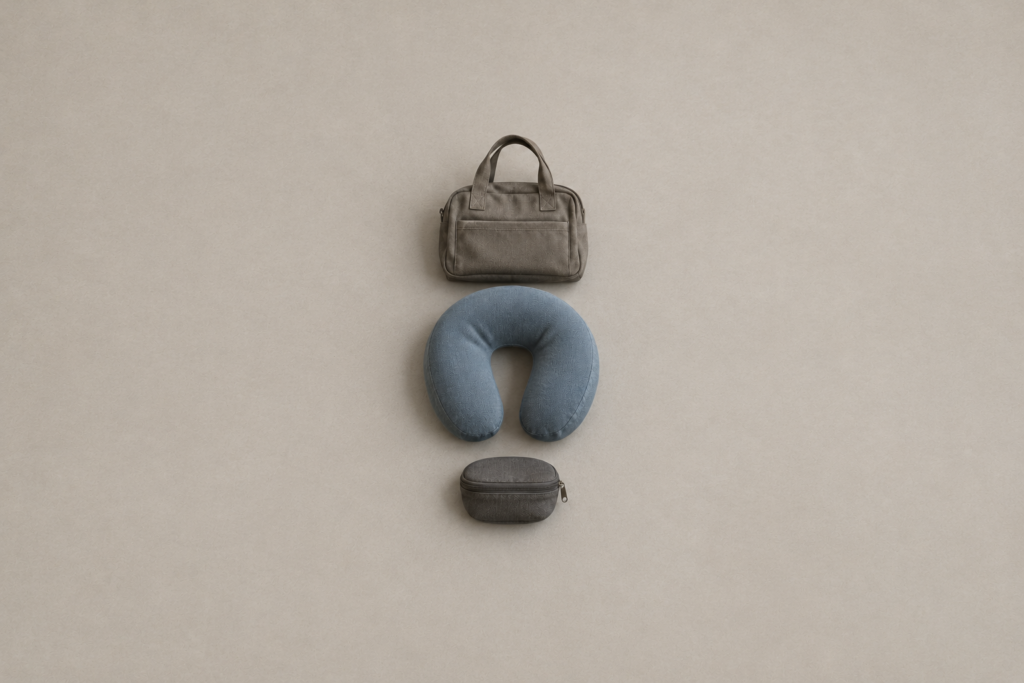
Buying framework
Start with the space you already have
A neck pillow has a shape on your shoulders and another when you put it away. Choose where it will travel in its packed form, then use that spot to set your buying limits.
Hold the task steady: If you want a neck pillow for sitting upright, use that same job for each option you consider. That makes the packed bundle the difference you’re evaluating.
Pick the pillow’s spot: Name the exact pocket or attachment point before you shop. That gives you a specific place to check the bundle when you find a promising pillow.
Load the bag as you’ll carry it: Leave the belongings beside the pocket in their usual positions. A sweater pressing against the pocket can change the depth available for a closed pillow case.
Measure the path in: Note the clear width and height at the opening, then measure how far the bundle can go inside. Keep track of which edge of the pillow would enter first.
Decide where you need certainty: Put a mark beside the measurement with the least room to spare. If a listing leaves that edge unclear, make it the first detail you ask the maker for.
Who this is for
Which packed form suits your carry spot?
Two travelers can want a pillow for the same seated journey and need different shapes when they pack it away. Start with the constraint you’ll notice each time the pillow comes out and goes back in.
A shallow pocket: A documented flat, deflated bundle is worth a look when the pocket leaves little front-to-back room. Pay particular attention to the sack’s thickness, since the pillow will travel inside it.
A deeper spot for a rolled pouch: A pouch that holds rolled foam is a candidate when the available space has depth as well as width. Use the shape of the closed roll to judge how it would sit next to the belongings already there.
Several stops with quick repacking: If you put the pillow away every time you change seats or leave a waiting area, think through the packing action you’d repeat. Deflating through a valve and rolling foam into a case call for different steps.
A usable exterior position: If you have a strap or handle in mind, look for directions that identify how the pouch connects. Leave room at that point for the case to hang and verify permission for the booked trip before relying on it.
A single inside spot with tight clearance: If the pillow has one possible place in the bag, an undocumented case depth can hold up the purchase. Ask for the missing edge of the packed bundle before committing to a pillow that would depend on that room.
What to pay attention to
Read the packed-size listing
A useful specification ties a measurement to the form you’ll actually carry. Look for the maker’s description of the closed bundle and compare the dimensions it supplies with the space relevant to your plan.
Packed form and size
Identify the pouch or sack that holds the pillow and the method used to get it there. A measurement in centimeters gives an edge you can compare with your pocket.
Carry location and attachment
Trace the whole pillow bundle through the opening or position the case at the proposed attachment point. Include any hardware that extends into the available space.
Exact version: Match product names, variants, and release versions between the listing and the packing instructions. A size table can apply to an older version with a nearly identical name.
The stated storage state: Find the heading for packed size and read nearby directions for the sack or pouch. That tells you which bundle the maker intended its figures to describe.
Absolute dimensions: Record the numerical edges and any axes the maker names. If the maker lists two figures with unlabeled axes, keep the full shape open until you have the missing information.
Width and height at entry: Use the sides that would face the mouth of the pocket in your chosen orientation. Compare the length going inward with the clear distance behind that opening.
Extent of the hardware: Look for a case drawing or a note about what the listing includes. A clasp or a cord lock that sticks out near the entry edge can use up the clearance there.
What an attachment is designed to do: Look for the maker’s specified connection and attachment points for the case. On a flight, consult the carrier’s current rules for your booking to determine how it treats a bag with an item clipped outside.
Avoid these traps
Packing assumptions that can cost you room
Treat compactness as a claim you can translate into the shape you need. These common shortcuts leave a buyer guessing about the space the pillow will occupy.
Borrowing dimensions from a similar listing: An old product page or a successor’s listing can surface when you search by a shared name. Match the identifier on the pillow you’ll receive to the instructions that supply the numbers.
Scaling each edge by a fraction: One foam pillow’s maker says its case reduces the pillow to a third of its original size. A relative claim like that leaves the closed case’s width, length, and depth to be established.
Assuming the clip is inside the published outline: A measurement table can leave the clip’s position unclear. If the case must enter clip first, ask how far that clip extends from the pouch in that position.
Giving an unnamed edge a label: Reading two packed measurements as length and diameter assumes a shape the maker may never have specified. Ask for the maker’s axis labels and the remaining edge if the carry spot depends on them.
Banking on an extra squeeze: A buyer may picture a tighter roll than the one held by the supplied pouch. Base the purchase on the ordinary packing method you can repeat each time you put the pillow away.
Treating the clasp as a travel allowance: The clasp tells you how its case is intended to connect. Check the terms for your booked journey before counting on the exterior spot as part of your carry plan.
Decision guidance
Compare two pillow bundles in one pocket
Keep the same backpack loaded with a laptop, sweater, and toiletry pouch. In this hypothetical example, both pillows are for sitting upright, and both have to go into the same inside pocket.
If the remaining pocket is shallow: Assume the usable space is 12 cm inward, 9 cm across, and 6 cm deep. The straight opening gives the bundle a 9 × 6 cm passage, so the sides presented at entry matter as much as the edge pointing in.
If considering a deflated pillow: One inflatable pillow’s maker lists its deflated size in the stuff sack as 9 × 7.5 × 4.5 cm. Plan to feed the 9 cm edge straight inward, with the other two edges across the opening and through its depth.
If considering rolled foam: One memory foam pillow’s maker lists 11 × 15 cm for its packed size and describes rolling it into the included pouch. For this comparison, point the 15 cm dimension inward and place the 11 cm dimension across the opening. The listing leaves a third dimension unspecified.
If comparing the planned placements: The inflatable bundle’s listed edges leave 3 cm inward and 1.5 cm along each opening axis in this example. The rolled pouch’s two published figures exceed the corresponding limits by 3 cm inward and 2 cm across in the planned orientation.
If using the figures to narrow your choices: Shortlist the deflated bundle for this pocket and verify its actual clearance, including any sack hardware. Revisit the rolled pouch only if you can verify another placement for its ordinary packed form.
Ownership & compatibility
Putting the pillow away between uses
The advertised packed shape comes from following a particular routine. Learn the maker’s packing steps and check where the case and its hardware end up on your bag.
Deflate before using the sack: The inflatable example uses its valve to release air before the pillow goes flat into its sack. If the bundle feels bulkier when you repack it, revisit the deflation step in the maker’s directions.
Roll the foam as directed: For one pillow with a zippered travel case, the maker describes rolling the foam inward before zipping the case around it. Learn the roll and closure sequence so you can reproduce the intended bundle between legs.
Use the intended connection: The maker of the rolled pouch in the pocket example describes clipping it to a strap or handle. With the bag loaded, see where the pouch falls on yours and whether the attachment interferes with the handle you need to grip.
Measure an attached case in place: Observe where the full case and clip sit relative to the bag’s outer edges. If your carrier measures the combined setup, those are the dimensions you’ll need to compare with the terms for the trip.
Follow the storage interval for the exact pillow: The maker of the roll-and-zip example advises a maximum of one month in the compacted state. Look up the instructions for your own pillow before leaving it packed between trips.
FAQ
Travel pillow packing FAQ
Use these answers when a pillow listing or the layout of your pocket leaves one practical detail unresolved.
Where should I measure a pocket that changes shape when I pack it?
How should I use a packed-size listing with two numbers?
Does the listed packed size apply if I use my own pouch?
Should I compare the pillow in its pouch or out of it?
What if the reported size matches my opening exactly?
What if the pocket opens narrowly and widens inside?
Where should I measure a case with a protruding zipper pull?
What should I look up before I rely on a clip for a flight?
Can the pillow stay in its compression case between trips?
Readiness check
Buy for the spot you’ll use
A travel pillow earns a place on your shortlist when its documented bundle makes sense for the space you have left. Buy when you can establish that the ordinary packed form works for that carry location.
Keep the original pocket in view: If the pillow would displace something you already carry, wait for a bundle that leaves that item where you need it.
Favor a clear opening and some spare room: A listed bundle with clearance on paper is worth verifying with its case closed and the full load in place.
Hold a choice with one crucial unknown: Ask for the packed edge or hardware measurement that controls your decision. Leave the pillow on hold until you have it.
Make an exterior spot a deliberate choice: Rely on it once the actual attachment and projection work on your loaded bag and you’ve established permission for your trip.
Leave an optional purchase open: If every candidate depends on uncertain clearance in the one place you have, wait for a pillow with a packed form you can verify there.
Reading shortcuts
Start by measuring the pillow pocket or jump to the worked example if you already know its usable size.
Pillow packing reminders
Trace the closed pillow pouch through your chosen pocket opening, including where its clip or zipper pull extends.
- Pack first: Measure with your usual load in place.
- Locate the pinch point: Find the narrowest part of the passage into the pocket.
- Match the packing directions: Use the bundle made with the maker’s method.
- Read the unit: Compare the pillow and pocket in the same units.
- Include the fastener: Check where the closed case’s clip or pull sits.
- Verify the outside option: Confirm how your carrier treats the clipped case.
Pillow packing terms
Use these terms to ask the maker for the exact pillow bundle measurement your pocket comparison needs.
When to use a Top 10 review
Browse lists when you’re still gathering pillow options to check against the space left in your bag.
- Explore packed shapes: Look for pillow designs that deflate flat or store as a roll.
- Find documented bundles: Flag entries where you can trace the case measurements to the maker.
- Spot the packing steps: Keep candidates with a deflation or rolling routine you’re prepared to do.
- Build a short list: Save a few pillows to compare with the same pocket measurements.
Take your shortlisted pillows to a comparison and check whether each listed width includes the case’s zipper pull or cord lock.
When to use a comparison
Use a comparison when you have specific pillows in mind and can line up their closed cases against the same opening.
- Match the measurement state: Put sack dimensions alongside closed pouch dimensions.
- Look past the longest edge: Compare the width and thickness each pillow presents at the pocket mouth.
- Surface what’s missing: Record which maker still needs to provide a packed measurement.
- Compare the repacking steps: See which cases need rolling, zipping, or releasing air before stowing.
If you’re still choosing which pillow shapes to investigate, start with a Top 10 and save the designs with published packed dimensions.