
How to Choose a Travel Clothing & Footwear for Packing Fit
When you need to pack a spare pair of shoes, the useful space is what’s left around your clothes. Before buying, measure the shoes in their sleeves and see how they’d sit in your loaded suitcase. You can try two placements with the same load and see whether either leaves enough room to close the lid normally.
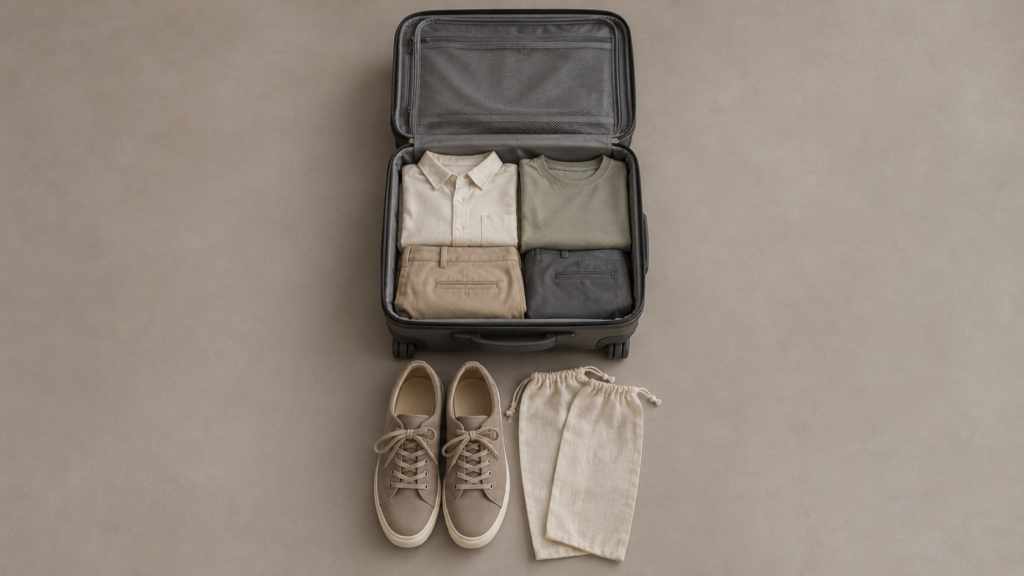
Buying framework
What counts as a good packing fit
Start with a pair that already meets your needs on foot. Packing fit is a separate buying decision you can make with the case and clothing you plan to take.
Pack the rest of the case first: Set out the clothes and other items that will be in the suitcase. The spaces left around them are where the shoes have to go.
Count the whole shoe: Picture each shoe in its natural shape at the angle it will rest. The widest part of the upper or the top of the heel collar can set how much room it needs.
Include the sleeves from the start: If you use sleeves to keep the soles off clean clothes, include them when judging the space the shoes will take up. The sleeve’s gathered fabric and closure are part of the packed shape.
Treat access and resting room as separate checks: The shoes have to pass through the case opening and reach their intended spot. Once there, they need enough room along the base and enough height for the lid or divider to close normally.
Give each shoe a place: A clear spot for one shoe only settles half the question. Before you count on the pair, account for where the second shoe will rest and how it will get there.
Who this is for
Which suitcase constraint do you have?
Look at what limits shoe space in your usual pack. A tall collar, a narrow zipper opening and two small gaps each make a different measurement worth getting first.
You have one open area: If everything else leaves a single space near the wheels, the combined footprint is the one to look at first. You need to know how far both covered shoes extend when they share that space.
You have space along both walls: When a stack of clothes divides the spare room into two strips, the strips may have different shapes. Look at each shoe’s outline separately and start with the narrower of the two gaps.
You have little room under the lid: A packed lid pocket or divider can make height the deciding measurement even when the floor looks open. Measure where the collar or toe rises highest in the orientation you could use.
You keep shoes in a zippered compartment: If a separate compartment is part of your routine, its mouth is the first constraint. A shoe can be small enough to sit inside while the covered heel is still too tall to make the turn through the opening.
You’re buying without the shoes in hand: Your first task is getting outer measurements for the style, size and width you’ll order. If you still need dimensions to judge how the sleeved shoes would sit, find an exact sample you can measure or hold off on a purchase that depends on fit.
What to pay attention to
The measurements that decide whether shoes fit
Measure the protected shoes and the space you can reach in the loaded case. Maker instructions help establish the shape you should measure.
Footwear form and storage
Use the measurements of the exact pair in the shape the maker’s instructions support, with the sleeves you plan to pack.
Loaded luggage access and room
Measure the space left by your real load from the zipper opening to the surface where the shoes will sit.
Exact style, size and width: Record all three before measuring a sample or requesting measurements. Keep those measurements with that exact version so you can match the numbers to the pair you order.
Storage instructions for the shoe: General guidance from a footwear maker favors dry, ventilated storage and advises against storing shoes under items that could crush them. Measure a shoe in its ordinary shape unless directions for that exact style explicitly allow the fold or compression you plan to use.
Outside dimensions with protection in place: Measure length, width and height at the outermost points with the actual sleeve closed around the shoe. Include a gathered end, closure or any support you will carry inside the sleeve.
Clear opening and narrowest turn: Open the zip or divider as far as you ordinarily would and measure the clear opening with your clothes in place. Check the tightest point where you’ll have to turn or lower the covered shoe.
Usable height at the resting spot: Measure the free length and width where the shoe will sit, then the height available under the lid or divider in that same area. A filled lid pocket belongs in that check.
Published case measurements: A maker may list one size for the case body and a second set of dimensions for the whole suitcase. Measure the loaded zipper opening and the space behind it directly, since those are the dimensions your shoes have to clear.
Avoid these traps
Shortcuts that make a tight pack look workable
Some buying shortcuts hide the precise point where a shoe will get in the way. Look for the assumption that would change your decision if it turned out to be wrong.
Buying from the size label: A shoe size helps you order a size to wear. Ask for the outside measurements of the version you’ll buy before relying on that pair to clear a tight spot.
Shopping by liters alone: A capacity figure combines space your contents may divide into several patches. Before choosing shoes for that bag, find the actual opening and the connected space available for placement.
Treating flex as folding permission: The way an upper bends during a step tells you about that movement. If your plan relies on a fold or compression, look for specific guidance for that exact shoe first. Without it, judge the pair in its usual shape.
Pulling the zipper through resistance: Extra pressure on the lid can temporarily flatten a shoe or force it deeper into the load. Treat a placement that needs that pressure as a failed attempt for the ordinary shoe shape.
Using one set of readings for both layouts: Putting two shoes heel to toe changes where the widest and tallest points fall. Measure the combined outline in that position and take separate readings for the shoes in the wall layout.
Leaving the sleeves out of a trial pack: A shoe that slides past the zipper tape on its own can catch once fabric covers it. Try the sleeves you’ll actually use while you still have a choice of footwear.
Decision guidance
Try two placements with the same pair
A luggage maker’s general packing guide describes two placements that keep shoes in their ordinary shape. The example below compares those placements with the same pair and load. Measure your own shoes and loaded case to find out whether either placement works.
Set up one fixed load: Use one exact pair of dry leather lace-up shoes in the intended size and width, one thin sleeve per shoe and one carry-on with its expansion closed. Put two folded shirts and a pair of trousers in a stack at the center of the main compartment, a closed toiletry pouch at the handle end and one pair of clean socks in the lid pocket. Leave the shoes empty and keep the same pair, sleeves, case and load in both attempts.
If you have two wall gaps, measure each shoe: Plan for one closed sleeve along each wall with its sole facing the outside wall. Measure the outer length, width and height of each sleeved shoe in that orientation. Measure the opening and any tighter turn on each shoe’s way in, then the free space and lid clearance at each wall.
If you have a gap at the wheels, measure the pair together: Keep the same two sleeved shoes and turn them in opposite directions, heel to toe, with the soles facing out from the group. Aim for one uninterrupted space near the wheels and measure the group’s full length, width and height against the room there. If you plan to carry them in together, measure the route for the group, too.
If the numbers allow it, try a normal close: If you have the shoes to hand, slide them into each measured position without squeezing or wedging them and check that the lid and zipper close as usual. The shoes should keep the same shape they had outside the case.
If one arrangement fits, buy for that setup: Buy the exact pair for this pack once you know the sleeved shoes can reach their spots and the case can close normally with the shoes holding their usual shape. If measurements leave a tight turn or lid clearance uncertain, try the placement with the actual shoes before buying for fit. If both arrangements fail, measure a different pair.
Ownership & compatibility
Keep soles separate on repeat trips
Once you know where the pair goes, keep the sleeves and placement part of your routine. That makes it easier to repeat the fit without putting exposed soles against clean clothes.
Keep one sleeve with each shoe: Pack the two sleeves you measured with the case so they’re available on the way home. Cover each sole before it goes back beside clean things.
Let damp shoes air out: General footwear care favors dry, ventilated storage. After wear, air out damp shoes when practical before leaving them enclosed in their sleeves and case.
Close the sleeves the same way: Set the fabric and closure as you did when measuring. A closure sticking out at the heel can occupy clearance you had counted on for that end.
Record where each shoe rested: Take a quick photo or note the direction of each toe and which wall or end the shoe occupied. Use it to put the pair back in the same position on a repeat trip.
Measure again after a change: A different sleeve, shoe size or toiletry pouch can change the space available along the route or at the resting spot. Repeat the measurements and normal closing check when the load or case expansion setting changes.
FAQ
Questions about packing shoes in a suitcase
Use these answers when a measurement leaves you unsure about a tight opening, an unusual shoe shape or a purchase you can’t size up in person.
Does the listed shoe size tell me the outside sole length?
Can I measure just the sole if the upper sticks out farther?
Can I use a published case measurement for the zipper opening?
Can I put the shoes in separately and group them inside?
Does a soft upper mean I can fold the shoe for packing?
Should I measure the sleeve before or after putting in the shoe?
Will grouping the shoes always leave more room for clothes?
What if I have to press above the shoes to close the case?
What can I ask for if a seller publishes no outside measurements?
Bottom line
Buy for the space your shoes will actually use
Make the purchase depend on one measured placement that works with your usual suitcase load. If you still need a measurement to decide whether the shoes fit, wait for it before committing to that pair.
Start with the exact version: Get the pair’s style, size and width, then check the maker’s instructions for the shape you plan to pack.
Measure the covered shape: Keep the soles covered and include the closed sleeves in your readings.
Measure the route to the spot: Use the loaded case to check how much space each shoe has on its way to the place it will rest.
Allow the lid to settle: Leave the shoes enough height to hold their usual shape when the case closes.
Use the result to choose: If a measured layout works from entry through closure, buy that exact pair for this case. If neither does, carry the same suitcase measurements into your next comparison.
Reading shortcuts
Jump to the part of the suitcase fit you’re working out.
Decision reminders
Keep these details alongside your measurements as you narrow your choices.
- Exact version: Write down the style, size and width together.
- Ordinary shape: Use the shape supported by the shoe’s storage guidance.
- Filled sleeves: Measure over the closure and any fabric that projects.
- Loaded opening: Include the tightest turn on the way to the resting spot.
- Free space: Check both the footprint and the height at that spot.
- Normal closure: Leave room for the lid to settle without pressing on the shoes.
Shoe packing terms
Five terms you’ll see when measuring shoes against your packed suitcase.
When to use a list
Browse travel clothing and footwear lists when you’re still gathering candidates to measure.
- Start with the shoe outline: Look for candidates whose toe or heel shape you can check in person.
- Plan for two wall spaces: Gather options if you want to compare how separate shoes might sit beside your clothes.
- Allow for the opening: Shortlist pairs you can measure for the zippered space you plan to use.
- Keep lid height in mind: Look for options whose covered height you can check before you commit.
Once you have a few candidates, use a comparison to decide which measurements to check first.
When to use a comparison
Put the tightest measurement first when you compare pairs. If the lid leaves little room, start with the height of the covered shoes in the position you plan to use.
- Grouped footprint: Look for details that help you judge which combined shoe dimensions you’ll need.
- Separate footprints: Compare the outlines of each candidate where the two wall gaps differ.
- Sleeve bulk: Include the same kind of cover when you measure the space each pair needs.
- Reachable clearance: Carry your own opening and lid measurements into the comparison.
If you’re still gathering candidates, start with a list to find options worth measuring.