
How to Choose Athletic Socks for Running Workouts
Running workouts put sock fit through more than a standing try-on. Strides, accelerations and recovery jogs can expose a heel that slides or toe fabric that gathers inside the shoe. A race label or extra padding does not resolve those movements, and neither feature guarantees a faster session or freedom from rubbing.
Choose around the running shoes used for the planned workout, then inspect where the sock sits and adds material. A pair that works for an easy run may need another check in close track footwear or across a longer continuous effort. This guide orders those checks so construction and actual contact behavior lead the purchase rather than promises about pace.
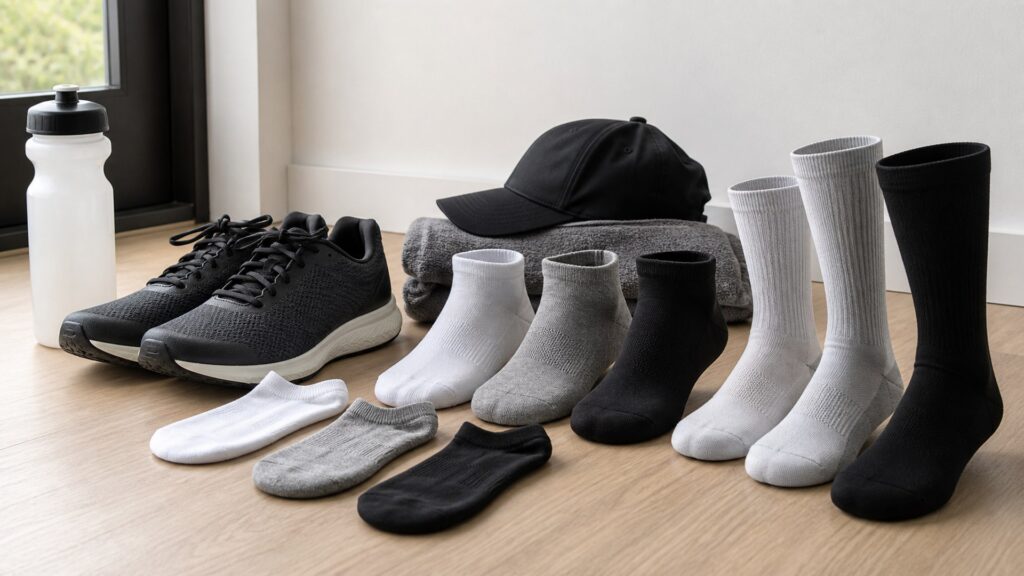
Buying framework
Follow the sock through the workout
Evaluate the intended shoe combination beyond its first few stationary moments. Pace and footwear changes make position as important as softness.
Name the workout and shoe: Identify whether the pair will serve steady running, intervals or another planned session and name the actual footwear. This prevents an attractive general running design being bought for a close shoe it has never been checked inside.
Set the heel pocket before fastening: Use the maker’s sizing guidance and place the shaped heel where intended. Excess front length or a displaced heel is a construction-size mismatch to investigate rather than something to hide by pulling the cuff higher.
Inspect fabric after representative movement: Check toe folds, cuff position and heel slipping through the relevant strides, within permitted trial conditions. Accelerations and easier recoveries can reveal movement a standing inspection misses; do not claim one short trial proves every future workout.
Choose the padding locations deliberately: Compare the zones you want padded with the space the shoe provides. A thicker sole and thin upper can serve a different role from full padding; buying cushion by label alone omits that physical map.
Prove the combination before extending its role: Build repeated purchases around a useful pair, and reassess when footwear or session conditions change. The objective is a workable running interface, not an assumed performance upgrade from adding more technical sock names.
Who this is for
Which workout combination changes the shortlist?
Use session patterns to prioritize different checks. Those differences are more useful than generic beginner or premium tiers.
Steady easy running in familiar footwear: Start with settled heel and toe fit and a contact feel you want to repeat. If an existing pair works, a new speed-oriented label is not a reason to replace it; compare a candidate only for an identified construction need.
Intervals with repeated accelerations: Inspect retention during both the faster portions and recoveries. Cuff slipping or toe gathering can be more informative than soft feel at rest; choose a pair that remains positioned without uncomfortable tightening to hold it there.
Close race or track footwear: Test lower-bulk options in the precise shoe, observing toe room and joins. Thin construction may preserve space but gives up plushness, and it does not approve the shoe or activity by itself; follow the footwear’s intended-use guidance too.
Longer continuous sessions: Choose a proven combination and preferred contact map, accounting for changing dampness and repeated strides. Do not turn a long-run name into a duration guarantee; comfort across the intended session needs your own experience rather than a package promise.
Workouts spread across several running shoes: Check each pair of shoes separately before assuming one sock serves the whole rotation. Different internal volume or collars may justify distinct constructions; the added sorting is a real cost of maintaining those proven combinations.
What to pay attention to
Inspect stride contact and construction details
Read features through their physical role inside the running shoe. Separate fit mechanisms from unverified promises about speed or injury.
Stride contact and shoe interface
Check heel and toe placement through representative movement in the actual shoe. Pace labels do not establish position or performance.
Construction across workout conditions
Compare padding, cuff and retention when the session or footwear changes. One suitable interface may not transfer to every workout shoe.
Size and shaped heel: Apply the current brand’s size chart and inspect where the pocket lands. A heel-retention claim assumes an appropriate fit; the familiar letter size from another brand may not describe the same intended range.
Toe join and fabric length: Check the front after fastening the shoe and moving. Low-profile joins are construction details, not permission to accept excess material, and separate toe compartments require their own length and shoe-room assessment.
Cushion map and upper bulk: Locate raised loops and compare their volume with the footwear. Targeted zones can offer selected padded feel while leaving other areas thinner; the amount that fits a roomy trainer may crowd a different workout shoe.
Cuff and collar contact: Inspect where the sock opening sits relative to the shoe edge during strides. A heel tab or higher cuff can change coverage, but the lowest-cut design does not automatically remain above every collar.
Elastic retention and shaped sides: Look at the arch knit and any left/right construction as positioning features. Use the intended sides where specified and check comfortable retention; ordinary elastic bands do not establish a medical compression specification.
Avoid these traps
Avoid performance proxies for a fit purchase
A feature can describe a real construction without proving a running outcome. Keep those two claims separate.
Buying a faster-sounding model name: Race or speed branding does not make the runner faster. Choose around the workout shoe and contact requirements rather than paying for a pace promise that the sock alone cannot establish.
Assuming maximum cushion prevents every problem: More material changes shoe volume and does not guarantee freedom from rubbing. Inspect the actual padded areas and fit instead of adopting a universal injury or blister claim from a comfort description.
Treating one shoe’s fit as universal: A successful trial in an everyday running shoe may not transfer to a different collar or close track design. Recheck the pair whenever the footwear combination changes instead of forcing a proven label into an unproven interface.
Pulling harder to hide a size mismatch: Overstretching or dragging the cuff upward can move the heel and toe shaping away from its intended position. Resolve the size and construction rather than using tension as the permanent answer to slipping fabric.
Decision guidance
Choose the combination that stays useful in strides
Filter by fit and relevant movement first. Then accept the padding or sorting burden attached to the selected construction.
For close workout shoes, favor compatible low bulk: Choose a thin pair that preserves toe room and remains settled at the heel. You sacrifice plushness for space; reject designs that achieve thinness but slide or leave a join pressed uncomfortably against the foot.
For wanted underfoot feel, choose a mapped cushion: Select padding at the areas you value and verify that the shoe accommodates it. You gain that contact material while accepting added local volume; an all-over heavy knit is not compulsory when selected zones do the wanted job.
For pace changes, prioritize demonstrated retention: Compare viable constructions through relevant movements within allowed trial conditions. You may give up a softer or more fashionable pair if it shifts; retention must remain comfortable rather than depending on excessive tightness.
For multiple footwear types, keep distinct proven pairs: Assign a suitable construction to each shoe where one option does not serve all. You gain known combinations and accept more inventory and sorting; buy the extra variation because fit requires it, not because every workout name needs a separate sock.
Ownership & compatibility
Track position and wear after sessions
A workout ends with useful evidence about the combination. Use that evidence alongside the pair’s care instructions.
Notice where the fabric finished: Check the heel, toe and cuff after the run, particularly when trying a new construction. Repeated migration is information for revisiting size or shoe fit, not proof that the solution is always a stronger arch band.
Inspect repeated contact damage: Look for thinning, rough joins and holes at the heel or toes, and examine the corresponding shoe lining. A recurring location can involve the whole interface; multiplying the same pair may simply repeat the unresolved wear.
Care for the precise knit: Follow its label and maintain enough ready pairs for the workout routine. Do not speed drying by an unapproved method or assume every light running blend follows the same wash restrictions.
Keep the intended pair arrangement: Sort left/right designs or toe-compartment pairs as directed and reassess them after laundering. Construction remains useful only when worn in its intended arrangement and when condition still supports the original fit.
FAQ
Questions about pace, placement and running features
Clarify what construction can establish and what needs a trial. Running outcomes should not be inferred from feature names.
Do running socks improve my interval pace?
Must track footwear always use the thinnest sock?
Can I use the same pair for easy and faster running?
Does a seamless join guarantee no rubbing?
Are separate left and right socks essential?
Should I change socks during every long run?
Can a toe sock fit every running shoe?
Why does my sock finish lower than it started?
When should a proven workout combination be rechecked?
Bottom line
Order the final checks around the run
The purchase earns its place through a workable shoe interface. Performance labels come after that evidence rather than replacing it.
Identify the intended workout footwear: Use the actual shoe and its intended activity. Reject a candidate whose added material makes that combination unsuitable.
Place the shaping correctly: Confirm heel location and smooth front fabric. Resolve excess length or joins before evaluating more decorative features.
Inspect relevant movement: Check retention through strides and pace changes where applicable. Choose comfort and position without assigning a universal future guarantee to the trial.
Commit to the useful construction: Select the padding map and coverage, then plan care and repeated pairs. Recheck when the shoe or workout conditions change.
Reading Shortcuts
Trace the pair from initial placement through the actual running session.
Decision Reminders
Use contact evidence before performance labels.
- Heel location: Set the shaped pocket before fastening.
- Pace changes: Inspect position after relevant strides.
- Shoe variation: Recheck distinct footwear combinations.
Glossary Snippets
Terms describing the running interface.
When to Use a Top 10 Review
Compare running pairs after naming the actual workout shoe.
- Map shoe room: Inspect thick zones and front space.
- Map fabric movement: Check heel and cuff position through strides.
Already down to 2-3 options? A Comparison is usually faster than reading broad buying advice.
When to Use a Comparison
Use the same footwear and movement pattern for finalists.
- Compare contact construction: Inspect joins, padding and shaping.
- Compare continued use: Account for wear checks and care.
Still exploring? Start with a Top 10 to identify the right category first.