
How to Choose Automotive Replacement Parts for OEM Replacement Planning
OEM replacement planning is the task of restoring a vehicle system to its intended function. The part installed at the factory may have a discontinued number, an updated design, a different current supplier, or a service kit that includes hardware not shown in an old catalog. Begin with the VIN, original identifier, and current manufacturer parts information.
Genuine packaging is one way to obtain that solution, but it is not the only sourcing path. An OEM supplier, manufacturer remanufacturing program, or well-documented equivalent may provide the required geometry and performance. The decision depends on traceability, integration, labor exposure, calibration, warranty, and availability. Plan the repair before ordering so an assembly is not undermined by obsolete instructions or reused single-use parts.
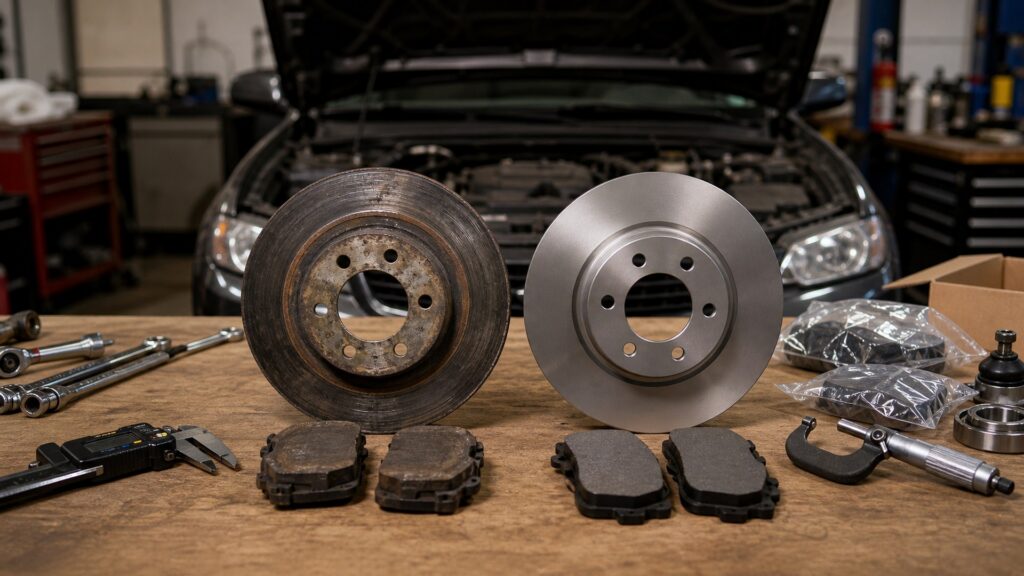
Buying framework
Plan the original function, not the old box
Factory intent can include later revisions. Trace the current service solution before choosing a source.
Establish the installed baseline: Record VIN, build date, factory options, original part number, casting or supplier marks, software level, and evidence of previous replacement.
Follow the supersession chain: Use current manufacturer information to learn whether numbers were replaced, divided by application, bundled into kits, or accompanied by revised mating parts.
Identify the performance obligation: Define material, output, geometry, sealing, noise, emissions, safety, communication, and calibration characteristics the replacement must preserve.
List the complete service procedure: Include one-time fasteners, gaskets, fluids, cleaning, programming, alignment, adaptation, testing, and post-install inspection required by current information.
Compare support as part of cost: Availability, warranty labor, technical help, return rights, core handling, and future supply may justify price differences when downtime or repeat access is expensive.
Who this is for
OEM-style planning serves different repair goals
Originality, speed, cost, and update access do not carry equal weight in every project. Define the priority.
Warranty-period owners: Written coverage, required documentation, approved repair channels for free work, and causation rules should be understood before sourcing or authorizing an outside repair.
Long-term daily drivers: Updated design, repeat-labor risk, service availability, common consumables, and future parts supply may matter more than matching the original label exactly.
Restoration owners: Casting marks, finish, date codes, supplier identity, and visual authenticity can matter alongside function, but aged new-old stock requires condition inspection.
Fleet and uptime planners: Predictable availability, standardized kits, traceable batches, labor reimbursement, and rapid warranty replacement can outweigh the lowest unit price.
What to pay attention to
Evidence for an OEM-equivalent repair
Equivalence must cover the system requirement, not only dimensions. Use current service data.
Original Design & Service Revision
OE identity, supplier, supersession, updated design, calibration, materials, and system integration.
Repair Completeness & Support
Kits, hardware, instructions, tools, warranty, core process, availability, and repeat-labor exposure.
Current service number: Verify the manufacturer catalog number for the VIN and whether the listing represents a component, assembly, kit, exchange unit, or programmed item.
Supersession notes: Determine why the number changed and whether the new revision requires companion parts, updated routing, modified fasteners, or a service bulletin procedure.
Original supplier relationship: An OEM-supplier brand can share design lineage, but confirm the exact application and specification because supplier catalogs may also contain alternative product lines.
Material and performance specification: Compare bearing class, rubber chemistry, friction formulation, flow, pressure, sensor output, thermal capacity, filtration, coating, or other function-specific requirements.
Software and adaptation: Modules, sensors, throttles, steering, cameras, transmissions, and batteries may require coding, calibration files, initialization, or learned values after installation.
Warranty and traceability: Read coverage for part and labor, installer restrictions, claim authorization, required records, serial or batch identification, core return, and exclusions for contamination or related failures.
Avoid these traps
OEM planning errors that defeat the objective
Original appearance is not the same as the current service solution. Verify revision and procedure.
Ordering the obsolete number blindly: An old number may have been replaced for availability, durability, calibration, or kit completeness; trace the current supersession before searching remaining stock.
Assuming supplier logo proves identity: A company may make the factory component and also sell different grades or designs, so compare the exact catalog line and application.
Reusing hardware omitted from the box: Some genuine parts are sold separately from seals, clips, bolts, or fluids; consult the procedure rather than treating package contents as the complete repair.
Ignoring the reason for revision: A later part may require changed routing, mating components, software, or installation steps, and mixing generations can recreate the original problem.
Equating highest price with lowest risk: Dealer pricing alone does not prove correct application or complete service; verify number, condition, procedure, warranty, and source authenticity.
Decision guidance
Choose the closest supported service solution
Preserve original system behavior while using current parts and procedures. Source choice follows consequence and evidence.
If a current genuine kit is available: Use it when integration, updated hardware, programming, or high repeat-labor exposure justifies the supported complete solution.
If the OEM supplier sells the exact application: Compare identifiers, construction, included pieces, warranty, and technical support; similar origin can offer value without assuming every supplier line is identical.
If only remanufactured assemblies remain: Prefer documented disassembly, wear-part replacement, machining limits, updates, end-of-line testing, contamination controls, and a practical core policy.
If originality controls the project: Verify provenance and storage condition of new-old stock or recycled parts, accepting that age, corrosion, seals, electronics, and warranty may limit function.
If the service chain is unclear: Ask the manufacturer or qualified specialist to resolve supersessions and procedure before purchase; forcing a legacy number can create an unsupported repair.
Ownership & compatibility
Retain the service lineage
Future diagnosis improves when the replacement revision and procedure are documented. Save the evidence behind the choice.
Record old and new numbers: Keep photographs, supersession notes, supplier and line, batch or serial, mileage, date, technician, and every related component installed.
Archive programming and measurements: Store scan reports, software versions, calibration certificates, alignment values, torque records, fluid specifications, and post-repair test results.
Register warranty correctly: Complete any required registration, keep proof of purchase and professional installation, and understand return or core deadlines before discarding packaging.
Monitor the revised system: Check the function targeted by the update, along with leaks, noise, warning data, wear, and mating components during the specified follow-up period.
FAQ
OEM replacement planning questions
Clarify original-equipment terminology and service revisions before ordering.
What is the difference between OE and OEM?
Is a genuine part always identical to the factory part?
What does a superseded part number mean?
Can I buy the same part from the OEM supplier?
When is a dealer-sourced part worth the premium?
Are remanufactured OEM assemblies reliable?
Do genuine parts include every required fastener?
Will non-genuine parts automatically void my warranty?
What should an OEM-style repair record contain?
Bottom line
Restore factory function with current evidence
The strongest OEM-style repair follows today's service chain, preserves required performance, and documents every revision. Old packaging is not the goal.
Trace the number: Follow supersessions and service notes.
Build the full kit: Include hardware, fluids, and calibration.
Save the lineage: Document parts, procedure, and results.
Reading Shortcuts
Move directly to the decision you need to resolve.
Decision Reminders
Use these checks while narrowing the field.
- Follow supersessions: Old numbers can mislead.
- Read current procedures: Service methods change.
- List separate hardware: Boxes may be incomplete.
- Confirm supplier line: A logo is not proof.
- Plan programming: Some parts need setup.
- Save revision records: Support future diagnosis.
Glossary Snippets
Terms that appear in listings, labels, and service information.
When to Use a Top 10 Review
Use rankings after requirements and exclusions are clear.
- Scan candidates: Find credible options.
- Compare strengths: See major tradeoffs.
- Build a shortlist: Choose what to inspect.
- Check availability: Confirm current offerings.
Already down to 2–3 options? A Comparison is usually the faster next step.
When to Use a Comparison
Compare directly when only a few candidates remain.
- Align versions: Compare equivalent configurations.
- Trace differences: Locate meaningful distinctions.
- Price the outcome: Include continuing costs.
- Verify uncertainty: Inspect unresolved details.
Still exploring? Start with a Top 10 to build a shortlist first.