
How to Choose Bath & Body Products for Daily Moisturizing
Choosing daily body moisturizers for daily full-body moisturizing requires separating pump lotion, humectant, and emollient instead of trusting a broad front-label promise.
This guide connects occlusive, damp-skin application, spread rate, and clothing transfer to concrete use. It avoids medical diagnosis and unsupported efficacy guarantees.
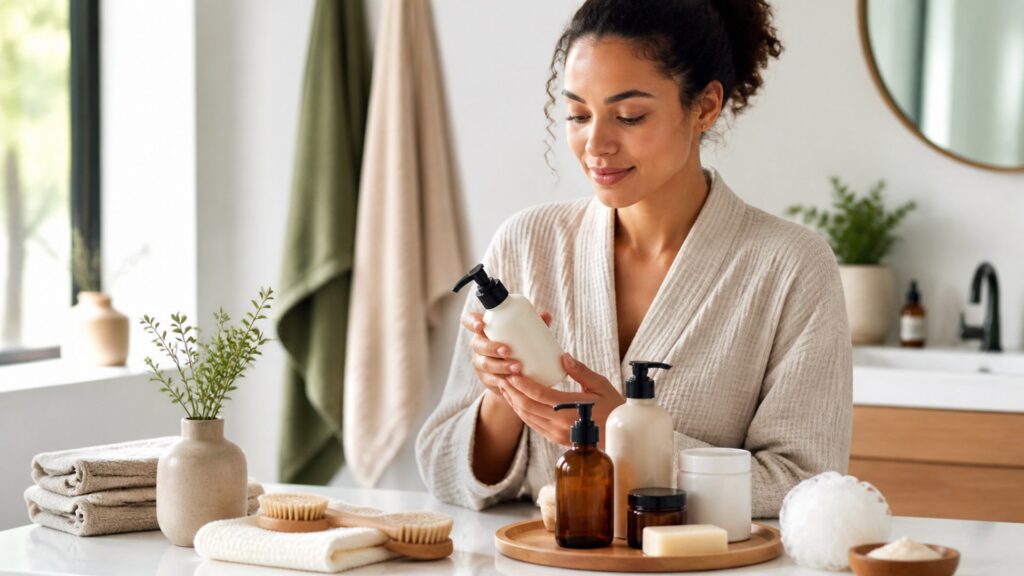
Buying framework
Set the decision around the real use
Start with pump lotion and humectant.
Design for repetition: Daily moisturizing succeeds when a product can cover arms, legs, and torso quickly enough to be used after ordinary bathing.
Reject automatic richness: The thickest texture is not automatically the most useful when spreading time causes skipped applications.
Assign moisture roles: Humectant, emollient, and occlusive roles should match climate, body zone, and comfortable finish.
Use zone-specific weight: A broad lotion plus targeted hand or heel balm often works better than one dense texture everywhere.
Who this is for
Identify the buyer pattern
Profiles change emollient priorities.
The baseline builder: You want one fast lotion immediately after showering.
The targeted user: Hands, elbows, or heels need denser localized care.
The frequent user: You moisturize large areas every day and empty bottles predictably.
The cautious comparer: You compare fragrance, spread, and clothing transfer before buying bulk.
What to pay attention to
Read the characteristics that change use
Specifications connect occlusive to use.
Moisture Architecture
Humectant, emollient, occlusive, and zone-specific weight.
Daily Workflow
Pump dose, spread rate, set time, transfer, and finish rate.
Pump dose: Pump output controls full-body dose and helps estimate how quickly a bottle will be finished.
Dress-time finish: Set time and clothing transfer determine whether morning application remains practical.
Seasonal adjustment: Seasonal changes can justify richer winter placement without replacing the entire product system.
One-hand access: Stable one-hand dispensing keeps wet fingers out of jars and makes prompt application easier.
Cost per successful use: Value depends on successful daily uses, not merely container size or promotional price.
Avoid these traps
Avoid the attractive wrong shortcut
Shortcuts distort damp-skin application decisions.
Following the headline: Reject emollient as proof. Inspect seasonal weight instead.
Stacking the same mechanism: Reject occlusive as proof. Inspect hand cream instead.
Ignoring the full routine: Reject damp-skin application as proof. Inspect heel balm instead.
Buying beyond usable frequency: Reject spread rate as proof. Inspect fragrance load instead.
Decision guidance
Choose the branch that fits
Choose through spread rate conditions.
If comfort is the constraint: Prioritize damp-skin application here. Defer heel balm when it conflicts.
If performance is the constraint: Prioritize spread rate here. Defer fragrance load when it conflicts.
If upkeep is the constraint: Prioritize clothing transfer here. Defer cost per use when it conflicts.
If the concern exceeds shopping: Prioritize seasonal weight here. Defer pump lotion when it conflicts.
Ownership & compatibility
Plan for repeat ownership
Ownership depends on clothing transfer upkeep.
Clean handling: Maintain seasonal weight carefully. Recheck fragrance load over time.
Storage discipline: Maintain hand cream carefully. Recheck cost per use over time.
Replacement planning: Maintain heel balm carefully. Recheck pump lotion over time.
FAQ
Questions before purchase
Resolve remaining seasonal weight questions.
How should buyers interpret pump lotion?
How should buyers interpret humectant?
How should buyers interpret emollient?
How should buyers interpret occlusive?
How should buyers interpret damp-skin application?
How should buyers interpret spread rate?
How should buyers interpret clothing transfer?
How should buyers interpret seasonal weight?
How should buyers interpret hand cream?
Bottom line
Keep the final priorities visible
Finish with hand cream evidence.
First priority: Lead with pump lotion. Confirm spread rate last.
Second priority: Lead with humectant. Confirm clothing transfer last.
Final check: Lead with emollient. Confirm seasonal weight last.
Reading Shortcuts
Navigate daily full-body moisturizing.
Decision Reminders
Use a short final screen.
- Role: Design for repetition.
- User: The baseline builder.
- Specification: Pump dose.
- Tradeoff: Dress-time finish.
- Branch: If comfort is the constraint.
- Ownership: Clean handling.
Glossary Snippets
Key category language.
When to Use a Top 10 Review
Rank only after applying the guide filters.
- Role filter: Design for repetition.
- Angle filter: Reject automatic richness.
- Format filter: Pump dose.
- Use filter: Clean handling.
Already down to 2-3 options? A Comparison is usually faster.
When to Use a Comparison
Compare only equivalent finalists.
- Same job: Design for repetition.
- Visible tradeoff: Dress-time finish.
- User match: The baseline builder.
- Ongoing burden: Storage discipline.
Still exploring? Start with a Top 10 first.