
How to Choose Beauty Devices for Red Light Therapy
Choose a red-light device by exact claim, wavelength, delivered dose, optical geometry, facial coverage, eye guidance, photosensitivity, and schedule.
Red-light shopping requires optical specifications and exact-model evidence, not confidence in a color label.
Buying framework
Choose the exact claim
Optical comparison starts after the intended endpoint and exposure geometry are fixed.
Choose the exact claim: Separate wrinkle appearance, acne, hair, wound, pain, and general wellness language. Buy only for the model’s supported skin endpoint.
Match the regulatory identity: Verify manufacturer, model, intended user, area, and clearance when claimed. A mechanism or brand family cannot stand in for the exact device.
Reconstruct delivered exposure: Connect wavelength, irradiance, session time, distance, and weekly schedule. Diode count or red color alone cannot describe dose.
Screen the user and routine: Review photosensitivity, medications, conditions, skin tone, eye instructions, recent procedures, and product timing before price comparison.
Who should buy what
Match the product to the real use pattern
Mask, wand, panel, evidence, and sensitivity needs create separate paths.
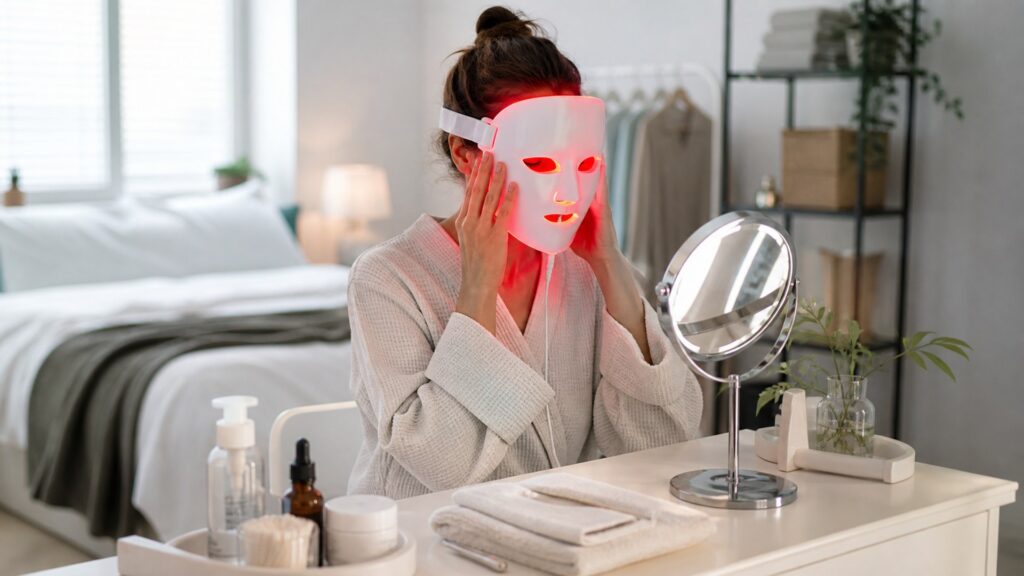
The hands-free mask user: Prioritize facial distance, nose and jaw gaps, strap pressure, eye comfort, heat, timer, and whether the evidence uses the mask in the same position.
The targeted-wand user: Compare treatment-window area, distance guides, per-zone timer, total face minutes, hand fatigue, and the risk of inconsistent overlap.
The panel user: Confirm intended skin use, measured distance, stand stability, facial angle, eye guidance, room exposure, and whether a large panel’s claim matches the desired endpoint.
The evidence-first buyer: Choose models with accessible labeling, exact-device research or regulatory records, disclosed optical units, adverse-event reporting, and clear support.
The photosensitivity-concerned buyer: Seek clinician input before use when medicines, conditions, pigment concerns, darker skin tone, recent procedures, or unexplained reactions could alter visible-light risk.
What to pay attention to
Read specifications through the intended task
Optical numbers require measurement conditions and a facial coverage map.
Decision fit
Verify the exact claim, task, user, and delivery method.
Ownership system
Assess handling, cleaning, storage, replacements, and support.
Wavelength bands: Record red and near-infrared peaks and tolerances, not just color names. Different wavelengths should not receive identical credit without claim-specific evidence.
Irradiance and fluence context: Require units, measurement plane, distance, session time, and area. Reject isolated high numbers that cannot be connected to directed use.
Optical geometry: Inspect diode spacing, face curvature, diffuser, eye cutouts, nose shadow, jaw coverage, edge falloff, and whether skin contact changes distance.
Timer and dose lock: Automatic session limits, mode identity, pause behavior, and clear indicators reduce accidental extension or wrong-mode use.
Eye and heat management: Follow exact eye instructions, assess glare leakage and warmth, and distinguish red or near-infrared devices from heat lamps and ultraviolet sources.
Evidence and maintenance: Review users, skin tones, endpoint, comparator, schedule, follow-up, attrition, cleaning, strap life, battery, controller, and warranty.
Avoid these traps
Do not let a strong signal replace fit
Color, diode count, and isolated power figures can mislead this purchase.
Buying by diode count: More emitters do not prove greater or more uniform dose. Geometry, distance, power distribution, session time, and evidence matter.
Comparing irradiance without distance: A measurement at the emitter cannot be compared with another at the skin plane. Use identical units and treatment geometry.
Calling every red lamp therapy: Decorative LEDs, heat lamps, infrared heating products, and authorized light devices are different. Require intended use and optical specifications.
Ignoring skin-tone and pigment questions: Visible light can interact differently across skin tones. AAD advises dermatologist input for darker skin before at-home red-light use.
Extending the session: Longer exposure is not proven better. Follow the exact schedule and stop after unexpected pain, irritation, pigment change, eye symptoms, or device faults.
Decision guidance
Choose the narrowest option that performs the job
Choose through endpoint, format, output context, and eligibility.
For wrinkle appearance: Choose a model with an exact full-face or regional wrinkle claim, relevant evidence, comfortable geometry, and a treatment course you can complete.
For acne: Use only a device indicated for the acne type and severity; red-light wrinkle evidence does not establish an acne outcome.
For mask versus wand: Choose a mask for repeatable broad coverage or a wand for targeted flexibility only after calculating total zone time and placement error.
For a high-output claim: Demand measurement conditions, thermal management, dose limits, and exact-device evidence rather than rewarding the largest number.
For uncertain eligibility: Bring the model manual, medicines, skincare, and health history to a board-certified dermatologist instead of self-testing around unclear contraindications.
Ownership & compatibility
Keep performance repeatable
Optics, fit, surfaces, and exposure records must remain consistent.
Clean optical surfaces: Use only permitted materials; residue, scratches, and clouding can alter delivery. Keep liquids away from controllers, ports, and unsealed seams.
Preserve fit: Inspect straps, hinges, eye pieces, diffusers, and mask shape. A stretched or warped device can change pressure and treatment distance.
Log exposure: Record mode, time, schedule, zone, product timing, and unwanted effects. Do not compensate for missed sessions by doubling exposure.
Verify over time: Retain model, serial, receipt, labeling, and support notices; recheck accessories, battery behavior, recalls, and evidence before a maintenance phase.
FAQ
Beauty Devices for Red Light Therapy FAQ
Answers focus on light bands, dose, eyes, products, and stopping.
Is red light the same as near-infrared light?
How many nanometers should a red-light device have?
Does more irradiance mean better results?
Are LED masks safe for the eyes?
Can red light treat both wrinkles and acne?
Can darker skin tones use red-light devices?
Should skincare be applied before red light?
How long does red-light therapy take to work?
When should a red-light device be stopped?
Bottom line
Choose for the exact job
A defensible light purchase connects claim, dose, geometry, and user.
Verify the fit: Match the exact claim, task, user, and context.
Control the routine: Follow the directed amount, schedule, handling, and exclusions.
Maintain the system: Clean, inspect, store, replace, and document as needed.
Reading Shortcuts
Move from intended job to verified ownership.
Decision Reminders
Specific fit matters more than category prestige.
- Verify the exact product: Do not transfer claims between models, materials, or mechanisms.
- Include full ownership: Time, cleaning, supplies, storage, and replacement count.
- Stop after faults: Do not improvise around damage, pain, or unclear labeling.
Glossary Snippets
Terms for this buying decision.
Using a Top 10
Rankings help after task and exclusions are fixed.
- Filter by job: Keep unlike mechanisms and tasks separate.
- Normalize the routine: Compare real time, contact, and supplies.
- Audit safety: Apply exact labeling and user exclusions.
- Price ownership: Include replacement and service.
Compare only finalists intended for the same job.
Comparing Finalists
Hold the task, user, routine, and endpoint steady.
- Match intended use: Record the exact job and user.
- Test realistic handling: Use normal time, amount, and contact.
- Inspect upkeep: Compare cleaning, drying, storage, and parts.
- Recheck value: Include time, supplies, support, and replacement.
Return to the framework when finalists solve different jobs.