
How to Choose Beauty Devices for Skin Tightening
Choosing beauty devices marketed for skin tightening for evaluating devices marketed for visible skin tightening requires separating radiofrequency, microcurrent, and temperature control instead of trusting a broad front-label promise.
This guide connects contact sensor, conductive gel, treatment grid, and facial contours to concrete use. It avoids medical diagnosis and unsupported efficacy guarantees.
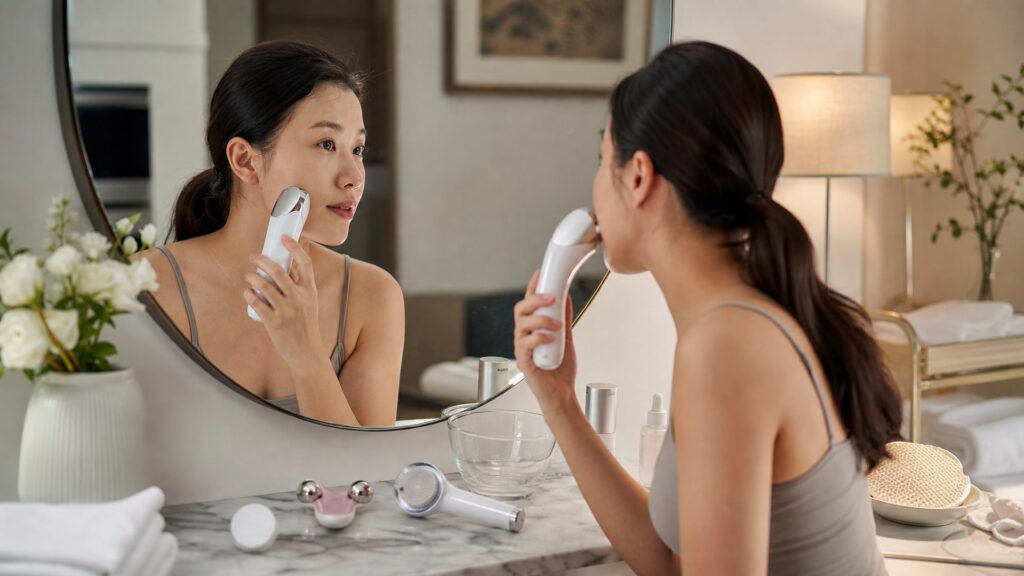
Buying framework
Set the decision around the real use
Start with radiofrequency and microcurrent.
Define tightening precisely: Skin tightening must be treated as a claim requiring definition: immediate temporary appearance, longer-term cosmetic change, and medical treatment are not the same outcome.
Separate energy systems: Radiofrequency and microcurrent devices use different energy and contact systems, so their controls and evidence cannot be compared by intensity numbers alone.
Evaluate delivery controls: Temperature limits, contact sensors, treatment grids, and manufacturer technique determine whether energy is delivered as intended.
Map contour workload: Facial contours and small treatment heads can increase precision while making sessions longer and more technique dependent.
Who this is for
Identify the buyer pattern
Profiles change temperature control priorities.
The baseline builder: You want a modest temporary cosmetic effect before occasional events.
The targeted user: You will follow a repeated home schedule and careful treatment grid.
The frequent user: Facial contours make contact, head size, and session time important.
The cautious comparer: You seek professional clearance because health history complicates device use.
What to pay attention to
Read the characteristics that change use
Specifications connect contact sensor to use.
Energy Delivery & Contact
RF or current mechanism, temperature, sensors, conductive medium, and grid technique.
Claim Scope & Clearance
Result duration, maintenance, contraindications, cleaning, and professional boundaries.
Verify conductive medium: Conductive medium must be explicitly compatible with the device; a favorite skincare gel is not a safe automatic substitute.
Understand maintenance: Claim duration and maintenance schedule determine whether visible results, if any, match the buyer's expectations and time.
Screen contraindications: Contraindications involving implants, pregnancy, skin conditions, medications, or treatment history require current manufacturer and professional guidance.
Preserve contact surfaces: Electrodes and contact surfaces need cleaning that preserves coatings, seals, and sensor function.
Recognize professional scope: A consumer device cannot replace individualized evaluation when laxity or another concern warrants clinical assessment.
Avoid these traps
Avoid the attractive wrong shortcut
Shortcuts distort conductive gel decisions.
Following the headline: Reject temperature control as proof. Inspect session duration instead.
Stacking the same mechanism: Reject contact sensor as proof. Inspect contraindication list instead.
Ignoring the full routine: Reject conductive gel as proof. Inspect claim duration instead.
Buying beyond usable frequency: Reject treatment grid as proof. Inspect clean electrodes instead.
Decision guidance
Choose the branch that fits
Choose through treatment grid conditions.
If comfort is the constraint: Prioritize conductive gel here. Defer claim duration when it conflicts.
If performance is the constraint: Prioritize treatment grid here. Defer clean electrodes when it conflicts.
If upkeep is the constraint: Prioritize facial contours here. Defer professional consultation when it conflicts.
If the concern exceeds shopping: Prioritize session duration here. Defer radiofrequency when it conflicts.
Ownership & compatibility
Plan for repeat ownership
Ownership depends on facial contours upkeep.
Clean handling: Maintain session duration carefully. Recheck clean electrodes over time.
Storage discipline: Maintain contraindication list carefully. Recheck professional consultation over time.
Replacement planning: Maintain claim duration carefully. Recheck radiofrequency over time.
FAQ
Questions before purchase
Resolve remaining session duration questions.
How should buyers interpret radiofrequency?
How should buyers interpret microcurrent?
How should buyers interpret temperature control?
How should buyers interpret contact sensor?
How should buyers interpret conductive gel?
How should buyers interpret treatment grid?
How should buyers interpret facial contours?
How should buyers interpret session duration?
How should buyers interpret contraindication list?
Bottom line
Keep the final priorities visible
Finish with contraindication list evidence.
First priority: Lead with radiofrequency. Confirm treatment grid last.
Second priority: Lead with microcurrent. Confirm facial contours last.
Final check: Lead with temperature control. Confirm session duration last.
Reading Shortcuts
Navigate evaluating devices marketed for visible skin tightening.
Decision Reminders
Use a short final screen.
- Role: Define tightening precisely.
- User: The baseline builder.
- Specification: Verify conductive medium.
- Tradeoff: Understand maintenance.
- Branch: If comfort is the constraint.
- Ownership: Clean handling.
Glossary Snippets
Key category language.
When to Use a Top 10 Review
Rank only after applying the guide filters.
- Role filter: Define tightening precisely.
- Angle filter: Separate energy systems.
- Format filter: Verify conductive medium.
- Use filter: Clean handling.
Already down to 2-3 options? A Comparison is usually faster.
When to Use a Comparison
Compare only equivalent finalists.
- Same job: Define tightening precisely.
- Visible tradeoff: Understand maintenance.
- User match: The baseline builder.
- Ongoing burden: Storage discipline.
Still exploring? Start with a Top 10 first.