
How to Choose Beauty Tools & Accessories for Travel
Travel selection begins with itinerary, baggage type, trip length, climate, lodging, and the exact routine. A miniature version of the home kit is often too large and poorly protected.
Confirm current security and carrier rules directly before departure, especially for liquids, aerosols, scissors, blades, batteries, and heated tools. Rules vary by route and can change.
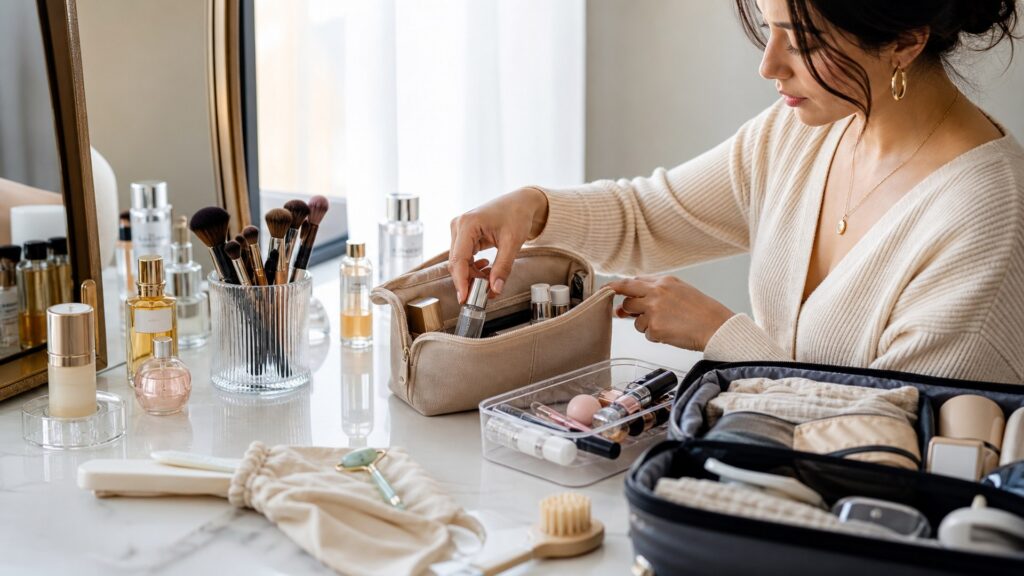
Buying framework
Start with the job, then choose the hardware
Begin with brush roll, establish the operating boundary, compare the complete system, and include ownership cost.
Map trip conditions: Record duration, climate, checked versus carry-on bags, transfers, outlets, and lodging surfaces.
Reduce by task coverage: Keep the smallest set that performs every intended motion without decorative duplicates.
Engineer the container: Assign rigid protection, leak containment, ventilation, and clean-used zones instead of relying on one pouch.
Plan the return journey: Include drying time, a wet-item fallback, inspection, and a rule check for the outbound and return airports.
Who should buy what
Match the kit to the working situation
Different routines create different equipment needs.
Carry-on minimalist: Choose short handles, solid formats where suitable, protected precision edges, and transparent liquid organization.
Checked-bag traveler: Add crush-resistant cases and secondary leak containment; checked baggage does not make fragile items immune to pressure.
Hot-climate trip: Reduce heat-sensitive formulas, ventilate damp tools, and avoid leaving the kit in vehicles or direct sun.
Event traveler: Pack the tested application sequence plus a small failure backup for the one tool that cannot be improvised.
Frequent commuter: Favor durable closures, washable interiors, fast-drying tools, and a restock checklist that remains packed.
What to pay attention to
Read the characteristics that change the result
Labels matter only when they predict control, care, or compatibility.
Transport viability
Current rules, caps, leaks, sharp parts, pressure, heat, and baggage handling.
Away-from-home care
Water access, drying time, ventilation, clean-used separation, and return packing.
Case structure: Check hinge, zipper, cap retention, interior wipeability, ventilation, and whether brush tips are compressed.
Dimensions and weight: Measure the packed item, not the empty case, against the actual bag and allowance.
Sharp-part protection: Tweezers, scissors, razors, sharpeners, and metal points require covers and current rule verification.
Mirror safety: Compare distortion, stand stability, lighting power, battery rules, and shatter protection.
Decant integrity: Use compatible clean containers with reliable closures and labels; do not decant products that cannot be identified or stored safely.
Drying capability: A holder should expose damp sponge and brush surfaces rather than trapping moisture inside a closed pouch.
Avoid these traps
Avoid purchases that create new problems
The most expensive errors usually begin with the wrong decision sequence.
Assuming travel size means permitted: Retail labels do not replace current transport rules for the itinerary.
Packing one universal pouch: Clean, damp, sharp, breakable, and leak-prone items need different containment.
Choosing a brush by short handle alone: A compact handle is useless if the head is crushed or the shape cannot complete the task.
Decanting without labels: An unidentified product is harder to use correctly, track, or replace after a spill.
Forgetting return-day drying: A tool washed on the final morning may remain damp inside luggage for hours.
Decision guidance
Choose a defensible setup
Use the path that matches the dominant constraint.
For a weekend carry-on: Build around actual tasks, current liquid limits, ventilated storage, and one compact mirror.
For air travel with grooming blades: Verify each item with the governing security authority and airline immediately before packing.
For a destination wedding: Protect the irreplaceable precision tool and carry a tested backup that does not multiply the whole kit.
For a humid destination: Choose fast-drying materials and a case that can remain open safely at the lodging.
For multi-city travel: Use a repeatable clean-used workflow and closures that withstand frequent repacking.
Ownership & compatibility
Keep the system reliable
Cleaning, storage, inspection, and replacement belong in the purchase.
Recheck rules before each trip: Do not rely on a screenshot or memory from an earlier itinerary.
Air the kit on arrival: Open cases, inspect for leaks or crushing, and let damp-prone compartments breathe.
Clean on a realistic schedule: Match washing to trip length, water access, drying time, and the return departure.
Reset after returning: Wash, dry, inspect, replenish, and remove destination-specific items before storage.
FAQ
Choosing Beauty Tools & Accessories for Travel
Answers to the questions that remain after comparison.
Can makeup brushes go in carry-on luggage?
How should a damp sponge be packed?
Are beauty scissors allowed on a plane?
What is the best travel brush case?
Should products be decanted for travel?
How can a travel mirror be protected?
Do travel tools need to be smaller?
How much tool redundancy is sensible?
How should a kit be cleaned after a trip?
Bottom line
Bottom line
Buy for the repeated task and its complete ownership loop.
Pack for the itinerary: Rules, climate, lodging, and baggage type govern the kit.
Protect different risks differently: Leaks, dampness, blades, mirrors, and brush tips need separate solutions.
Design the return: Drying and reset are part of travel ownership.
Brush Roll Shortcuts
Move from the brush roll decision to specifications, user fit, and unresolved questions.
Brush Roll Reminders
Keep brush roll visible through the final comparison.
- Map trip conditions: Keep brush roll visible while features compete for attention.
- For a weekend carry-on: Select the path whose brush roll tradeoffs fit the repeated situation.
- Recheck rules before each trip: Confirm brush roll upkeep can be performed consistently before purchase.
Brush Roll Glossary
Terms that make brush roll easier to compare.
Using a Beauty Tools & Accessories Top 10
Use rankings only after defining the brush roll job and ownership constraints.
- For a weekend carry-on: Filter finalists through the primary brush roll use case.
- For air travel with grooming blades: Check whether brush roll changes the necessary configuration.
- For a destination wedding: Compare brush roll consequences under realistic conditions.
- For a humid destination: Include supporting brush roll supplies and upkeep in value.
A ranking is useful when test conditions resemble the buyer's brush roll routine.
Comparing Beauty Tools & Accessories Options
Hold the brush roll use case steady while comparing construction, control, and care.
- Case structure: Observe the first brush roll characteristic during the actual task.
- Dimensions and weight: Record where the second brush roll feature changes control.
- Sharp-part protection: Test the third brush roll variable with the intended setting.
- Mirror safety: Inspect the fourth brush roll factor after cleaning and storage.
Return to the brush roll task when two options appear tied.