
How to Choose Blackhead Removal Devices for Facial Treatment Devices Safety and Settings
Blackhead devices can concentrate vacuum, pressure, vibration, scraping, or heat onto a small facial area. Safety depends less on the number of power levels than on whether the lowest exposure is genuinely mild, the controls are predictable, and the user can stop immediately.
Screen contraindications and prepare a stopping rule before touching the face. Broken skin, inflamed acne, sunburn, active dermatitis, recent procedures, easy bruising, or medications affecting skin response may make home extraction inappropriate.
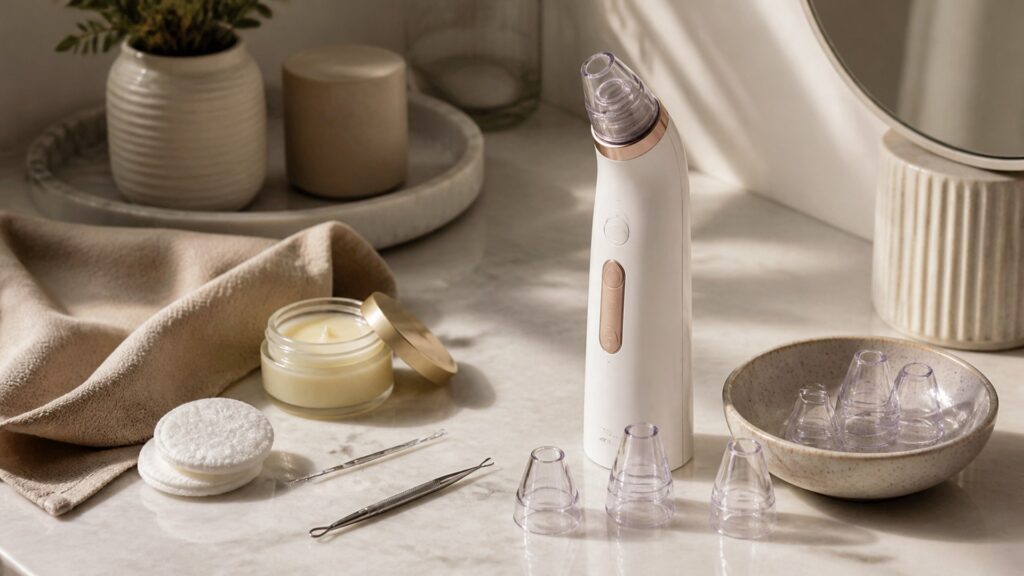
Buying framework
Define the facial treatment devices safety and settings routine before comparing products
Use the setting, frequency, and skin priorities to narrow blackhead removal devices logically.
Start with the use case: Identify energy or force type and the exact skin footprint of every attachment.
Rank the practical tradeoffs: Review contraindications, lowest setting, timer behavior, and emergency shutoff.
Check instructions early: Plan one short pass on a limited suitable area with delayed monitoring.
Use profiles
Match blackhead removal devices to the person and pace
Three shopper profiles expose different priorities for facial treatment devices safety and settings.
Routine-focused buyer: A first-time user needs simple controls and a clearly distinct lowest setting.
Performance-focused buyer: An easy-bruising user should avoid suction-based experimentation.
Occasional or flexible user: A technique-confident user still needs limits that prevent repeated passes under magnification.
Specifications
Read the specifications through a facial treatment devices safety and settings lens
Translate technical language into visible routine benefits.
Handling lens
Compare the weakest exposure across identical tip footprints.
Ownership lens
Watch for delayed swelling or bruising after the mirror check ends.
Suction Method: Vacuum rises nonlinearly in effect as seal and tip size change.
Adjustable Intensity: Small tips concentrate force even when the displayed level stays constant.
Tip Attachments: Metal loops provide no electronic limit on hand pressure.
Charging Runtime: Heat or steam may increase redness without making extraction safer.
Cleaning Method: Automatic shutoff reduces session length but not local over-treatment.
Common mistakes
Avoid shortcuts that undermine facial treatment devices safety and settings
A good purchase can still disappoint when selection or use is based on the wrong assumption.
Buying from one metric: Do not begin at medium power because the lowest setting feels subtle.
Skipping compatibility checks: Avoid holding suction stationary on one pore.
Ignoring post-use care: Do not stack scraping, suction, and acid treatment in one session.
Decision guidance
Choose the simplest option that covers the real need
Use these decision rules to finish a shortlist for facial treatment devices safety and settings.
Choose the basic format when: Choose equipment with simple low-range control and cleanable attachments.
Choose the flexible format when: Skip home use when contraindications or reaction history make response unpredictable.
Pause before upgrading when: Stop for sharp pain, persistent redness, bruising, skin lifting, bleeding, or swelling.
Ownership & compatibility
Plan for clean, repeatable ownership
The best value remains convenient after the first few uses.
Consumables and replacements: Inspect tips for cracks, rough edges, and blocked passages.
Cleaning and storage: Charge and store the device away from wet treatment areas.
Routine compatibility: Record tip, setting, passes, and delayed response before any reuse.
FAQ
How to Choose Blackhead Removal Devices for Facial Treatment Devices Safety and Settings FAQ
Practical answers about choosing and owning blackhead removal devices for facial treatment devices safety and settings.
What matters most when choosing blackhead removal devices for facial treatment devices safety and settings?
Is the most expensive option better for facial treatment devices safety and settings?
How should I compare two similar blackhead removal devices options?
Bottom line
Buy for repeatable facial treatment devices safety and settings results
A focused shortlist is easier to own and use well.
Prioritize fit: Buy for trustworthy low-range control, not peak intensity.
Verify the limits: Set stop conditions before looking through magnification.
Count ownership costs: Treat tip footprint and suction seal as part of power.
Reading Shortcuts
Jump to the key blackhead removal devices decisions.
Decision Reminders
Keep these checks beside your shortlist.
- Check suction method: Begin with the lowest setting and never hold suction in one place.
- Check adjustable intensity: Do not use on broken, inflamed, infected, or highly irritated skin.
- Check tip attachments: Stop if bruising, pain, or persistent irritation develops.
Glossary Snippets
Plain-language blackhead removal devices terms.
When to Use a Top 10 Review
Use a ranked list to identify a manageable set of strong candidates.
- You are still exploring: A ranked list can reveal the main formats and price tiers.
- You want a shortlist: Start broad, then confirm fit with this buying guide.
Have finalists? Use a Comparison.
When to Use a Comparison
Use a direct comparison when only a few candidates remain.
- Features are close: Side-by-side details clarify meaningful differences.
- Prices overlap: Compare ownership value, not only purchase price.
Still exploring? See the Top 10.