
How to Choose Body Fragrance for Travel Sizes
Travel-size body fragrance is a container decision as well as a scent decision. The right format supplies enough sprays for the trip, stays identifiable, survives pressure and movement, and fits the carrier's current liquid rules.
Begin with the itinerary rather than the bottle display. Count wearing days, decide whether fragrance will be used once or reapplied, check the transport policy, and plan where the container can stand away from heat after arrival.
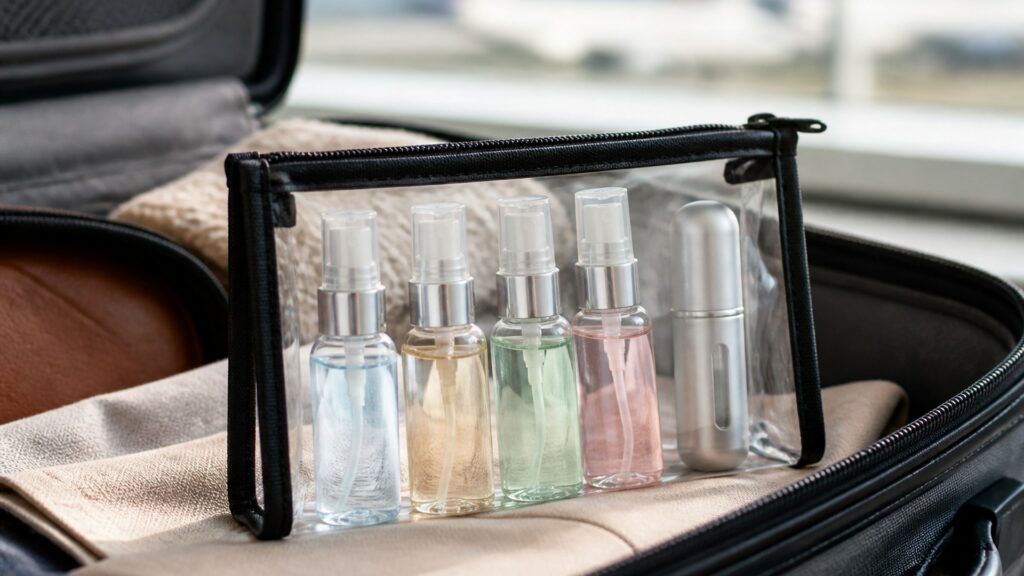
Packing plan
Calculate the trip before choosing the vessel
A weekend in a cool hotel and a month of changing climates impose different demands. Volume, durability, and refill access should follow the actual journey.
Estimate applications: Use the normal spray count and number of planned wearing days, then add a modest margin instead of packing an arbitrary maximum.
Check transport rules: Confirm current airline, rail, cruise, and destination restrictions directly; a retail “travel” label does not guarantee compliance.
Map destination storage: Identify a cool, shaded place where the fragrance can remain upright rather than living in a hot vehicle or sunny bathroom shelf.
Format profiles
Match the container to the traveler
Convenience means different things to a carry-on minimalist, a frequent refiller, and someone who wants the original sealed formula.
Official-mini buyer: Choose a manufacturer travel spray when formula identity, factory filling, and a familiar atomizer matter more than the lowest possible volume.
Careful decanter: A clean labeled vial can carry a small amount economically, provided the transfer method limits spills, air exposure, and cross-contamination.
Reusable-atomizer traveler: A refillable case suits repeated trips only when its valve seals reliably, its reservoir is compatible, and old scent can be cleaned out completely.
Container details
Inspect the parts that prevent a ruined bag
Nominal milliliters reveal capacity, but they do not reveal spray quality, closure security, glass protection, or resistance to sideways packing.
Sideways test
Place the closed container on absorbent paper inside a sealed pouch and change its orientation before trusting it near clothing or electronics.
Handling test
Operate the sprayer with travel-day dexterity in mind, confirming that the cap removes cleanly and the bottle does not slip easily.
Closure system: Check the crimp, screw threads, valve, cap fit, and any refill port for looseness, residue, or evidence of previous seepage.
Sprayer output: Count sprays from a measured fill when practical. Fine mist, coarse droplets, and partial pumps use liquid at different rates.
Identification: Label the exact fragrance and transfer date on any decant; similar clear liquids in unmarked vials invite mistakes and complicate security checks.
Packing errors
Avoid shortcuts that create leaks or waste
Most problems come from poor vessel choice, careless transfer, excess volume, or exposure to heat—not from the fragrance being sold in a small bottle.
Trusting the cap alone: A decorative cap protects the nozzle but may not seal the liquid path. Treat the valve and bottle joint as the real leak points.
Mixing formulas: Never top up a partly used atomizer with another scent; the blend becomes impossible to identify and may be unpleasant or unstable.
Packing beside valuables: Even a tested vessel belongs in its own washable, sealable pouch, separated from documents, medication labels, chargers, and delicate fabric.
Format choice
Choose official mini, decant, or refillable atomizer
The best format balances authenticity, flexibility, cleaning effort, breakage risk, and how often the traveler expects to use the fragrance away from home.
Buy an official mini: This is the simplest route when the preferred scent is available in a sealed size and the trip justifies its capacity and price.
Prepare a decant: Use a new or thoroughly cleaned compatible vial when only a few wears are needed and careful labeling is possible.
Use a refillable atomizer: Choose this for repeated travel after verifying the fill mechanism, seal, spray pattern, cleanout instructions, and replacement-part availability.
Care between trips
Keep the travel supply clean and traceable
Small containers are easy to forget in luggage. A return-home routine protects the fragrance, catches leaks, and prevents mystery vials from accumulating.
Inspect after arrival: Wipe the exterior, check the fill level and seams, and investigate any fragrance odor inside the packing pouch before storing the vessel.
Record the contents: Keep the formula name and transfer date legible; replace labels that oil, alcohol, abrasion, or condensation has made difficult to read.
Store away from extremes: Return the travel bottle to a stable, cool, dark location and leave it upright until the next trip rather than in permanent car luggage.
FAQ
Travel-size body-fragrance questions
These answers help match volume and container design to the route, packing method, and number of intended wears.
How much body fragrance should I pack for a trip?
Are refillable fragrance atomizers safe from leaks?
Can I put body fragrance into any small bottle?
Bottom line
Pack the smallest reliable supply
A sensible travel size contains enough fragrance for the itinerary, meets the relevant rules, remains identifiable, and has already passed a realistic leak test.
Count the wears: Let actual spray habits determine volume, rather than allowing the largest permitted container to become the default.
Test before departure: Confirm spray function, valve security, cap retention, label readability, and sideways resistance while repacking is still easy.
Quarantine the liquid: Place the fragrance upright in its own sealed pouch and keep it away from heat, sunlight, electronics, documents, and stain-sensitive materials.
Reading Shortcuts
Move directly to the portable fragrance decision stage you need.
Decision Reminders
Keep the evidence for portable fragrance visible while comparing.
- Role: The body fragrance serves the named task.
- Proof: The trial observes comfortable projection, stable dry-down, suitable longevity, and no skin irritation.
- Care: Store the bottle upright away from heat, sunlight, and humid bathroom air.
Glossary Snippets
Useful language for comparing body fragrances.
When a Top 10 List Helps
Use rankings to discover credible body fragrances, then screen them for portable fragrance.
- The format is undecided: A broad list reveals plausible forms and price levels.
- A shortlist is needed: Rankings narrow discovery but do not replace fit testing.
Have finalists already? Open the comparison section.
When a Direct Comparison Helps
Compare finalists after establishing their suitability for portable fragrance.
- Two candidates remain: Side-by-side evidence exposes meaningful tradeoffs.
- An upgrade is uncertain: Compare whether added cost corrects the original weakness.
Still exploring? Start with the Top 10 section.